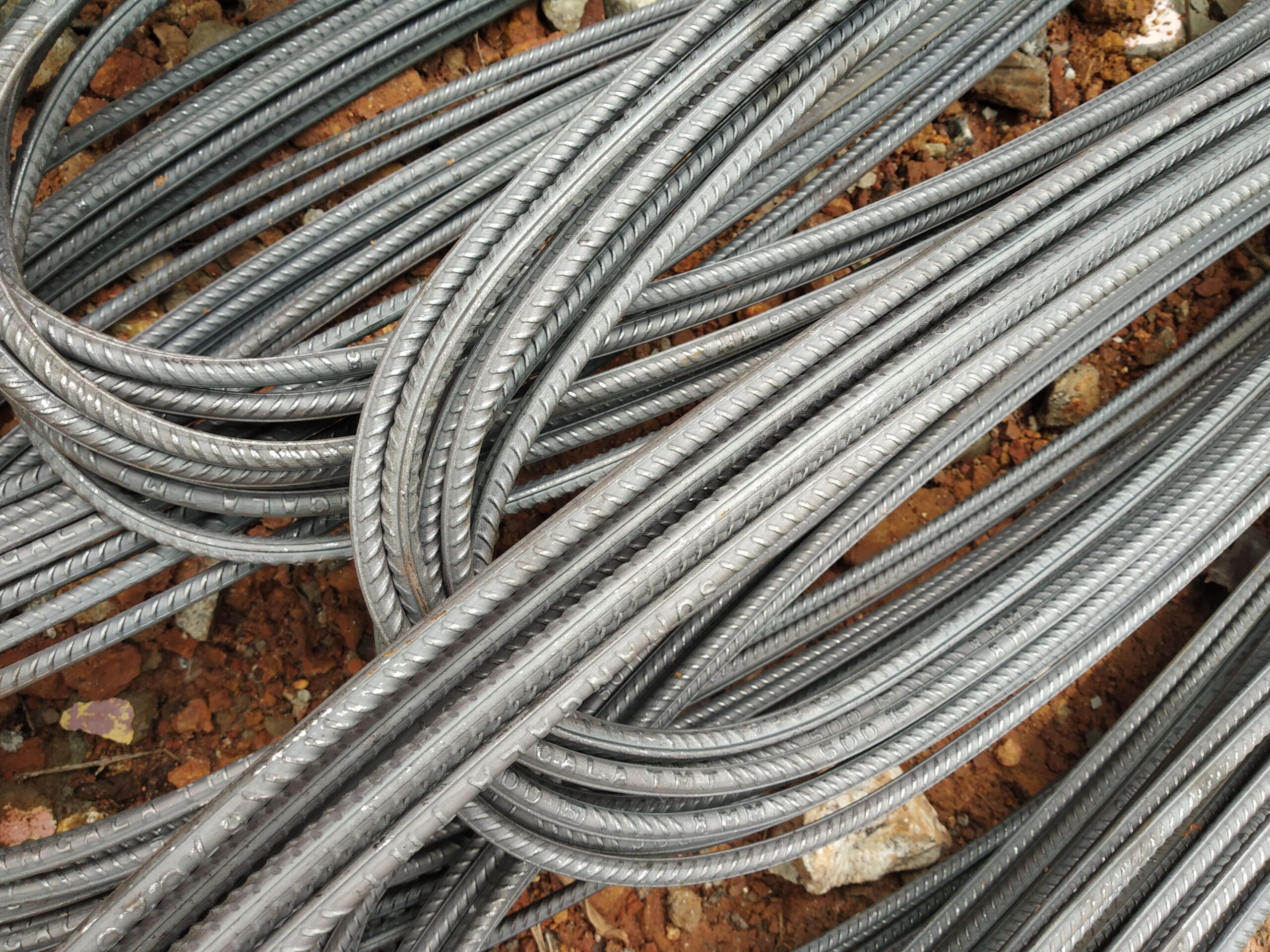
Rebar Wastage & Lap Allowance in Take-offs
How to calculate realistic wastage factors and lap length allowances when preparing rebar take-offs for DIN 488 / EN 10080 projects — with worked examples and a reference table.
Why Wastage and Lap Allowances Matter
Rebar wastage and lap allowances are two separate adjustments that a take-off must account for over and above the net bar quantities shown on structural drawings. Underestimating either leads to material shortfalls and programme delays; overestimating inflates costs and burdens the site with excess steel. For export procurement — where re-ordering from Germany involves lead times of weeks — accuracy at the take-off stage is especially important.
The two concepts are distinct. Lap allowance is a structural requirement: extra bar length needed to transfer forces from one bar to the next at a joint. It is determined by the engineer from Eurocode 2 (EN 1992-1-1) or DIN 488 principles and must appear in the cutting list. Wastage is a procurement allowance: extra tonnage ordered to cover offcuts, site damage, erection offcuts, and minor scheduling errors. It is not shown on drawings — it is an uplift added to the net order quantity.
Lap Length Allowance — The Structural Calculation
Under Eurocode 2 (§8.7), the design lap length l₀ is derived from the basic anchorage length l_bd, modified for bar arrangement, concrete cover, and the proportion of lapped bars at a single cross-section. For B500B rebar in a common construction scenario (C25/30 concrete, good bond, ≤25% of bars lapped at one section), typical lap multiples range from 40d to 60d. Where more than 50% of bars are lapped at one section, a further multiplier of 1.5 applies.
| Bar Dia (mm) | Lap @ 40d (mm) | Lap @ 50d (mm) | Lap @ 60d (mm) | Extra kg per lap (B500B) |
|---|---|---|---|---|
| 10 | 400 | 500 | 600 | 0.25 – 0.37 |
| 12 | 480 | 600 | 720 | 0.43 – 0.64 |
| 16 | 640 | 800 | 960 | 1.01 – 1.52 |
| 20 | 800 | 1,000 | 1,200 | 1.98 – 2.96 |
| 25 | 1,000 | 1,250 | 1,500 | 3.85 – 5.78 |
| 32 | 1,280 | 1,600 | 1,920 | 8.08 – 12.12 |
Extra kg per lap = lap length (m) × d² × 0.00617. Values are indicative; engineer must specify actual design lap for the project.
Counting Laps in Your Take-off
The number of laps depends on bar layout and available stock lengths. If your structural drawings call for continuous 20 mm bars in a 30 m wall, but stock arrives in 12 m lengths, you need a minimum of two laps per bar line (at approximately 12 m and 24 m). In practice, laps are staggered to avoid concentrating them at one cross-section.
The lap count per bar run = ⌈(total bar length) / (stock length)⌉ − 1. Each lap adds l₀ to the cut length of the lapping bar. Include this in your cutting list bar lengths — it is not a separate allowance, but part of the actual cut length of each bar that provides the overlap.
Wastage Factors — Industry Norms and What Drives Them
Wastage factors are not fixed by any standard; they reflect the complexity and bar-size distribution of the project. Typical industry values:
| Project Type | Typical Wastage Factor | Main Driver |
|---|---|---|
| Simple foundations / slabs (large bars, few cuts) | 2 – 3% | End offcuts from stock lengths |
| General building frames | 3 – 5% | Mixed bar sizes, stirrup offcuts |
| Complex geometry / precast | 5 – 8% | Short cut lengths, many different marks |
| High proportion of small dia (≤10 mm) | up to 10% | Short offcuts, coil tails |
For an export order, apply the wastage factor per diameter group — not across the whole project — because different bar sizes come from different stock lengths and have very different offcut patterns. A 32 mm bar in a 12 m length leaves a small proportion of waste per cut; a 6 mm bar from a 50 kg coil may have more tail wastage.
Worked Example — Applying Both Allowances
Net quantity from cutting list: 18,400 kg of B500B 16 mm bar in a multi-storey frame. The drawing requires laps at every floor level (3 laps per bar); the engineer specifies l₀ = 800 mm (50d).
- Average bar count with laps already in cutting list: lap lengths included in cut lengths → net 18,400 kg already accounts for laps.
- Apply 4% wastage: 18,400 × 1.04 = 19,136 kg to order.
- Round up to the nearest tonne per mill order convention: 19.2 t of 16 mm B500B.
Had laps not been included in the cutting list net quantity (a common error on fast-track projects), the shortfall would be: 3 laps × 800 mm × 0.00617 × 16² ÷ 1000 × estimated bar count. Always verify your cutting list includes all lap lengths before applying the wastage uplift.
Mechanical Splices as an Alternative
Where lap lengths become impractical — particularly for large-diameter bars (≥25 mm) in congested zones — mechanical rebar couplers (parallel-thread or taper-thread) eliminate the lap entirely. A coupler splice adds near-zero extra bar length and reduces total steel tonnage on large-diameter reinforcement. The trade-off is the coupler component cost and threading labour. For export projects, couplers and threaded bar ends can be supplied together with the rebar shipment.
Frequently Asked Questions
Common questions about rebar wastage and lap allowances.
Is the lap allowance already included in the net cutting list quantity?
What is a typical wastage factor for a reinforced concrete building?
Does DIN 488 specify a lap length directly?
Can I reduce wastage by optimising stock lengths?
Source German-standard rebar with full export documentation
Tell us your specification and destination port — we’ll respond with a detailed quotation.