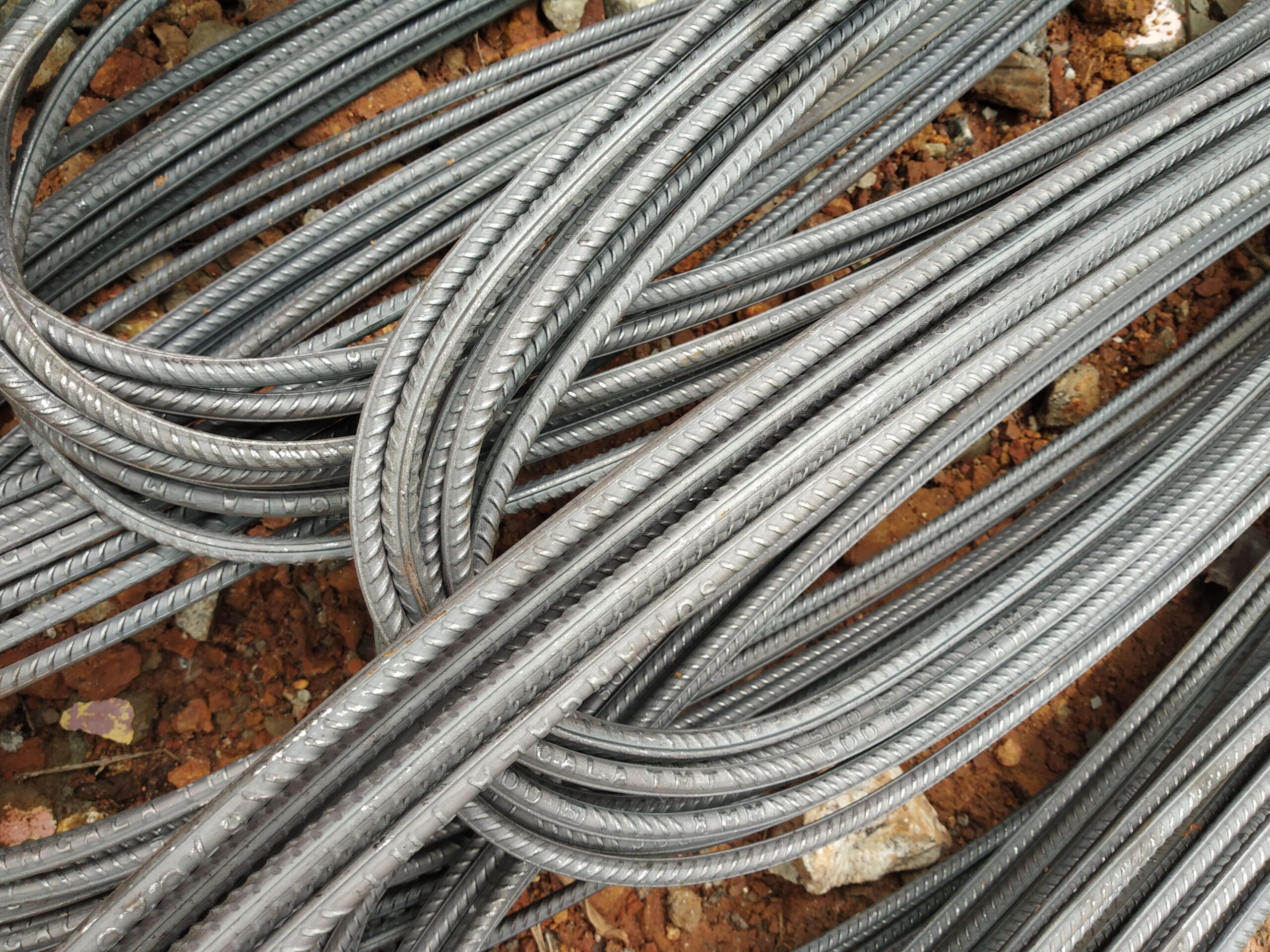
TMT Steel Rebar — Ø8-40mm, Grade 60/75 & B500B
As a specialist TMT steel rebar supplier and exporter, Steel Rebar Germany rolls, quenches and certifies thermo-mechanically treated reinforcement bar for contractors and distributors worldwide — high yield strength, superb bendability, and a mill test certificate on every tonne.
- ✓Diameters Ø8mm to Ø40mm — Grade 60, Grade 75 (ASTM A615) and B500B (BS 4449)
- ✓Hot-rolled, quenched & self-tempered for a tough martensitic rim and ductile core
- ✓Certified to BS 4449:2005, ASTM A615/A706 & ISO 6935-2 — MTC included
- ✓Cut & bend to BS 8666, coils, and custom lengths on request
Rebar grade glossary — pick the right standard
Reinforcement grade defines the characteristic yield strength your structural engineer designs to. Steel Rebar Germany stocks the four families specified across British, American and ISO codes, plus the size and weight data you need for take-off.
Grade 40, Grade 60 & Grade 75 (ASTM A615) +
Grade 60 is the workhorse of US and GCC reinforced concrete, with a minimum yield strength of 60,000 psi (420 MPa). Grade 75 (520 MPa) is specified for high-rise columns and heavily loaded members where reducing steel congestion matters. Grade 40 (280 MPa) remains in use for stirrups, ties and lightly loaded work. All three are supplied to ASTM A615 deformation and chemistry requirements.
B500B & B500C (BS 4449:2005 / EN 10080) +
B500B is the standard ductility class for the UK, Europe and most GCC export specs, offering a characteristic yield of 500 MPa with a minimum total elongation at maximum force (Agt) of 5%. B500C raises ductility for seismic and high-demand designs, with a tighter tensile-to-yield ratio (Rm/Re ≥ 1.15). Steel Rebar Germany B500B carries the ribbed bond pattern and CARES-traceable marking required for UK projects.
ASTM A615 vs ASTM A706 (weldable / seismic) +
A615 is the general-purpose carbon-steel rebar standard with no upper limit on yield. A706 is a low-alloy, controlled-chemistry grade engineered for welding and seismic ductility, with a capped yield range and a guaranteed Rm/Re ratio. Specify A706 where bars will be field-welded or where the design relies on inelastic hinge behaviour.
Sizes, lengths & weight per metre +
Steel Rebar Germany rolls Ø8, 10, 12, 16, 20, 25, 32 and 40mm bar in standard 12 m lengths, with 6 m and custom cut-to-length available. Nominal mass follows the formula kg/m = 0.00617 × d² (d in mm) — the full weight table is in the spec sheet below.
Where our TMT rebar goes to work
From port infrastructure to residential towers, the same certified bar is trusted across the projects our distributor and contractor clients deliver.
High-Rise & Commercial
Grade 75 columns and shear walls that cut bar congestion in tall reinforced-concrete frames.
Infrastructure & Bridges
A706 weldable, seismic-grade bar for piers, decks, culverts and retaining structures.
Industrial & Energy
Heavy foundations, turbine bases and plant slabs requiring high-fatigue reinforcement.
Residential & Housing
B500B and Grade 60 for footings, beams, slabs and cut-and-bend housing schedules.
About TMT steel rebar: a buyer’s guide for contractors and distributors
Choosing a TMT steel rebar supplier is one of the highest-leverage procurement decisions on any reinforced-concrete project. The bar you pour into a foundation will outlive everyone who signed off on it, and the difference between a compliant, well-rolled bar and a marginal one is invisible on site but decisive in a structural test. This guide explains what thermo-mechanically treated rebar actually is, how grades and standards map onto real design decisions, and what to verify before you commit a single container to a project.
What “thermo-mechanically treated” really means
TMT is a manufacturing process, not a grade. A billet is heated and hot-rolled into a ribbed bar, and then — while the bar is still red-hot leaving the final rolling stand — it passes through a high-pressure water quench box. The quench rapidly cools the outer skin of the bar, transforming it into hard martensite, while the core stays hot. As the bar leaves the quench line, residual heat from the core flows back outward and self-tempers the martensitic rim. The result is a bar with a tough, high-strength outer ring around a soft, ductile ferrite-pearlite core.
That dual microstructure is the whole point. It gives the engineer high yield strength (from the rim) without sacrificing the bendability and ductility (from the core) that reinforced concrete depends on to redistribute load and warn before failure. Compared with older cold-twisted (CTD/Tor) bar, TMT rebar offers better elongation, superior weldability, and far better corrosion and fatigue behaviour — which is why virtually every modern structural code now assumes TMT-class reinforcement.
Grades, standards and what they control
Reinforcement is specified by a grade (its characteristic yield strength) and a standard (the test regime, chemistry limits and marking it must comply with). The three families Steel Rebar Germany supplies cover essentially every export market:
- ASTM A615 (Grade 60 / Grade 75) — the dominant specification across the United States, the GCC and much of Asia. Grade 60 (420 MPa) is the default; Grade 75 (520 MPa) is reserved for high-load members where reducing the number of bars eases congestion and placement.
- BS 4449:2005 (B500B / B500C) — the British and European standard, harmonised with EN 10080. B500B is the standard ductility class; B500C adds the higher uniform elongation and tensile/yield ratio demanded by seismic and high-redundancy designs.
- ISO 6935-2 — the international ribbed-bar standard, frequently cited in multinational contracts and as a bridge between national codes.
A subtle but important distinction sits inside the ASTM family: A615 versus A706. A615 is general-purpose carbon-steel bar with no ceiling on yield strength. A706 is a low-alloy, tightly controlled grade designed to be reliably welded and to deform predictably in a seismic event — it caps the yield range and guarantees a minimum tensile-to-yield ratio. If your drawings call for field welding or rely on plastic-hinge behaviour, specify A706 and confirm your supplier can certify it; substituting A615 because it is in stock is a real and recurring compliance failure.
Sizing, lead times and the economics of the order
Steel Rebar Germany rolls the full structural range from Ø8mm to Ø40mm. Smaller diameters (8–12mm) typically serve stirrups, links and slab mesh; the mid-range (16–25mm) carries most beam and column main steel; and 32–40mm bar appears in heavy transfer structures, piles and large foundations. Standard stock length is 12 m, with 6 m and custom cut lengths available to suit local handling and crane limits.
For accurate take-off, weight is calculated from the nominal diameter using kg/m = 0.00617 × d². A Ø16mm bar therefore weighs about 1.58 kg/m, and a 12 m length about 18.9 kg. Getting these figures right matters: ordering by length when the mill prices by tonne, or vice versa, is a common source of dispute. Our export desk quotes in both, cross-checked against your bar bending schedule.
Cut, bend and prefabrication
Buying straight bar and bending it on site wastes labour and floor space. Steel Rebar Germany offers cut-and-bend to BS 8666 shape codes, producing bars tagged and bundled by mark, sequenced to your pour schedule. For distributors this means a single supplier for stock and fabrication; for contractors it means less scrap, faster fixing, and fewer rejected bends. We also supply welded wire mesh and reinforcement coil where continuous feed suits the application.
How to verify a supplier before you commit
The single most important document is the mill test certificate (MTC). A genuine MTC ties a specific heat number to its chemical analysis and to mechanical results — yield, tensile, elongation and the rebend/bend test — against the named standard. Every Steel Rebar Germany shipment ships with its MTC, and the bars carry rolled-in marking (mill, grade, diameter) so the steel on the rack can be traced back to the paperwork. Beyond the certificate, ask about independent third-party approvals such as CARES for UK work, ISO 9001 quality management, and the supplier’s ability to support pre-shipment inspection. A credible exporter welcomes inspection; a marginal one finds reasons to avoid it.
In short: specify the grade and standard your engineer actually requires, confirm weldability where you need it, demand the MTC, and work with a supplier whose export desk speaks the language of bar bending schedules and shipping documents. That is exactly the brief Steel Rebar Germany is built to answer — certified reinforcement, traceable from heat number to hatch cover, delivered where you build.
TMT rebar size & weight chart
Nominal mass per metre, cross-sectional area and standard length for each diameter. Figures to ISO 6935-2 / BS 4449; tolerances per the governing standard.
| Nominal Ø (mm) | Mass (kg/m) | Section area (mm²) | Length per tonne (m) | Standard length | Typical grade |
|---|---|---|---|---|---|
| 8 | 0.395 | 50.3 | 2,532 | 12 m | B500B / Gr 60 |
| 10 | 0.617 | 78.5 | 1,621 | 12 m | B500B / Gr 60 |
| 12 | 0.888 | 113.1 | 1,126 | 12 m | B500B / Gr 60 |
| 16 | 1.578 | 201.1 | 634 | 12 m | Gr 60 / Gr 75 |
| 20 | 2.466 | 314.2 | 406 | 12 m | Gr 60 / Gr 75 |
| 25 | 3.853 | 490.9 | 260 | 12 m | Gr 75 / A706 |
| 32 | 6.313 | 804.2 | 158 | 12 m | Gr 75 / A706 |
| 40 | 9.864 | 1,256.6 | 101 | 12 m | Gr 75 / A706 |
Mass = 0.00617 × d² kg/m. Custom lengths (6 m, project-cut) and additional grades available on request — contact the export desk for full datasheets.
Standards & certifications
TMT steel rebar — frequently asked questions
What is TMT steel rebar and how is it made? +
TMT (Thermo-Mechanically Treated) rebar is hot-rolled reinforcement steel that is rapidly quenched on the surface and then self-tempered by residual core heat. This produces a tough martensitic outer ring around a ductile pearlitic-ferritic core, giving high yield strength with excellent bendability and weldability.
Which grades and diameters does Steel Rebar Germany supply? +
Steel Rebar Germany supplies TMT rebar from Ø8mm to Ø40mm in Grade 60 and Grade 75 (ASTM A615) and B500B (BS 4449), in standard 12 m lengths with 6 m and custom cut lengths available. Coil and cut-and-bend formats are also offered.
Do you provide a mill test certificate (MTC) with every shipment? +
Yes. Every Steel Rebar Germany TMT rebar shipment ships with a mill test certificate reporting heat number, chemical composition, yield and tensile strength, elongation and bend test results, traceable to the originating heat and standard (BS 4449, ASTM A615 or ISO 6935).
Can you cut and bend TMT rebar to BS 8666 shape codes? +
Yes. Our dedicated fabrication line cuts and bends rebar to BS 8666 shape codes and to project bar bending schedules, delivered tagged and bundled by mark for direct placement on site.
Which countries and ports do you export to? +
Steel Rebar Germany exports TMT rebar in containers and break-bulk to over 40 ports across the GCC, Africa, Europe and Asia, handling documentation, inspection and logistics through a dedicated export desk.
Request export pricing on TMT rebar today
Send us your diameters, grades, quantities and destination port. Our export desk returns a same-day quote with lead time, documentation and MTC scope — container or break-bulk.
Steel Pro Rebar Germany Gmbh · Hans-Roth-Straße 10, 8093 Feldkirchen b. Graz, Austria · WhatsApp: +49 163 1141934
Complete your reinforcement package
Cut & Bend Rebar
Prefabricated to your bar bending schedule, tagged and sequenced for fixing.
View specs →Welded Wire Mesh
Reinforcement fabric in standard and bespoke sheet sizes for slabs and walls.
View specs →Rebar in Coil
Continuous coil for automated cut-and-bend and high-volume fabrication lines.
View all products →