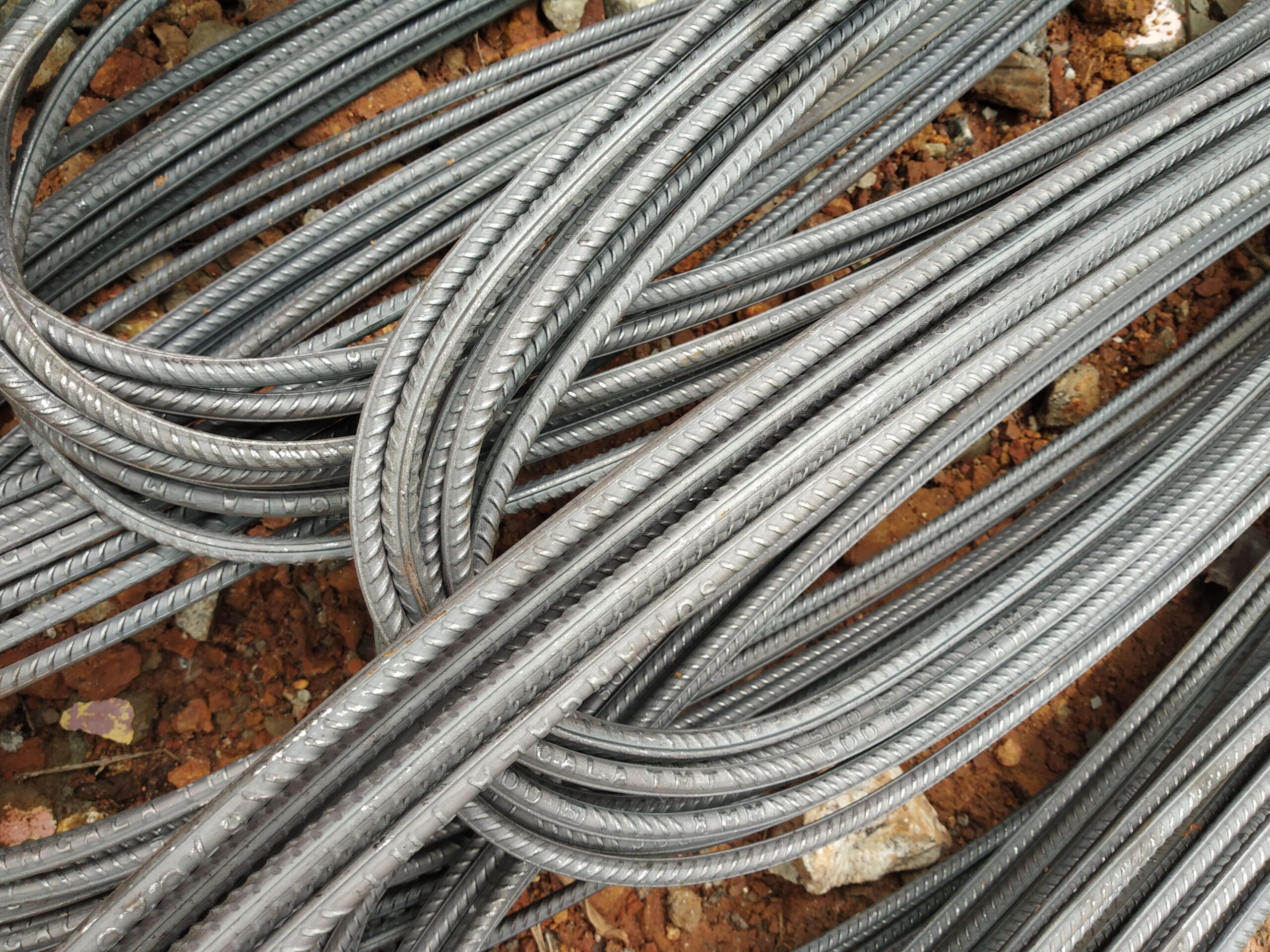
Steel Rebar vs FRP Bars
Fibre-Reinforced Polymer (FRP) bars — GFRP, CFRP, and BFRP — are increasingly specified for corrosion-critical applications. This guide compares FRP bars against DIN 488 B500B steel rebar across structural performance, design codes, cost, and export logistics, so international buyers can make an informed choice.
Steel Rebar vs FRP Bars — What Each Technology Offers
Fibre-Reinforced Polymer (FRP) bars consist of continuous glass, carbon, basalt, or aramid fibres embedded in a polymer matrix (typically epoxy or vinyl ester). They are being adopted in niche applications — primarily where conventional steel rebar’s susceptibility to corrosion is a dominant design constraint: marine structures, highway bridge decks exposed to deicing salts, chemical-plant floors, and tunnel drainage channels.
However, FRP bars are not a general-purpose replacement for DIN 488-compliant B500B steel rebar. The two materials have fundamentally different mechanical behaviours, design code support, supply chains, and installed cost profiles. Understanding those differences is essential for any B2B buyer assessing which material to specify or procure.
Key Mechanical Properties Compared
| Property | Steel Rebar B500B (DIN 488) | GFRP Bar (typical) | CFRP Bar (typical) |
|---|---|---|---|
| Tensile strength | ~550–650 MPa (ultimate) | 600–1,000 MPa | 1,200–2,400 MPa |
| Yield strength | ≥ 500 MPa (well-defined) | No yield plateau — linear elastic to failure | No yield plateau — linear elastic to failure |
| Elastic modulus | ~200 GPa | ~40–55 GPa | ~120–165 GPa |
| Ductility (Agt) | ≥ 5.0% (B500B) | None — brittle failure | None — brittle failure |
| Corrosion resistance | Requires adequate cover; susceptible if cover cracked | Excellent | Excellent |
| Thermal expansion coefficient | ~12 × 10⁻⁶/°C (matches concrete) | ~6–10 × 10⁻⁶/°C (transverse: ~20–30) | ~0–1 × 10⁻⁶/°C longitudinal (mismatch risk) |
| Unit weight (kg/m for ∅16) | ~1.58 | ~0.37–0.50 (much lighter) | ~0.30–0.40 |
Steel data per DIN 488 / EN 10080. FRP data indicative; varies by manufacturer, fibre type, and volume fraction. Always verify against product-specific datasheets and applicable test standards (ISO 10406, ACI 440.1R, EN ISO 527).
The Ductility Gap — Why It Matters for Structural Design
The single most important difference between steel rebar and FRP bars for structural applications is ductility. Steel B500B (Agt ≥ 5.0%) and especially B500C (Agt ≥ 7.5%) provide significant post-yield deformation before failure — the behaviour that underlies moment redistribution in frames, ductile failure modes in seismic design, and the general principle of “fail safe” structural response.
FRP bars are linear-elastic to rupture. They have no yield point, no plastic plateau, and no ductility in the conventional sense. This means that FRP-reinforced concrete structures cannot be designed using standard plastic analysis or moment redistribution. Seismic applications requiring B500C-class behaviour are currently incompatible with FRP. Design codes (ACI 440.1R, fib Bulletin 40) account for this by requiring additional safety factors and deformation-controlled design approaches, which generally result in higher required cross-sections or lower utilisation rates than equivalent steel-reinforced members.
Code and Standards Framework
Steel rebar design is governed by Eurocode 2 (EN 1992-1-1) and DIN 488 / EN 10080, a mature, globally adopted framework with decades of in-service performance data. Most national annexes explicitly cover B500A, B500B, and B500C.
FRP design is addressed in guidance documents rather than harmonised standards in most jurisdictions:
- ACI 440.1R (USA) — Guide for the Design and Construction of Structural Concrete Reinforced with FRP Bars
- fib Bulletin 40 (Europe) — FRP reinforcement in RC structures
- CSA S806 (Canada) — Design and Construction of Building Structures with FRP
- ISIS Canada design manuals
No harmonised European product standard equivalent to EN 10080 exists for FRP bars. Products are certified to EN ISO 10406-1/2 or national approvals (ETA). This creates additional procurement and QA complexity for international projects compared to the straightforward EN 10204 3.1 MTC documentation that accompanies every DIN 488 steel bar delivery.
Where FRP Bars Are Genuinely Superior
- Marine and coastal structures: seawater-exposed piles, jetties, sea walls where chloride-induced corrosion is the dominant life-cycle cost driver. GFRP can eliminate the need for increased cover depth, epoxy-coated bar, or cathodic protection systems.
- Bridge decks with deicing salts: North American bridge deck rehabilitation frequently specifies GFRP top-mat reinforcement to eliminate future deck-cracking repair cycles caused by corrosion.
- Electromagnetic neutrality: hospital MRI rooms, airport radar facilities, and research laboratories where steel rebar would interfere with electromagnetic fields.
- Chemical environments: industrial floor slabs in fertiliser plants, chemical storage facilities, and water treatment works where aggressive chemicals would attack conventional steel even with adequate cover.
Where Steel Rebar Remains the Correct Choice
- All primary structural frames: columns, beams, cores — where ductility is specified for seismic, robustness, or moment-redistribution requirements.
- Projects under Eurocode 2 as the design standard: FRP has no harmonised EC2 design method; use of FRP requires specific project approval.
- High-temperature environments: FRP bars lose strength above 60–120°C depending on resin type; steel retains structural integrity to significantly higher temperatures (with appropriate fire cover).
- Procurement cost and supply chain: B500B straight bar and coil are available globally in large volumes with proven logistics. FRP is a specialty product with limited mill capacity and longer lead times.
- Any project where Mill Test Certificate traceability, CE marking, and EN 10204 3.1 documentation are contractual requirements — FRP cannot meet these specific document standards.
FAQ — Steel Rebar vs FRP Bars
Can GFRP bars replace steel rebar in a seismic zone?
Is GFRP cheaper than steel rebar on a per-tonne basis?
Does DIN 488 apply to FRP bars?
What is the fire performance of FRP bars compared to steel?
What documentation does Steel Rebar Germany provide with B500B deliveries?
Source German-standard rebar with full export documentation
Tell us your specification and destination port — we’ll respond with a detailed quotation.