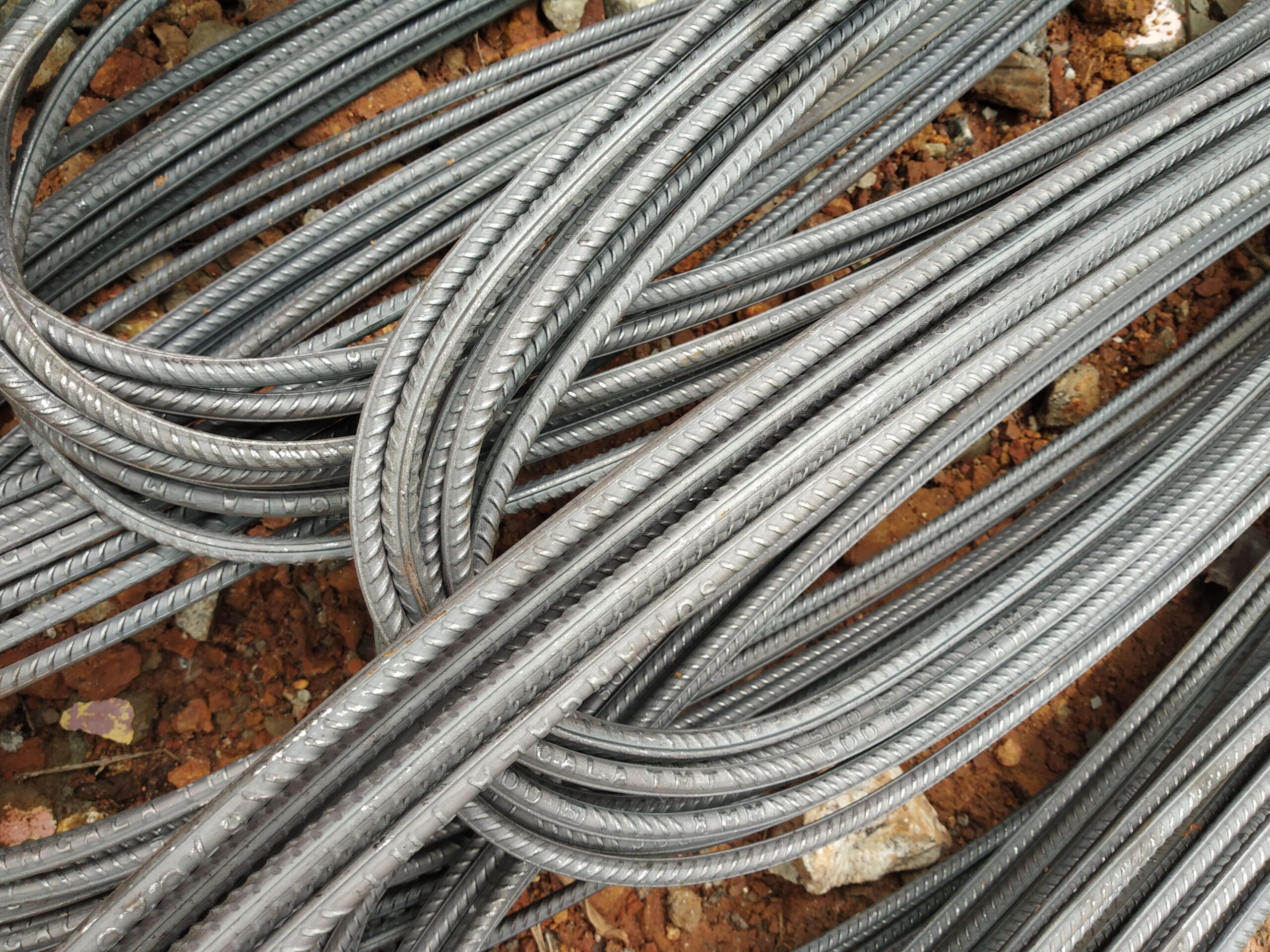
Steel Rebar vs FRP Reinforcement Compared
Steel rebar and Fibre-Reinforced Polymer (FRP) bars are the two dominant options for concrete reinforcement in major construction today. This comparison examines mechanical properties, corrosion resistance, design implications, cost, and the scenarios where each material is the correct choice.
Steel Rebar vs FRP: Side-by-Side Property Comparison
The fundamental difference between steel rebar and FRP bars lies in their material behaviour: steel is isotropic, ductile, and yields before fracture; FRP is anisotropic, linear-elastic to failure, and carries no yield plateau. This has profound implications for structural design, detailing, and project economics.
| Property | Steel Rebar (B500B) | GFRP (typical) | CFRP (typical) |
|---|---|---|---|
| Tensile strength | 560–700 MPa (ultimate) | 550–1000 MPa | 1200–2400 MPa |
| Elastic modulus | ~200 GPa | ~40–50 GPa | ~120–150 GPa |
| Yield / ductility | Pronounced yield plateau (ductile) | No yield — brittle fracture | No yield — brittle fracture |
| Density | 7.85 g/cm³ | ~2.1 g/cm³ | ~1.6 g/cm³ |
| Corrosion resistance | Requires cover / coating / CP | Excellent — non-metallic | Excellent — non-metallic |
| Thermal expansion | ~12 × 10⁻⁶/°C (matches concrete) | Transverse: 20–40 × 10⁻⁶/°C (mismatch risk) | Near-zero axial (mismatch risk) |
| Weldability | Yes (DIN EN ISO 17660) | No | No |
| Relative cost per tonne | Baseline | 3–6× steel | 10–20× steel |
| Applicable codes | EN 1992, DIN 488, BS 8666 | ACI 440, CAN/CSA S806, fib TG 9.3 | ACI 440, CAN/CSA S806 |
Structural Design Implications
The absence of a yield plateau in FRP bars means that design must be based on ultimate strength with a brittle failure mode. Eurocode 2 (EN 1992-1-1) is written for ductile reinforcing steel; its redistributions, minimum reinforcement rules, and ductility-based detailing requirements are not directly transferable to FRP. Designers using FRP must follow dedicated guidance such as ACI 440.1R or the fib Bulletin for FRP reinforcement.
The lower elastic modulus of GFRP (~40–50 GPa vs steel’s 200 GPa) means that deflection and crack-width serviceability often govern design rather than strength — requiring larger bar quantities or smaller spacings to achieve adequate stiffness. This partially offsets the weight advantage of FRP.
Corrosion Resistance: The Primary Case for FRP
Steel rebar corrodes when the alkaline protection of the concrete cover is breached by carbonation, chloride ingress (marine and de-icing salt environments), or cracking. The resulting oxide expansion causes spalling — a major lifecycle cost in bridges, coastal structures, and car parks. FRP bars are non-metallic and immune to electrochemical corrosion, making them compelling for structures where cover cracking or severe chloride exposure is the governing durability concern.
However, FRP bars can be susceptible to alkali attack over time (particularly GFRP in high-pH concrete environments) and to UV degradation if exposed before encasement. These factors are managed through bar surface treatment and design conservatism in the durability parameters.
When Steel Rebar Remains the Right Choice
For the overwhelming majority of reinforced concrete structures, B500B steel rebar under DIN 488 / EN 10080 remains the technically superior and economically rational choice:
- Seismic structures: Ductility (Agt ≥ 5 % for B500B, ≥ 7.5 % for B500C) is a design requirement for energy dissipation in earthquakes. FRP cannot provide this.
- Complex geometries and moment-frame construction: Steel bars can be welded, lapped, and mechanically spliced (couplers) in ways FRP cannot match.
- Cost-sensitive projects: At a fraction of the per-tonne cost of FRP and with a mature global supply chain, steel rebar offers predictable project economics.
- Standard Eurocode-designed structures: European design codes are fully calibrated for steel reinforcement; FRP requires designer re-qualification.
FRP’s Niche: Where It Excels
FRP reinforcement is appropriate in specific applications: MRI rooms requiring non-magnetic reinforcement; tunnel linings where steel recovery by TBM cutterheads is needed; wharf and jetty structures in permanently saturated marine zones; and bridge decks subject to heavy de-icing salt application where whole-life cost analysis justifies the premium. Outside these niches, the structural and economic case for steel rebar is compelling.
For your next project’s rebar requirements, explore our B500B rebar, review our full grade range, or request a quotation for any quantity.
Frequently Asked Questions
Common questions about choosing between steel rebar and FRP reinforcement.
Is FRP rebar stronger than steel rebar?
Can FRP rebar be used under Eurocode 2?
Is steel rebar corroding faster than FRP in chloride environments?
What is the cost difference between steel rebar and GFRP bars?
Source German-standard rebar with full export documentation
Tell us your specification and destination port — we’ll respond with a detailed quotation.