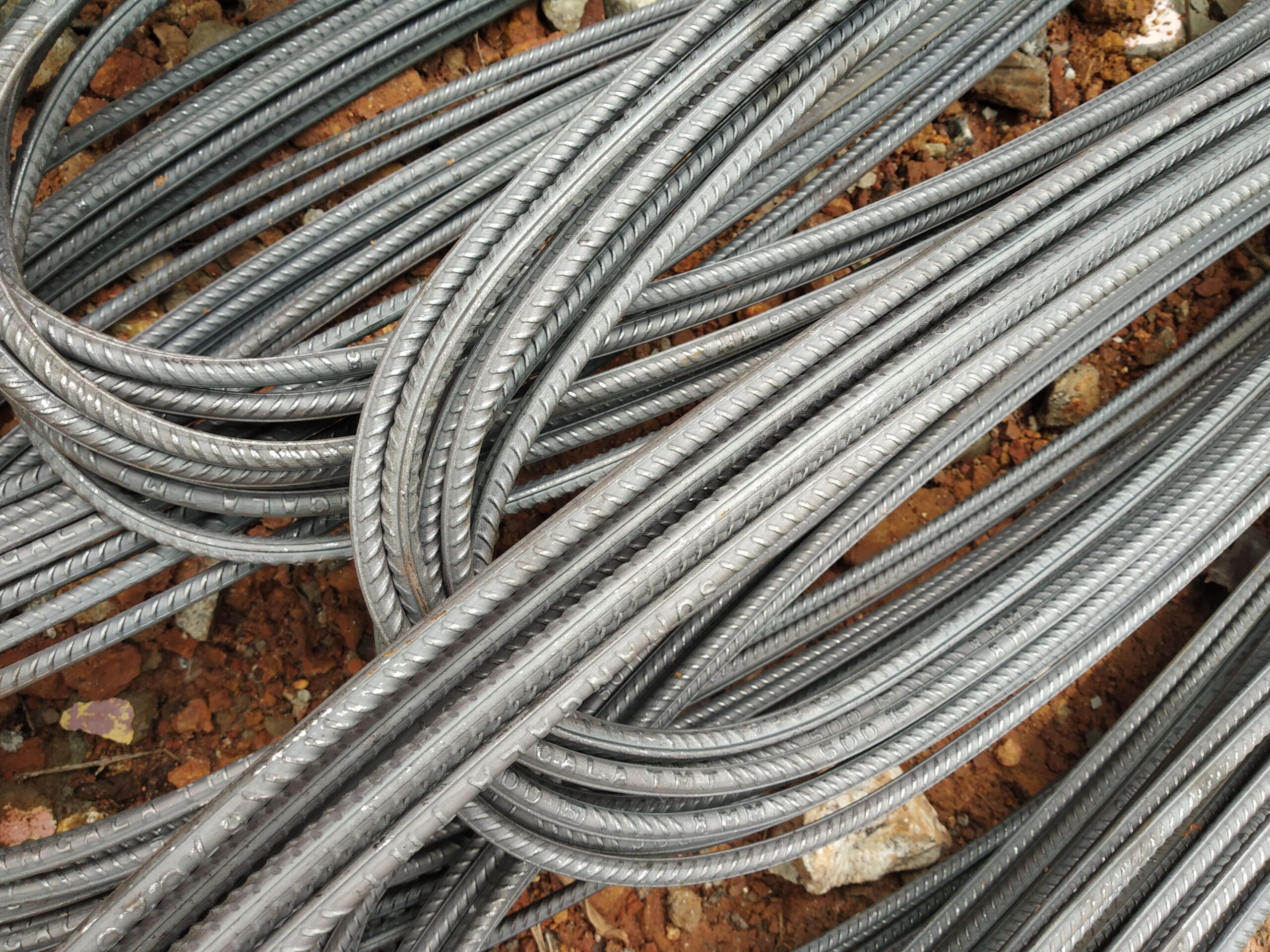
How Long Does Rebar Last in Concrete?
Service life, concrete cover, carbonation, chloride attack — and why DIN 488 / EN 10080 reinforcing steel is engineered for multi-decade performance in demanding environments.
Rebar Service Life: What the Standards Say
Properly designed reinforced concrete structures can achieve service lives of 50 to 100 years — and in some infrastructure categories under EN 1992-1-1 (Eurocode 2), design service lives of 100 years are explicitly targeted. How long does rebar last in concrete under those conditions? The honest answer is: as long as the concrete protects it. Steel reinforcement does not degrade inside high-quality, intact concrete. Corrosion only begins when aggressive agents — carbonation or chloride ions — penetrate to the steel surface and destroy the passive oxide film that forms in the alkaline concrete environment (pH ≥ 12.5).
The two dominant deterioration mechanisms are carbonation-induced corrosion (atmospheric CO₂ reacts with portlandite, lowering pH) and chloride-induced corrosion (de-icing salts or seawater). Both are governed by diffusion rates, which are in turn controlled by concrete quality (water/cement ratio, cement type, compaction) and concrete cover depth. DIN 488 and EN 10080 specify the steel; Eurocode 2 (EN 1992-1-1) and EN 206 govern the concrete that protects it.
The Role of Concrete Cover in Rebar Durability
Concrete cover is the single most influential factor in how long rebar lasts. Eurocode 2 defines nominal cover (cnom) as minimum cover (cmin) plus a construction tolerance (Δcdev, typically 10 mm). Minimum cover values are exposure-class dependent — see the table in our concrete cover guide. For a standard interior slab (exposure class XC1), 15 mm minimum cover may suffice; for a coastal bridge pier (XS3), 50 mm or more is required. Every extra millimetre of cover extends the carbonation or chloride ingress front’s journey to the steel surface, often by years or decades.
Carbonation: A Slow, Steady Process
Carbonation depth follows a roughly square-root-of-time relationship. In dense, low w/c concrete (w/c ≈ 0.40), the carbonation front advances only a few millimetres over 50 years. In poorer-quality concrete (w/c ≈ 0.60+), the same front might reach 30–40 mm in the same period. Design guidance under EN 1992-1-1 Annex E and fib Model Code provides the probabilistic framework for estimating time to depassivation, using carbonation coefficient k as input. The practical implication: specifying a higher concrete strength class (C30/37 or above) and ensuring adequate curing dramatically extends the time before carbonation threatens the rebar.
Chloride Attack: The More Aggressive Threat
Chloride-induced corrosion is generally more aggressive than carbonation because it can be localised (pitting), progresses faster in wet-dry cycling environments, and is difficult to stop once initiated. The threshold chloride content at the steel surface (ccrit) for standard carbon-steel rebar is approximately 0.4% by mass of cement. Structures in XD (de-icing salt) or XS (marine) exposure classes must use increased cover, reduced w/c ratios, and often supplementary cementitious materials (fly ash, GGBS) to extend the initiation phase.
For the most aggressive marine splash/spray zones (XS3), EN 1992-1-1 Table 4.4N specifies cmin,dur = 45 mm for 50-year design life — meaning nominal cover reaches 55 mm with tolerances. Stainless-steel rebar or epoxy-coated bar may be specified in extreme cases, but standard B500B rebar to DIN 488 is appropriate for the vast majority of exposures when cover and concrete quality are correctly designed.
How Rebar Grade Affects Long-Term Performance
The grade of rebar — B500A, B500B, or B500C per DIN 488 / EN 10080 — does not directly affect corrosion resistance; all are carbon-manganese steel with similar electrochemical behaviour in concrete. Grade selection governs structural performance: ductility class, weldability, and whether the bar is hot-rolled or cold-worked. For durability purposes the key variables remain cover, concrete quality, and detailing. That said, correctly specified B500B hot-rolled ribbed bar to DIN 488 offers reliable, consistent chemistry and mechanical properties, reducing the risk of localised composition anomalies that can accelerate corrosion.
| Factor | Effect on Rebar Service Life |
|---|---|
| Concrete cover (cnom) | Primary barrier — each +5 mm adds years to initiation phase |
| Concrete quality (w/c ratio) | Lower w/c → slower carbonation and chloride diffusion |
| Exposure class (XC/XD/XS) | Determines minimum cover and concrete class per Eurocode 2 |
| Curing duration | Adequate curing densifies near-surface concrete — critical |
| Rebar grade (DIN 488) | Governs structural ductility; corrosion resistance similar across grades |
| Spacers / chairs (DBV) | Maintain specified cover during pour; critical for achieving design life |
Practical Design Lives for Common Structure Types
Eurocode 0 (EN 1990) defines indicative design service lives: Category 1 (temporary structures) 10 years; Category 3 (buildings and common structures) 50 years; Category 5 (monumental buildings, bridges, civil infrastructure) 100 years. Reinforcement in well-executed Category 3 buildings routinely outlasts its 50-year design life — surveys of mid-20th-century concrete structures in central Europe find functional reinforcement with residual passivity where cover was maintained. In infrastructure (Category 5), detailed durability design per fib Model Code and probabilistic carbonation/chloride models is standard practice to justify the 100-year target.
For export projects, buyers should request a Mill Test Certificate to EN 10204 3.1, confirming chemical composition and mechanical properties. This document is essential for QA records that support the long-term structural warranty of the completed structure. We supply EN 10204 3.1 MTCs with every shipment. See our standards and certification page for full documentation detail.
Frequently Asked Questions
Key durability questions answered for structural engineers and procurement teams.
How long does rebar last in concrete under normal conditions?
Does rebar rust inside concrete?
What exposure classes affect rebar durability?
Does the DIN 488 grade of rebar affect how long it lasts?
What documentation should I request to verify rebar quality for long-life structures?
Source German-standard rebar with full export documentation
Tell us your specification and destination port — we’ll respond with a detailed quotation.