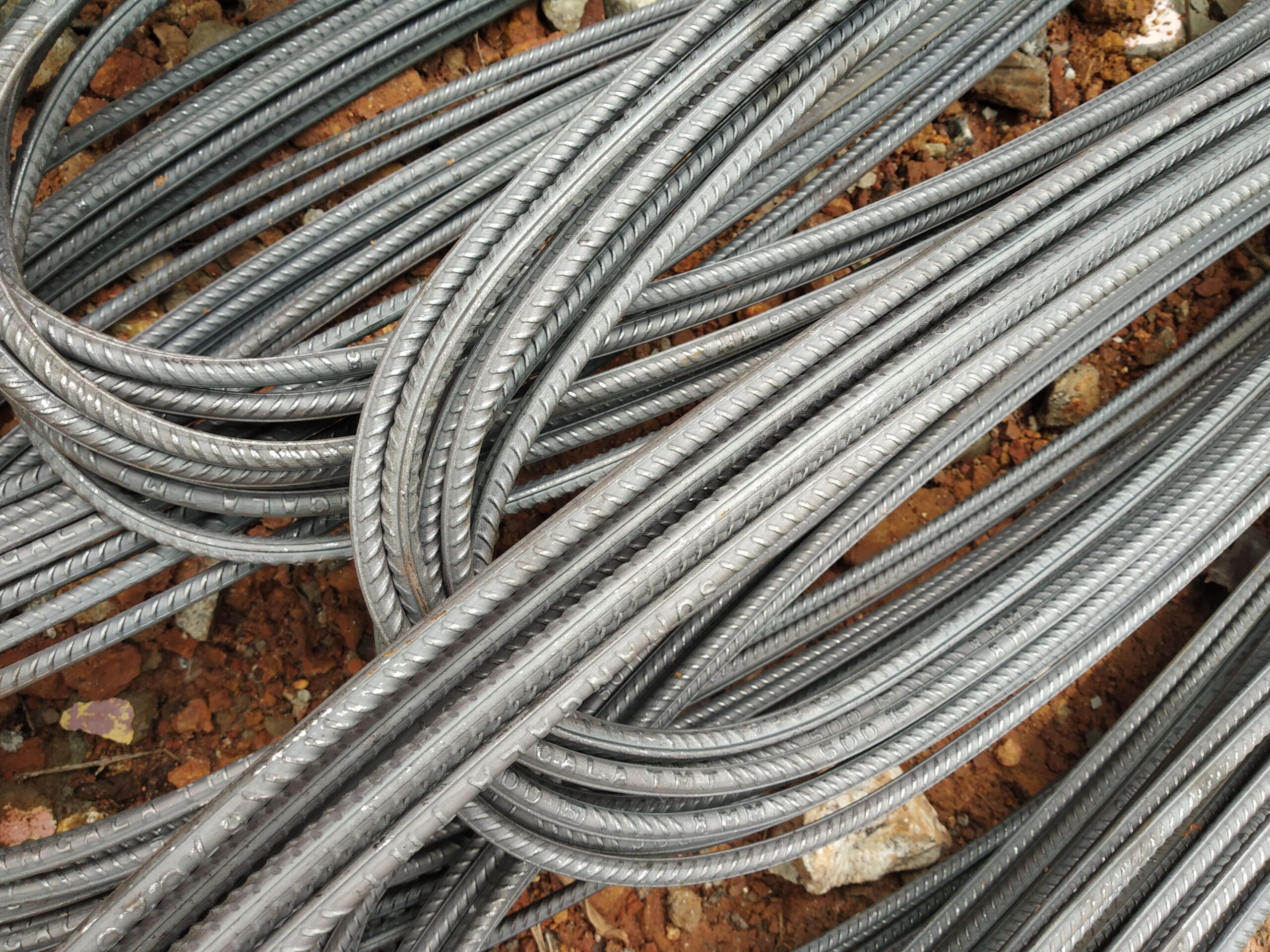
What Size Rebar for a Sidewalk or Path?
Practical B500B bar-size and spacing guidance for reinforced concrete sidewalks, pedestrian paths, and light-duty pavements — slab thickness, mat layout, cover, and an indicative rebar estimate. DIN 488 / EN 10080 standard.
Rebar Size for a Sidewalk: The Basics
A reinforced concrete sidewalk or pedestrian path is primarily a slab-on-ground element. Its function is to distribute applied loads (foot traffic, occasional light vehicle crossing) to the sub-base, control shrinkage cracking, and provide a durable wearing surface. While lightly loaded compared to structural slabs, rebar remains essential for crack control and long-term serviceability.
B500B to DIN 488 / EN 10080 — or B500A for welded mesh applications — is the standard grade for this application throughout Europe. With 500 MPa minimum yield strength and reliable ductility, it controls shrinkage and thermal cracks effectively in thin slabs.
Typical Bar Sizes for Sidewalks and Paths
- Ø6 mm B500A/B500B — minimum practical bar size; used in thin decorative paths (80–100 mm slab) with short panel lengths. Weight: 0.222 kg/m, cross-section: 28.3 mm².
- Ø8 mm B500B — common for residential paths and garden sidewalks (100–120 mm slab). Weight: 0.395 kg/m, cross-section: 50.3 mm².
- Ø10 mm B500B — standard for municipal sidewalks, shared pedestrian/cyclist paths, and paths with occasional light vehicle loading (100–150 mm slab). Weight: 0.617 kg/m, cross-section: 78.5 mm².
- Reinforcing mesh (Q-type to DIN 488-4) — a highly efficient alternative; standard mesh panels (e.g. Q188, Q257) provide a ready-made orthogonal mat, reducing labour significantly.
Slab Thickness and Bar Spacing
| Application | Slab Thickness | Bar / Mesh Size | Spacing | Cover (mm) |
|---|---|---|---|---|
| Residential garden path | 80–100 mm | Ø6 or mesh Q131 | 200 mm c/c | 30 mm |
| Standard pedestrian sidewalk | 100–120 mm | Ø8 or mesh Q188 | 150–200 mm c/c | 30–35 mm |
| Municipal path / shared use | 120–150 mm | Ø10 or mesh Q257 | 150 mm c/c | 35–40 mm |
| Path with light vehicle crossing | 150–200 mm | Ø10–Ø12 double mat | 150 mm c/c each way | 40 mm |
For standard slab-on-ground paths, a single central mat (mid-depth) or mesh panel is common. For slabs with significant bending (spanning over soft spots or voids), a two-layer layout may be needed.
Cover of 30–40 mm is recommended for outdoor slabs on ground per Eurocode 2 / EN 1992-1-1. In areas exposed to de-icing salts or coastal spray, 40–50 mm should be considered.
Why Mesh is Often the Best Choice for Sidewalks
For large-area sidewalk and path work, welded reinforcing mesh to DIN 488-4 offers significant advantages over individual bar placement: faster installation, consistent spacing, no tying required, and reduced labour costs. Standard panels (typically 6.0 × 2.3 m) cover large areas quickly. B500A mesh is suitable for standard shrinkage/crack-control applications; B500B mesh provides additional ductility where required.
Indicative Rebar Estimate for a Sidewalk
Consider a 50 m × 1.5 m municipal sidewalk, 120 mm slab, Ø8 @ 150 mm both ways (single mat):
- Longitudinal bars: ≈ 10 bars × 50 m × 0.395 kg/m ≈ 197.5 kg
- Transverse bars: ≈ 333 bars × 1.5 m × 0.395 kg/m ≈ 197.5 kg
- Laps and wastage (approx. 10%): ≈ 40 kg
- Total indicative: ≈ 435 kg of Ø8 B500B for this 75 m² area
Sourcing DIN 488 Rebar and Mesh for Path Projects
Steel Rebar Germany supplies B500B bars (Ø6–40 mm) and B500A/B500B welded mesh panels to DIN 488-4. All material ships with EN 10204 3.1 Mill Test Certificate and Certificate of Origin. Export worldwide, seaworthy bundle packing.
| Diameter (mm) | Weight (kg/m) | Cross-section (mm²) |
|---|---|---|
| 6 | 0.222 | 28.3 |
| 8 | 0.395 | 50.3 |
| 10 | 0.617 | 78.5 |
| 12 | 0.888 | 113 |
See also: Reinforcing Steel Mesh · B500B Steel Rebar · Standards & Certification.
Frequently Asked Questions — Rebar for Sidewalks and Paths
Does a concrete sidewalk need rebar?
What size rebar is standard for a residential concrete path?
Can I use mesh instead of individual rebar bars for a sidewalk?
How do I calculate the rebar needed for a path?
What cover should I specify for outdoor path rebar?
Source German-standard rebar with full export documentation
Tell us your path or sidewalk specification, area, and destination port — we’ll respond with a detailed quotation including Mill Test Certificate and Certificate of Origin.