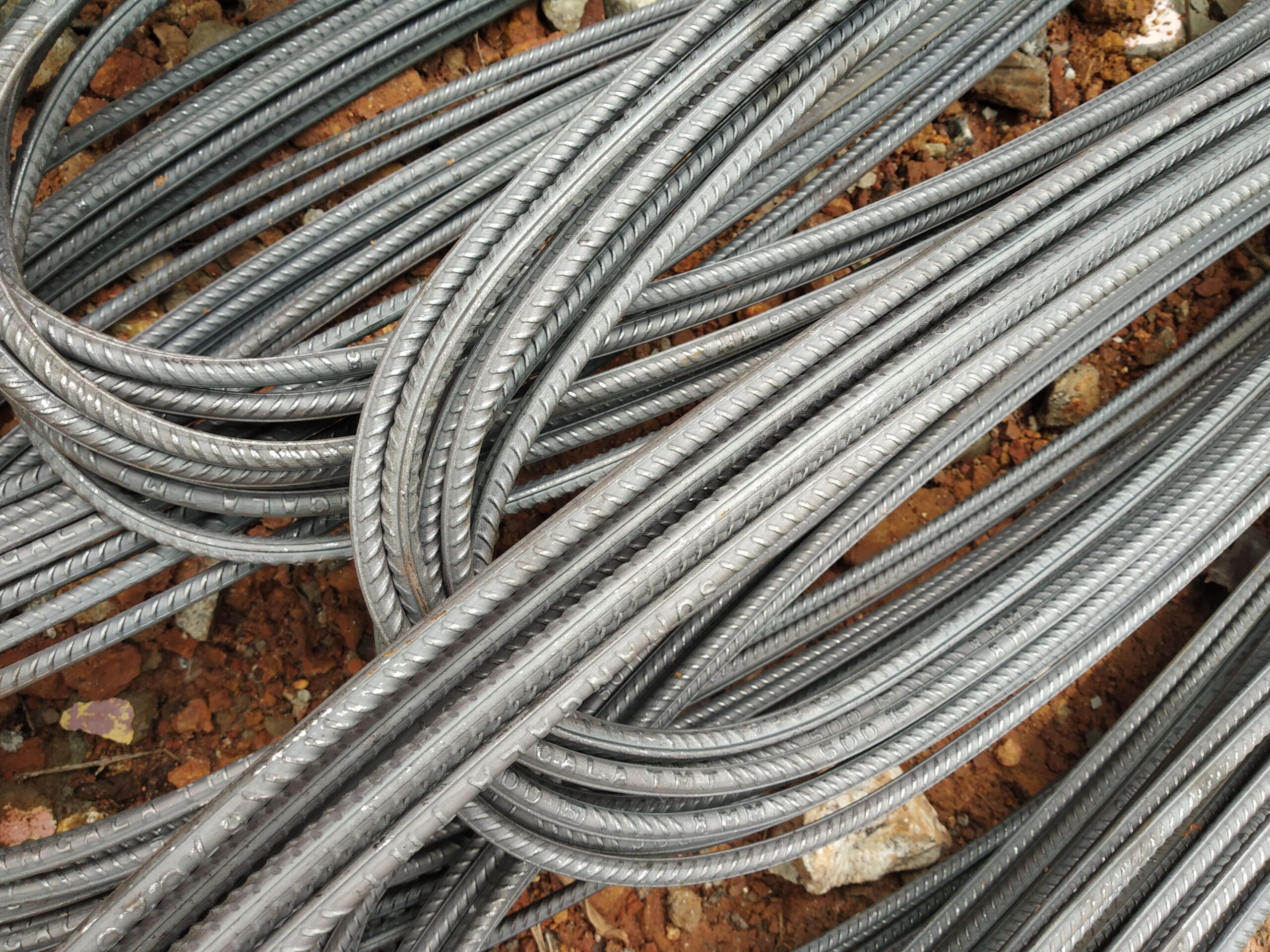
What Is fyk (Rebar Yield Strength)?
The characteristic yield strength fyk is the single most important number on a rebar Mill Test Certificate. This guide explains what it means, how it relates to ductility class and design strength, and how DIN 488 B500B rebar meets fyk requirements under EN 1992.
Definition: fyk Is the Characteristic Yield Strength of Reinforcing Steel
fyk is the characteristic yield strength of reinforcing steel — defined in EN 1992-1-1 (Eurocode 2) as the 5th percentile of the yield (or 0.2% proof) strength measured on a population of test specimens from the same product class. It is expressed in megapascals (MPa) and is the primary mechanical property that determines rebar grade.
For all B500-series rebar — B500A, B500B, B500C — fyk is specified at a minimum of 500 MPa. This is why “500” appears in the grade designation. The corresponding German standard DIN 488 uses the same 500 MPa threshold, harmonised with EN 10080.
fyk, ft, and the Key Mechanical Parameters
fyk is one of three interrelated mechanical parameters that appear on every EN 10204 3.1 Mill Test Certificate for reinforcing steel:
- fyk — Characteristic yield (or 0.2% proof) strength. Minimum 500 MPa for B500 series.
- ft — Tensile strength (ultimate). Must be ≥ fy × k-ratio.
- k = ft/fy — Tensile-to-yield ratio, measuring the strain-hardening reserve. Ductility class-dependent.
- Agt — Total elongation at maximum force (uniform elongation). Ductility class-dependent.
Ductility Classes: A, B, C — How fyk Alone Is Not Enough
Two bars can both show fyk = 500 MPa on test yet belong to different ductility classes with very different structural behaviour under seismic or impact loading. The three Eurocode 2 ductility classes are:
| Ductility Class | Grade (DIN 488) | fyk min (MPa) | k = ft/fy min | Agt min (%) | Typical use |
|---|---|---|---|---|---|
| A (normal) | B500A | 500 | ≥ 1.05 | ≥ 2.5 | Mesh, coils, stirrups |
| B (high) | B500B | 500 | ≥ 1.08 | ≥ 5.0 | Main structural bars — the workhorse |
| C (seismic) | B500C | 500 | 1.15 ≤ k < 1.35 | ≥ 7.5 | Seismic zones, critical ductile frames |
B500B is the dominant grade for structural rebar worldwide because its combination of 500 MPa yield strength and Class B ductility satisfies the detailing requirements of EN 1992-1-1 for the majority of buildings and infrastructure. Steel Rebar Germany supplies B500B as our primary bar product. Full B500B product details →
Design Strength fyd: How fyk Is Used in Calculations
Structural engineers do not use fyk directly in section design. They apply the partial safety factor for steel γs = 1.15 (for persistent and transient design situations in EN 1992) to derive the design yield strength:
fyd = fyk / γs = 500 / 1.15 ≈ 435 MPa
This design value is used in the flexural, shear, and anchorage calculations. Specifying the correct fyk on your procurement order ensures the engineer’s assumed 435 MPa design strength is achievable by the supplied steel. See our post on partial safety factors for concrete and steel for a deeper explanation of γs.
Reading fyk on a Mill Test Certificate
When you receive an EN 10204 3.1 Mill Test Certificate for a shipment of B500B rebar from Steel Rebar Germany, the certificate will report the actual measured yield strength (Re or ReH), tensile strength (Rm), and elongation (Agt or A5) for each heat/cast. These values will typically exceed the minimum requirements:
- Actual ReH typically 520–580 MPa for B500B (above 500 MPa minimum).
- Actual Rm/ReH ratio typically 1.10–1.20 (above 1.08 minimum).
- Actual Agt typically 8–12% (above 5.0% minimum).
These are indicative typical ranges based on standard German mill production; actual values vary by heat and supplier. The MTC contains the authoritative actual values for each delivery. See our Standards & Certification page for the full documentation chain, or request a quote with your project specifications.
Frequently Asked Questions: fyk Rebar Yield Strength
What is the minimum fyk for B500B rebar?
What is the difference between fyk and fyd?
Can I specify fyk = 500 MPa on my purchase order?
Why does B500C have a higher fyk k-ratio than B500B?
Where does fyk appear in a concrete reinforcement design?
Source German-standard rebar with full export documentation
Tell us your specification and destination port — we’ll respond with a detailed quotation.