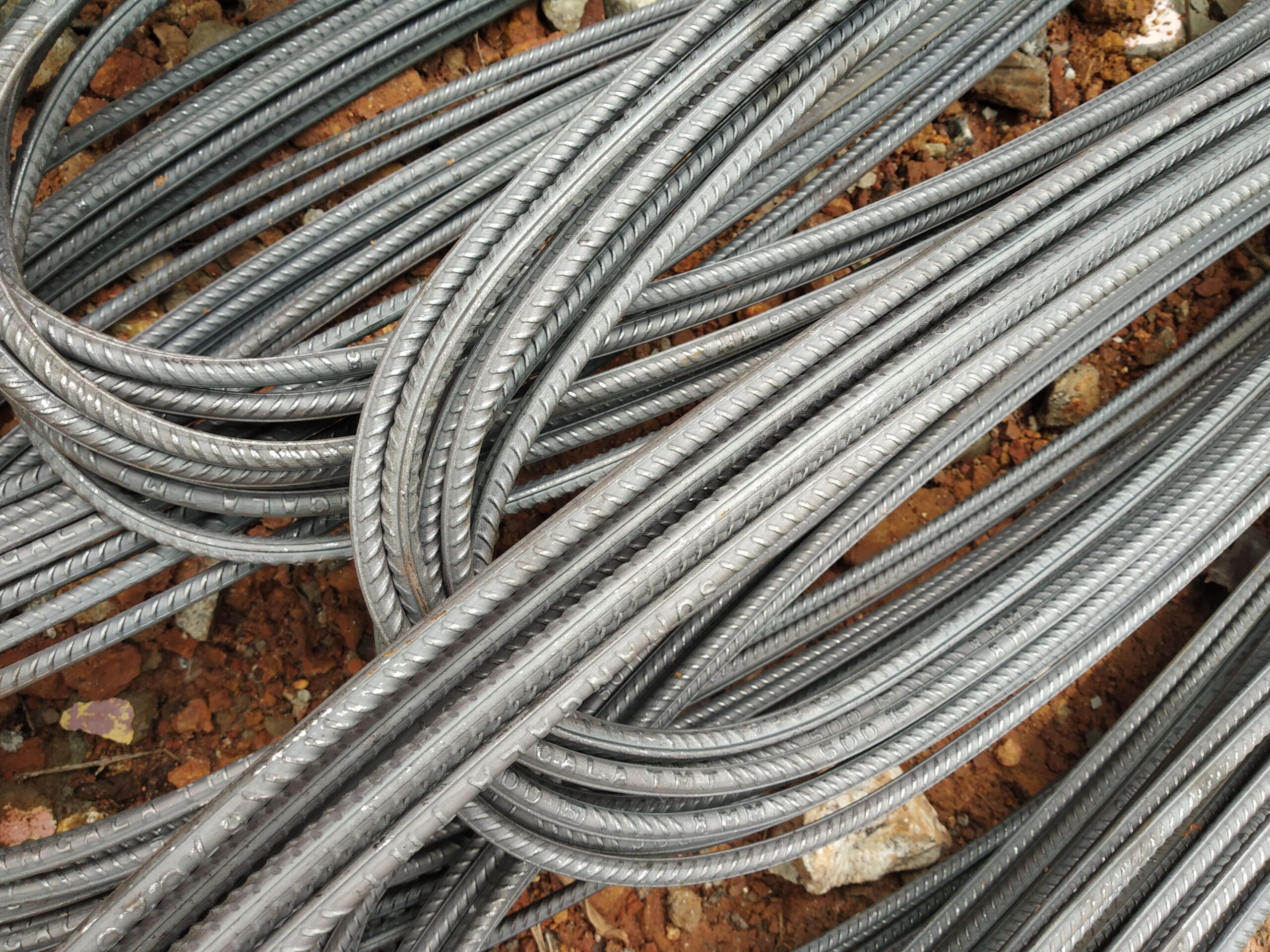
Steel vs GFRP (Composite) Rebar: Which Reinforcement Is Right for Your Structure?
Glass fibre reinforced polymer (GFRP) rebar is gaining ground in corrosion-critical applications. This guide compares GFRP composite rebar against German-standard steel B500B on strength, ductility, durability, cost, and design suitability — so you can make an informed procurement decision.
Two Different Philosophies of Reinforcement
Reinforced concrete has relied on carbon steel rebar since the 19th century. The logic is well-established: steel’s high elastic modulus and yield strength allow it to carry tensile forces that concrete cannot, while concrete protects the steel from corrosion. That protection is robust in most environments — but it can fail when chlorides or carbonation reach the bar, causing expansive corrosion and spalling.
GFRP (glass fibre reinforced polymer) rebar offers a fundamentally different approach: eliminate the corrosion problem entirely by using a non-metallic material. A GFRP bar consists of continuous glass fibres embedded in a thermoset resin matrix (typically vinylester or polyester), produced by a pultrusion process and surface-profiled for concrete bond. The result is a bar that is immune to chloride-induced corrosion — but which behaves very differently from steel under load.
Mechanical Properties: A Critical Comparison
| Property | Steel B500B (DIN 488) | GFRP (typical) |
|---|---|---|
| Tensile strength | 540–680 MPa | 600–1000 MPa (higher grades) |
| Yield / characteristic strength | 500 MPa (defined yield plateau) | No yield — linear elastic to failure |
| Elastic modulus | 200–210 GPa | 40–60 GPa (approx. 1/4 of steel) |
| Ductility (Agt) | ≥ 5.0 % (Class B) | None — brittle fracture at failure |
| Density | 7,850 kg/m³ | ~2,000–2,100 kg/m³ (approx. 1/4 of steel) |
| Thermal expansion (longitudinal) | ~12 × 10⁻⁶ /°C | 6–10 × 10⁻⁶ /°C (anisotropic) |
| Magnetic / electrical | Magnetic, conductive | Non-magnetic, non-conductive |
| Corrosion resistance | Passive in concrete (fails at high Cl⁻) | Immune to chloride-induced corrosion |
The Ductility Difference — Why It Matters for Structural Safety
This is the most important distinction for structural engineers. Carbon steel B500B exhibits a defined yield plateau: when the bar reaches 500 MPa, it deforms plastically without losing load-carrying capacity. This ductility provides warning before failure and allows plastic redistribution of moments in hyperstatic structures — a fundamental assumption in most reinforced concrete design to Eurocode 2.
GFRP bars are linear elastic to failure with no yield plateau. When the tensile strength is reached, fracture is sudden and brittle. Eurocode 2 (EN 1992-1-1) is calibrated for steel reinforcement; designing with GFRP requires specialist design guides (such as ISIS Canada, ACI 440, or fib Bulletin 40 for GFRP) and fundamentally different design approaches. The absence of ductility means GFRP structures must be designed so that the concrete compressive failure governs before bar fracture — the inverse of normal reinforced concrete practice.
Stiffness and Deflection
With an elastic modulus of only 40–60 GPa versus 200–210 GPa for steel, a GFRP bar at the same area and stress level will deflect roughly 3–5 times more than the equivalent steel bar. In practice this means GFRP-reinforced members must be significantly over-sized in section or bar area to meet serviceability deflection limits, partially or fully offsetting any weight savings. For structures where deflection is the governing criterion — slabs, beams — the lower stiffness of GFRP is a significant design challenge.
Corrosion Resistance and Durability
GFRP’s primary competitive advantage is corrosion immunity. In marine splash zones, de-icing salt environments, and aggressive chemical exposures where steel corrosion is practically inevitable over a 50–100 year design life, GFRP eliminates the corrosion risk entirely. This makes it genuinely attractive for:
- Bridge deck overlays and parking structure slabs exposed to de-icing salts
- Marine structures in tidal and splash zones
- Concrete elements in chemical plants or wastewater treatment facilities
- Structures requiring electromagnetic transparency (MRI facilities, radar installations)
- Tunnel linings in aggressive groundwater
However, GFRP durability has its own complexities. Long-term alkaline degradation of glass fibres in Portland cement concrete pore solution has been documented — the rate depends on fibre type (E-glass degrades faster than ECR or AR glass) and resin quality. Design codes apply long-term strength reduction factors (typically 0.6–0.8 for wet or alkaline environments) to GFRP design strengths to account for this. Steel B500B, by contrast, has a century of field performance data in concrete.
Cost and Availability
GFRP rebar is typically priced higher per unit weight than carbon steel B500B, though the lower density (approximately one-quarter of steel) means fewer tonnes per linear metre. For standard reinforced concrete construction, steel B500B remains significantly more cost-effective. GFRP becomes economically competitive — and can be cost-saving on a whole-life basis — specifically in the niche applications where steel corrosion would otherwise require extensive repair or replacement programmes.
Supply chain depth is another consideration: German-standard B500B rebar is a globally traded commodity available from multiple EU mills with full EN 10204 3.1 documentation. GFRP rebar supply chains are thinner, with fewer certified suppliers and less standardised documentation, particularly outside North America.
When to Use Each Material
- Choose steel B500B for the vast majority of reinforced concrete structures — buildings, foundations, bridges in non-aggressive environments, industrial structures. Superior ductility, well-understood design codes, global supply chain, full EN documentation.
- Consider GFRP specifically where: corrosion is virtually certain over the design life; the structure is not ductility-critical (e.g. slabs, walls); electromagnetic transparency is required; and a specialist design team is available to use GFRP-specific design methods.
For standard reinforcement procurement, explore our B500B steel rebar product page and our steel grades overview. For corrosion-critical applications where steel is still preferred, see our guides on galvanized vs epoxy rebar and stainless vs carbon steel rebar.
Frequently Asked Questions
Technical queries on steel vs GFRP composite rebar.
Can GFRP rebar be designed to Eurocode 2?
Is GFRP rebar compatible with standard concrete mixes?
Can GFRP rebar be bent on site?
What is the standard governing GFRP rebar in Europe?
Does Steel Rebar Germany supply GFRP rebar?
Source German-standard rebar with full export documentation
Tell us your specification and destination port — we’ll respond with a detailed quotation.