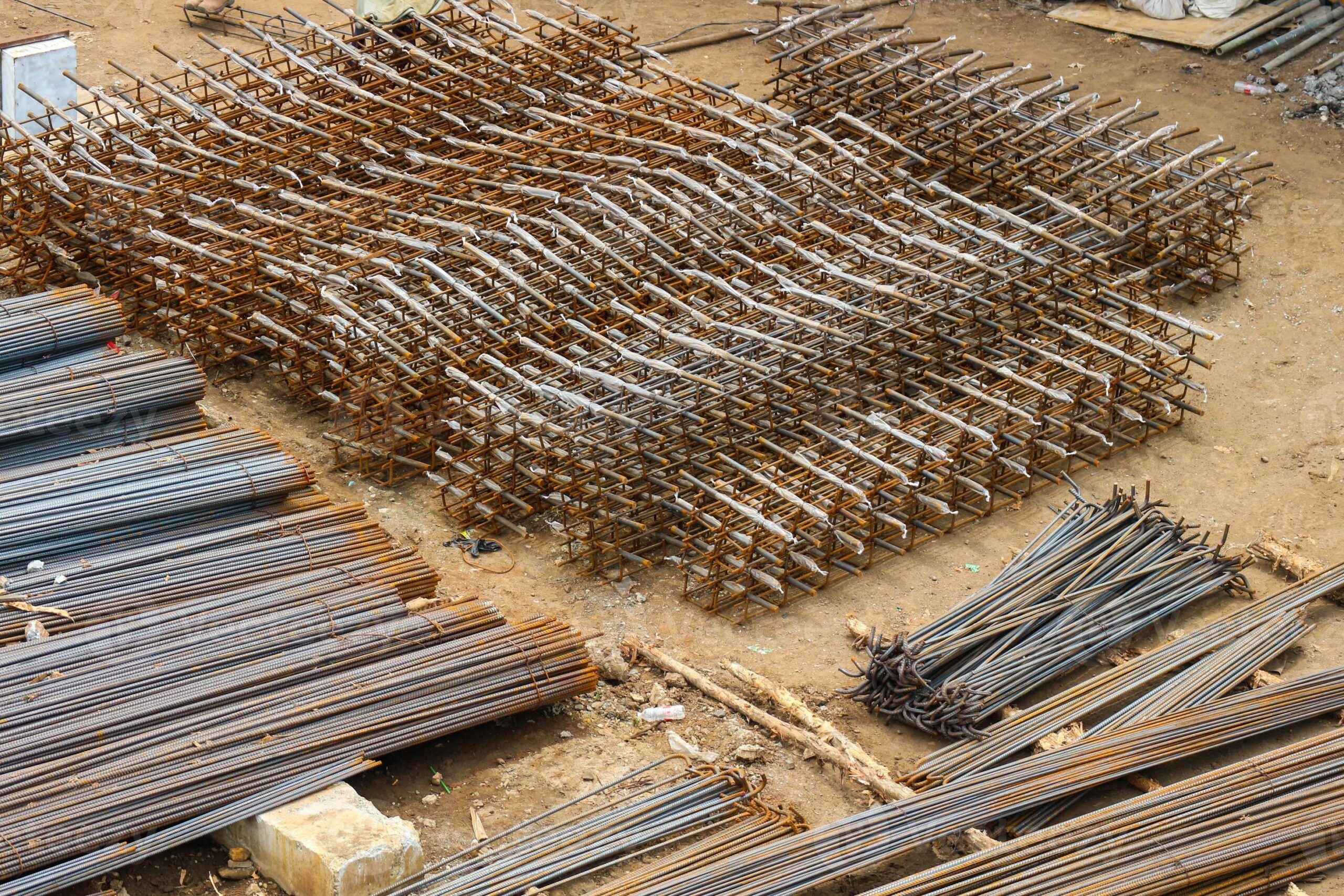
Reinforcing Steel for Precast Concrete
Reinforcing steel for precast concrete production — welded mesh, lattice girders and B500A/B500B coil engineered for automated benders, filigree slabs, double walls and façade panels, all to DIN 488 and EN 10080.
Reinforcing steel for precast concrete has to do something ordinary site rebar never does: arrive at a factory in consistent, machine-ready form and feed automated production lines that run hundreds of identical elements a day. A precast plant is an industrial operation, not a building site — so the reinforcement it consumes must hold tight dimensional tolerances, weld reliably and deliver to a just-in-time schedule. Steel Rebar Germany supplies German- and EU-standard reinforcement built for exactly this environment: welded mesh, lattice girders and coil for automated benders, all certified to DIN 488 and EN 10080 and designed to design rules under EN 1992-1-1 (Eurocode 2).
Precast elements concentrate reinforcement into repeatable cages and panels: filigree (lattice-girder) slabs, double walls, hollow-core edge reinforcement, columns and beams, and architectural façade panels. Each product family below maps to a specific reinforcement type — and to a dedicated product page where you can see grades, dimensions and ordering detail.
Precast elements and the reinforcement they need
Filigree slabs and lattice girders
Filigree (semi-precast) floor slabs are thin precast plates that carry a welded mesh in the lower zone plus lattice girders (Gitterträger) projecting above. The lattice girder does two jobs: it stiffens the thin plate so it can be lifted and transported without cracking, and after the in-situ topping is poured it acts as the shear connection that bonds the precast plate to the cast-in-place concrete into a composite slab. Consistent diagonal geometry and weld integrity are essential — read more on our lattice girders page.
Double walls, columns, beams and façades
Double walls (twin-wall) use two welded mesh skins linked by lattice girders, later filled with in-situ concrete on site. Precast columns and beams use cut-and-bend cages and stirrups; architectural façade panels combine fine mesh with edge detailing. For all of these, welded reinforcing mesh in standard Q/R types and bespoke panels is the core reinforcement, supplied flat or in custom sheet sizes such as 6.0 × 2.3 m.
Coil feed for automated production
Modern precast plants run automated mesh welders, stirrup benders and cage robots that draw straight from rebar coils. B500A and B500B coil in 6–16 mm, hot- or cold-rolled, feeds these machines continuously — eliminating bar-end offcuts, reducing handling and letting the line produce thousands of identical stirrups or mesh intersections with no manual cutting.
Reinforcement products for precast concrete
The table below maps each precast element to its primary reinforcement product and the relevant grade and standard.
| Precast element | Reinforcement product | Typical grade | Standard |
|---|---|---|---|
| Filigree / lattice slab | Welded mesh + lattice girders | B500A / B500B | DIN 488-4 · DIN 488-5 |
| Double wall (twin-wall) | Two mesh skins + lattice girders | B500A | DIN 488-4 |
| Hollow-core edge zone | Bar + coil-fed stirrups | B500B | DIN 488-2 |
| Columns & beams | Cut-and-bend cages, coil stirrups | B500B | DIN 488-3 · EN 10080 |
| Façade / cladding panels | Fine welded mesh | B500A | DIN 488-4 |
Why consistency and automation matter in a precast plant
On a construction site, a few millimetres of variation in a bar can be absorbed. In a precast plant feeding automated machinery, it cannot. Mesh welders and stirrup benders are calibrated to a precise wire diameter and a predictable yield; out-of-tolerance material jams machines, produces rejects and stops the line. That is why precast buyers value dimensional consistency, uniform mechanical properties and clean, oil-free surfaces above almost everything else.
Reinforcement to DIN 488 and EN 10080 delivers that repeatability. B500A coil offers the cold-workability and tight diameter tolerance automated machines need; B500B provides the higher ductility (k ≥ 1.08, Agt ≥ 5.0%) demanded where elements must perform structurally under Eurocode 2. Weldability is governed by DIN EN ISO 17660, which matters because mesh and lattice production rely on resistance welding at every intersection. Every delivery is backed by a Mill Test Certificate (EN 10204 3.1) so your QA team can trace each batch to its heat analysis.
Just-in-time supply is the other half of the equation. Precast factories run lean: they do not want a yard full of slow-moving coil. We coordinate scheduled deliveries of mesh, lattice girders and coil to match production runs, with seaworthy bundles (~2 t) for container or break-bulk export and full documentation — Certificate of Origin, CE/DoP and packing list — included as standard. See our full standards and certification overview for the compliance detail behind every shipment.
Core products for precast production
Three reinforcement families do most of the work in a precast plant — each on its own product page.
Welded reinforcing mesh
Standard Q/R types and bespoke panels for filigree slabs, double walls and façade skins — flat or custom-sized.
Explore mesh →Lattice girders
Gitterträger that stiffen thin precast plates for handling and provide the composite shear connection to the topping.
Explore lattice girders →Rebar coils
B500A / B500B coil, 6–16 mm, hot- or cold-rolled, for automated mesh welders, stirrup benders and cage robots.
Explore coils →Frequently asked questions
Reinforcement for precast concrete production — answered.
Which reinforcement grades suit precast concrete?
What do lattice girders actually do in a filigree slab?
Why use coil rather than straight bar in a precast plant?
Can you supply on a just-in-time schedule for our production runs?
Source German-standard rebar with full export documentation
Tell us your specification and destination port — we’ll respond with a detailed quotation.