Chloride Attack on Rebar: Mechanisms, Risks and Protection Strategies
Chloride-induced corrosion is the leading cause of premature reinforced concrete failure worldwide. Understanding how chloride ions penetrate concrete and destroy the passive film on steel rebar is essential for every structural engineer and procurement team specifying DIN 488 / EN 10080 reinforcing steel.
What Is Chloride Attack and Why Does It Matter?
Concrete normally protects embedded steel rebar through a tightly adherent passive oxide layer — the result of the highly alkaline pore solution (pH 12.5–13.5) generated by cement hydration. This passive film, roughly 2–6 nm thick, prevents electrochemical corrosion almost indefinitely under ideal conditions. Chloride attack disrupts this equilibrium.
When chloride ions (Cl⁻) diffuse through concrete and accumulate at the rebar surface, they destabilise the passive film at local defect sites. Once the chloride concentration at the steel surface exceeds a threshold — typically expressed as a chloride-to-hydroxide ratio [Cl⁻]/[OH⁻] greater than 0.6 — pitting corrosion initiates. From that point, expansive iron-oxide products (rust) generate internal tensile stresses of 200–600 MPa within the concrete cover, leading to cracking, spalling and ultimately structural compromise.
The economic consequences are severe. Global infrastructure corrosion costs are estimated at 3–4% of GDP annually, with chloride-induced rebar corrosion responsible for the majority of reinforced-concrete repair expenditure. Marine structures, road bridges exposed to de-icing salts, coastal buildings and underground car parks in frost regions are the most vulnerable asset classes.
Chloride Sources and Ingress Pathways
Chlorides reach rebar by two principal routes:
- External ingress: Sea water, tidal spray, de-icing salts (NaCl, CaCl₂, MgCl₂) and salt-laden groundwater penetrate concrete through diffusion, capillary suction and pressure-driven flow. Diffusion dominates in permanently wet conditions; capillary absorption dominates in wetting-drying cycles, which can drive chloride accumulation well above the surface concentration.
- Mix-water contamination (admixed chlorides): Chloride-contaminated mix water, sea-dredged aggregate or calcium-chloride accelerators introduce chlorides at casting. EN 206 limits total chloride content to 0.20% by mass of cement for reinforced concrete and 0.10% for prestressed concrete.
The Fick second-law diffusion model is routinely used to predict chloride penetration depth over time: C(x,t) = C_s × [1 − erf(x / (2√(D_app × t)))], where C_s is the surface chloride concentration, D_app the apparent diffusion coefficient (typically 1×10⁻¹² to 5×10⁻¹¹ m²/s depending on binder type) and t is service time in seconds.
Influencing Factors: Cover Depth, Concrete Quality and Rebar Grade
Three design levers dominate chloride resistance:
- Concrete cover depth: Eurocode 2 (EN 1992-1-1) specifies minimum covers of 40 mm (XS2 — permanently submerged) to 55 mm (XS3 — tidal/spray/splash) for 50-year design life in seawater exposure. Increasing cover from 40 mm to 60 mm can extend the onset of corrosion by a factor of 2–3 under equivalent diffusion conditions.
- Water/cement ratio and binder type: Reducing w/c from 0.55 to 0.40 cuts D_app by roughly 10×. Supplementary cementitious materials — ground granulated blast-furnace slag (GGBS) at 50–70% replacement, fly ash at 25–35% — further reduce diffusivity by pore-structure refinement and chloride-binding capacity.
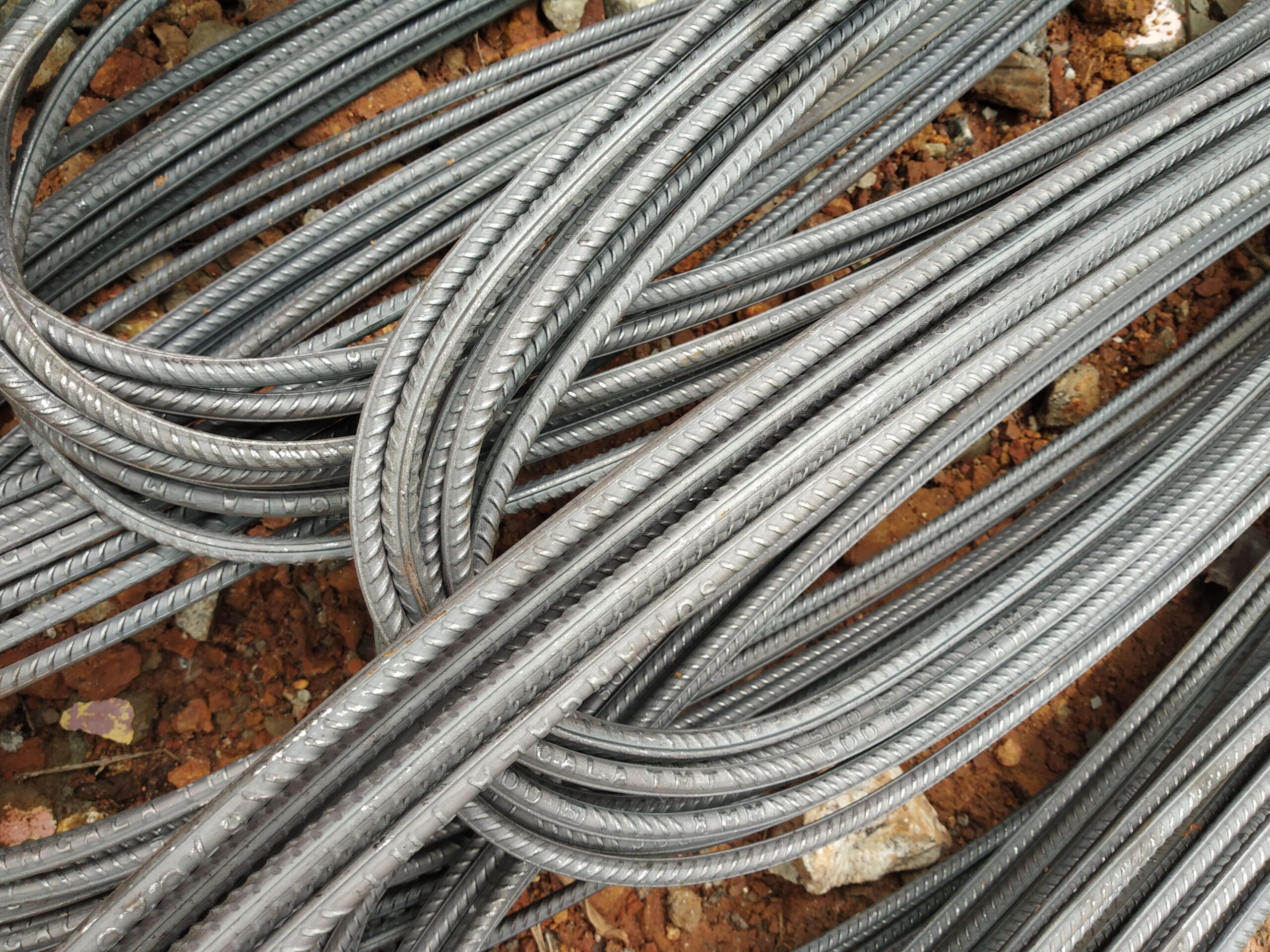
- Rebar type: Standard B500B hot-rolled rebar per DIN 488 / EN 10080 relies entirely on the concrete cover for corrosion protection. The ribbed surface geometry — transverse rib inclination 35–75°, rib height ≥ 0.03d — provides mechanical bond but does not itself resist chlorides. For extreme environments, epoxy-coated, galvanised or stainless-steel rebar are specified (see our guide on stainless rebar).
Chloride Threshold Values — Key Data Table
| Rebar Type | Critical [Cl⁻] (% cement mass) | Typical Service Context |
|---|---|---|
| Carbon steel B500B (uncoated) | 0.3–0.5% | Most RC structures |
| Galvanised steel | 0.6–1.0% | Moderate chloride exposure |
| Epoxy-coated rebar | 0.5–1.5% (if film intact) | Bridge decks, car parks |
| Duplex stainless (316L / 2205) | 2.0–4.0% | Marine, tidal, severe XS3 |
| Austenitic stainless (304) | 1.0–2.5% | Coastal, XS2 |
Prevention and Mitigation Strategies
Structural designers and procurement teams can deploy a layered defence:
- Concrete mix design: Specify low w/c (≤ 0.40 for XS3), GGBS or silica fume blends, and EN 206 exposure class XS2/XS3 — this alone cuts D_app by an order of magnitude versus plain Portland cement at w/c 0.55.
- Adequate cover and construction tolerances: Specify cover + 10 mm allowance for construction tolerances per EN 13670. Use certified plastic spacers (DBV-approved) to guarantee nominal cover during casting.
- Corrosion inhibitors: Calcium nitrite (Ca(NO₂)₂) at 10–30 litres/m³ raises the chloride threshold by competing with Cl⁻ at the steel surface, extending initiation time by 5–15 years at moderate dosages.
- Surface treatment: Silane penetrating sealers (isobutyl triethoxysilane) applied at 100–200 g/m² reduce chloride diffusivity by 80–95% in capillary absorption tests (BS 1881-208).
- Cathodic protection: Impressed-current or galvanic cathodic protection (EN ISO 12696) arrests active corrosion on existing structures. Mandatory on many major bridge rehabilitation projects across Germany and the EU.
- Stainless or coated rebar: For structures in XS3 or XD3 environments where 100-year design life is required, specify duplex stainless rebar per DIN / EN standards.
Specifying Rebar for Chloride-Exposed Projects
When procuring B500B rebar for structures in chloride environments, the Mill Test Certificate (EN 10204 3.1) should confirm: heat analysis with carbon equivalent (C_eq) ≤ 0.50% (to support welding per DIN EN ISO 17660), yield strength R_eH ≥ 500 MPa, tensile strength R_m ≥ 540 MPa, elongation A_gt ≥ 5.0%, and k-ratio ≥ 1.08. These parameters, mandated by DIN 488 and EN 10080, ensure the steel’s microstructure is optimised for both structural performance and resistance to hydrogen embrittlement in aggressive environments.
Seaworthy export bundling — wire-tied bundles of approximately 2 tonnes, mill-marked with heat number, diameter and grade — enables full traceability back to the certificate in case of future forensic investigation. See our export and delivery page for documentation details.
Frequently Asked Questions — Chloride Attack on Rebar
At what chloride concentration does corrosion initiate in standard B500B rebar?
How long does it take for chlorides to reach the rebar in a marine structure?
Does the ribbed surface of DIN 488 rebar make it more vulnerable to chloride attack?
Can cathodic protection be applied to existing rebar structures?
Does Steel Rebar Germany supply documentation suitable for corrosion-sensitive projects?
Source German-standard rebar with full export documentation
Tell us your specification and destination port — we’ll respond with a detailed quotation.