Designing Reinforced Concrete for Durability: Exposure Classes, Cover Depths and Rebar Specification
Durability design for reinforced concrete is not an afterthought — it determines whether a structure reaches its 50- or 100-year design life without major remediation. This guide covers EN 206 exposure classes, minimum cover requirements under Eurocode 2 and how to specify DIN 488 / EN 10080 rebar to meet durability targets.
The Durability Design Framework: EN 206 and Eurocode 2
Durability design for reinforced concrete is governed by two interlocking standards: EN 206 (concrete — specification, performance, production and conformity) and EN 1992-1-1 (Eurocode 2, Design of concrete structures — General). EN 206 classifies the exposure environment into classes that determine the minimum concrete performance; EN 1992-1-1 translates these classes into minimum cover depths for the reinforcing steel.
The fundamental principle is that concrete cover, combined with adequate concrete quality, must provide a service life during which the reinforcing steel remains passive — neither carbonation nor chloride ingress should reach the steel surface within the design life. For most structures this means proving that initiation of corrosion is delayed beyond 50 years (EN 1990 CC2) or 100 years (bridges, infrastructure per CC3).
EN 206 Exposure Classes — Reference Table
| Class | Description | Typical example |
|---|---|---|
| X0 | No corrosion risk (dry, no reinforcement) | Interior concrete without reinforcement |
| XC1 | Corrosion by carbonation — dry or permanently wet | Concrete inside buildings with low humidity |
| XC2 | Wet, rarely dry | Foundations, parts of water-retaining structures |
| XC3 | Moderate humidity | Concrete sheltered from rain; external walls in low humidity |
| XC4 | Cyclic wet and dry | External concrete surfaces exposed to rain |
| XD1 | Chloride (non-marine) — moderate humidity | Concrete exposed to airborne chlorides; car park surfaces |
| XD2 | Wet, rarely dry | Swimming pools; industrial exposure to chloride solutions |
| XD3 | Cyclic wet and dry | Bridge decks; parts of marine structures above tidal zone |
| XS1 | Marine chloride — airborne salt, not in contact with seawater | Structures near coast |
| XS2 | Permanently submerged | Parts of marine structures |
| XS3 | Tidal, splash and spray zones | Parts of marine structures above submerged zone |
| XF1–XF4 | Freeze/thaw attack | Exposed horizontal surfaces, road structures with de-icing salts |
Minimum Cover Depths Under Eurocode 2 (EN 1992-1-1)
Table 4.4N of EN 1992-1-1 specifies minimum cover for bond (c_min,b = bar diameter, ≥ 10 mm) and minimum cover for durability (c_min,dur) based on exposure class and structural class. The nominal cover c_nom = c_min + Δc_dev, where Δc_dev is the construction tolerance allowance (typically 10 mm for cast-in-situ concrete per EN 13670).
Key values for 50-year design life (Structural Class S4):
- XC1: c_min,dur = 15 mm → c_nom ≥ 25 mm
- XC2 / XC3: c_min,dur = 25 mm → c_nom ≥ 35 mm
- XC4: c_min,dur = 30 mm → c_nom ≥ 40 mm
- XD1 / XS1: c_min,dur = 35 mm → c_nom ≥ 45 mm
- XD2 / XS2: c_min,dur = 40 mm → c_nom ≥ 50 mm
- XD3 / XS3: c_min,dur = 45 mm → c_nom ≥ 55 mm
For 100-year design life, structural class increases by 2 (to S6 for XC1–XD2 and S5 for XD3/XS3), increasing c_min,dur by 5–10 mm across all classes. This underscores the importance of early durability decision-making: increasing cover depth at design stage costs almost nothing compared to repair after initiation of corrosion.
Concrete Mix Design for Durability
EN 206 specifies maximum water/cement ratios and minimum cement content per exposure class. For XD3/XS3 the requirements are: w/c ≤ 0.40, minimum cement content 340 kg/m³ (with Portland cement). Replacing 50–70% of Portland cement clinker with GGBS — a common practice in UK, Dutch and German bridge specifications — reduces the chloride diffusion coefficient by 5–10× while maintaining strength, and qualifies for a 5 mm cover reduction under EN 1992-1-1 Table 4.5N when special quality assurance applies.
Admixed chloride limits per EN 206: maximum 0.20% Cl by mass of cement for reinforced concrete, 0.10% for prestressed concrete. Aggregate testing per EN 12620 must confirm chloride content within these limits when using marine-dredged or reclaimed materials.
Rebar Specification for Durability-Critical Projects
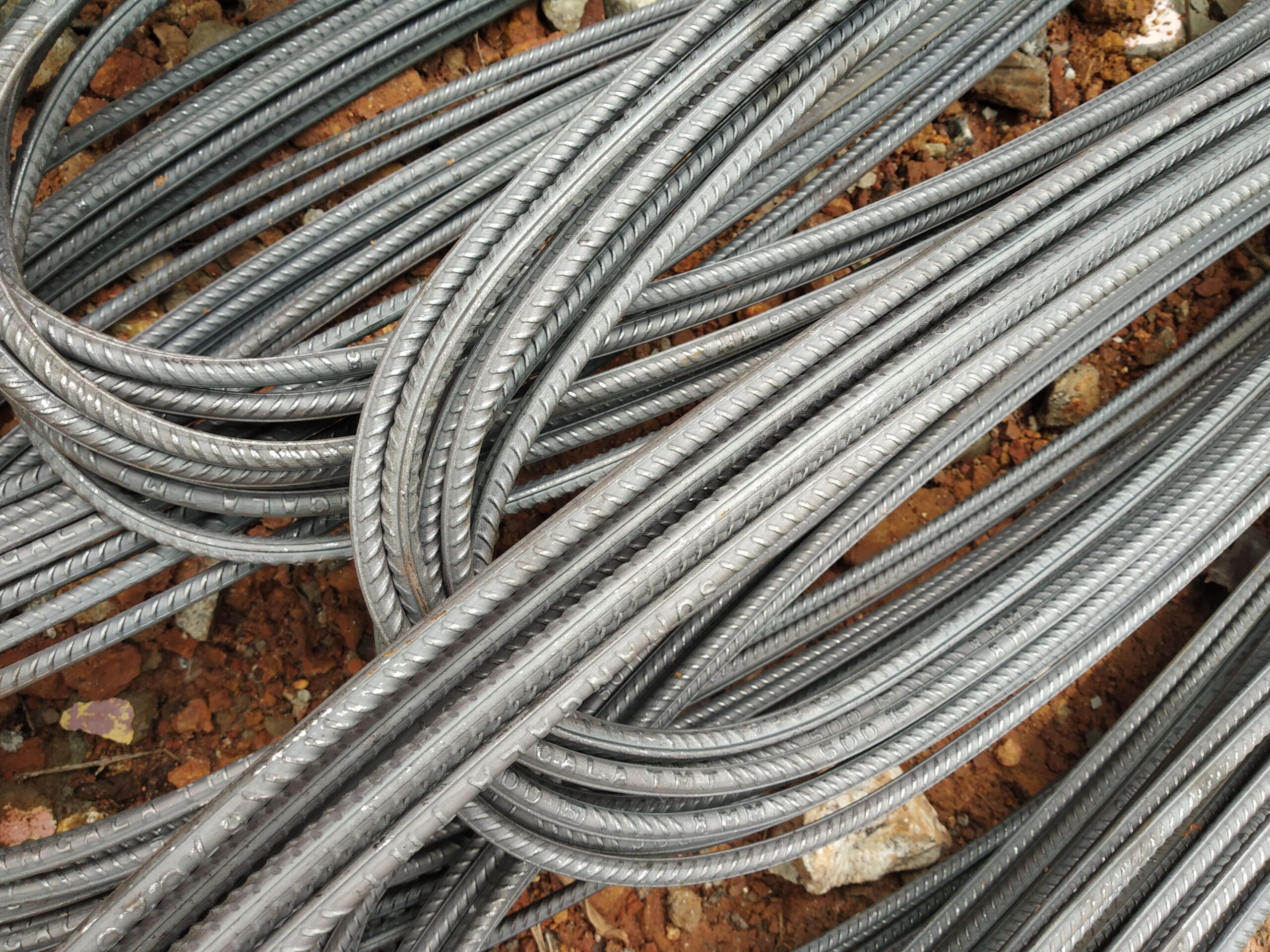
Standard B500B hot-rolled rebar per DIN 488 / EN 10080 is appropriate for the full EN 206 exposure class range when combined with correct cover and concrete quality. Key rebar specification points for durability projects:
- Carbon equivalent C_eq ≤ 0.50%: Confirms weldability per DIN EN ISO 17660 and low hydrogen-induced cracking risk — important for structures where future repairs may involve welding of additional reinforcement.
- Ductility class B (k ≥ 1.08, Agt ≥ 5.0%): Provides post-yield redistribution capacity — critical in structures where durability deterioration may cause local yielding before repair.
- EN 10204 3.1 Mill Test Certificate: Provides full heat analysis, mechanical test results and dimensional compliance for asset management records spanning the structure’s design life.
- Seaworthy bundle packing: Wire-tied bundles with waterproof wrapping for export supply prevents surface rust that could compromise passive film formation during casting. See our export and delivery page.
For structures in XS3 or XD3 where even optimised concrete cover and mix design cannot guarantee the required design life — submerged tunnels, long-span offshore structures — consider hybrid reinforcement with stainless rebar in the critical outer layers. See our guide on stainless rebar for a cost-benefit framework.
Construction Quality: Where Durability Is Won or Lost
Design intent is only realised if construction execution matches specification. The most common durability failures in reinforced concrete trace back to: inadequate concrete cover due to spacer displacement during casting; poor consolidation creating honeycombing; incorrect water addition on site raising effective w/c above the specified maximum; and premature formwork striking causing surface cracking before concrete gains sufficient tensile strength.
EN 13670 (execution of concrete structures) provides the quality management framework. Key controls: use certified DBV-approved plastic spacers sized to deliver nominal cover; specify and monitor slump at point of placement; apply curing membrane or polyethylene sheeting immediately after strike. These measures cost almost nothing relative to structural remediation and are the final line of defence for durability performance across the structure’s life.
Frequently Asked Questions — Durability Design for Reinforced Concrete
What is the difference between structural class and exposure class in Eurocode 2?
Can I reduce cover depth if I use a better concrete mix?
What exposure class applies to a basement slab in contact with aggressive groundwater?
Does the rebar grade affect durability performance?
What documentation does Steel Rebar Germany provide to support long-term asset records?
Source German-standard rebar with full export documentation
Tell us your specification and destination port — we’ll respond with a detailed quotation.