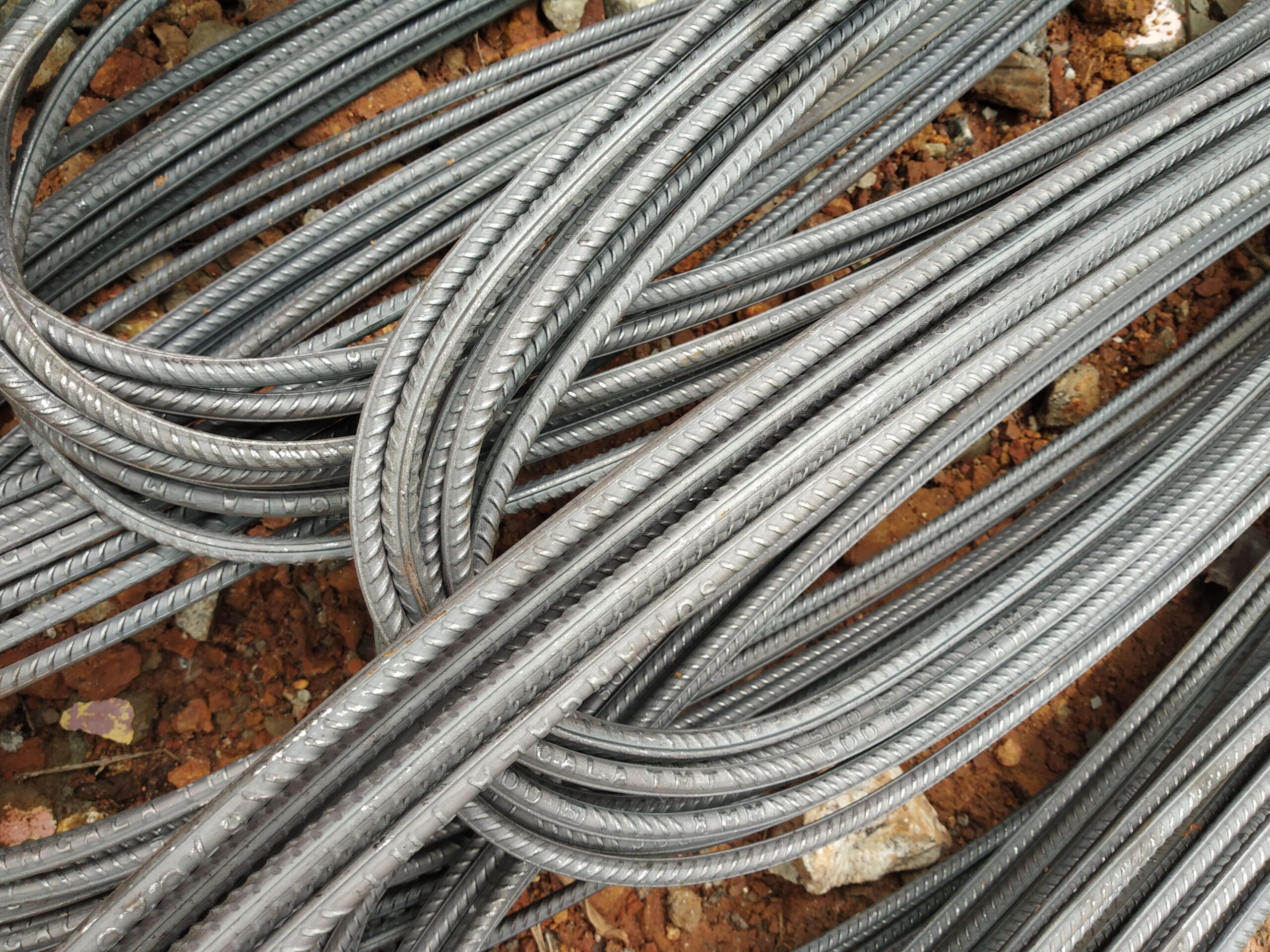
Rebar Behaviour in Fire: Steel Properties, Temperature Limits and Structural Fire Design
Understanding how B500B reinforcing steel performs at elevated temperatures is critical for structural fire engineers specifying DIN 488 / EN 10080 rebar to Eurocode 2 Part 1-2. This guide covers yield strength reduction, axis distances, fire ratings and post-fire assessment.
Why Fire Performance of Rebar Matters
Reinforced concrete is widely regarded as one of the most fire-resistant structural systems available. The concrete cover acts as an insulating layer, slowing heat penetration to the embedded steel. Yet steel is fundamentally sensitive to elevated temperature: at 400°C the yield strength of carbon steel has already fallen to roughly 94% of its ambient value; at 600°C it drops below 40%; and above 700°C the residual strength is so low that unprotected steel cannot carry structural loads.
For rebar embedded in concrete, the critical question is how quickly fire-driven heat reaches the steel surface — a function of cover depth, fire severity and exposure duration. Eurocode 2 Part 1-2 (EN 1992-1-2) provides the framework for structural fire design, specifying minimum cover depths, axis distances and section sizes to achieve fire ratings of R30 to R240 (30 to 240 minutes of standard fire exposure).
Temperature-Dependent Mechanical Properties of Hot-Rolled B500B
The temperature-dependent reduction factors for reinforcing steel are defined in EN 1992-1-2 Annex C. Hot-rolled B500B — the standard grade per DIN 488 and EN 10080 — exhibits the following characteristic reduction in yield strength and elastic modulus with temperature:
| Temperature (°C) | Yield strength factor k_s(θ) | Elastic modulus factor k_E(θ) |
|---|---|---|
| 20 (ambient) | 1.00 | 1.00 |
| 100 | 1.00 | 1.00 |
| 200 | 1.00 | 0.90 |
| 300 | 1.00 | 0.80 |
| 400 | 0.94 | 0.70 |
| 500 | 0.67 | 0.60 |
| 600 | 0.40 | 0.31 |
| 700 | 0.12 | 0.13 |
| 800 | 0.11 | 0.09 |
| 900 | 0.08 | 0.07 |
Cold-worked steel (B500A, commonly used in mesh and coil) loses strength more rapidly than hot-rolled steel above 400°C, which is why EN 1992-1-2 distinguishes between the two in its reduction factor tables. For critical fire-resistance applications, hot-rolled B500B is therefore preferred.
The Role of Concrete Cover in Fire Resistance
Concrete’s low thermal conductivity (λ ≈ 1.0–1.6 W/m·K for normal-weight concrete) means it acts as an effective thermal barrier. The standard fire curve (ISO 834) reaches 842°C at 30 minutes and 1049°C at 120 minutes at the exposed surface. Even under these severe conditions, temperatures at depth rise slowly.
EN 1992-1-2 specifies minimum axis distances (a = cover + half bar diameter) for simply supported beams and slabs to achieve standard fire ratings:
- R30: axis distance a ≥ 25 mm (beam), 10 mm (slab)
- R60: a ≥ 35 mm (beam), 20 mm (slab)
- R90: a ≥ 45 mm (beam), 30 mm (slab)
- R120: a ≥ 55 mm (beam), 40 mm (slab)
- R240: a ≥ 90 mm (beam), 65 mm (slab)
These values apply to normal-weight concrete (density ≥ 2000 kg/m³). Lightweight aggregate concrete requires adjusted tables per EN 1992-1-2 clause 5.2.
Post-Fire Assessment: Can Rebar Recover?
Hot-rolled reinforcing steel (B500B) heated above approximately 300°C but below 650°C generally recovers most of its ambient-temperature properties on cooling — the microstructure is not permanently altered unless temperatures exceed the Ac1 transformation point (~720°C for plain carbon steel). Above 720°C, austenitisation followed by air cooling produces a new microstructure; yield strength may partially recover but the steel’s ductility class (k-ratio, Agt) can shift unpredictably.
Post-fire structural assessment requires: visual and non-destructive inspection (rebound hammer, ultrasonic pulse velocity), concrete core testing, and where required, rebar sampling for tensile testing per EN ISO 15630-1 to verify compliance with DIN 488 / EN 10080 yield strength and elongation requirements. See our standards and certification page for a full overview of compliance testing.
Structural Fire Design Methods Under EN 1992-1-2
Three methods are available for fire design under EN 1992-1-2:
- Tabular data method (Section 5): The simplest approach — minimum dimensions and axis distances for the required fire rating. Suitable for standard beams, slabs and columns in normal-weight concrete.
- Simplified calculation methods (Section 4): The 500°C isotherm method and zone method use temperature profiles and reduced cross-section properties. Allows optimisation where tabular data is conservative.
- Advanced calculation methods: Full finite-element thermal and structural analysis. Used for complex geometry, parametric fire curves or irregular sections requiring R120 or R240 ratings.
For most building structures, tabular data combined with correct cover depth is cost-effective. Projects requiring R120 or R240 — underground infrastructure, high-rise cores, tunnels — benefit from advanced analysis and may require larger sections. See the high-rise construction applications page for related guidance.
Procurement Considerations for Fire-Resistant Design
When procuring B500B rebar for fire-critical applications, the Mill Test Certificate (EN 10204 3.1) should confirm: hot-rolling route, grade B500B, k-ratio ≥ 1.08 and Agt ≥ 5.0%. These ductility parameters matter because fire-damaged concrete redistributes loads to adjacent members — high ductility prevents brittle fracture during this redistribution phase. Full export documentation including Certificate of Origin and CE conformity is available for all supply.
Frequently Asked Questions — Rebar Behaviour in Fire
At what temperature does B500B rebar lose significant structural capacity?
Why is hot-rolled rebar preferred over cold-worked steel in fire design?
What is axis distance and how does it differ from concrete cover?
Does rebar need to be replaced after a building fire?
Can Steel Rebar Germany supply documentation confirming rolling route and ductility class?
Source German-standard rebar with full export documentation
Tell us your specification and destination port — we’ll respond with a detailed quotation.