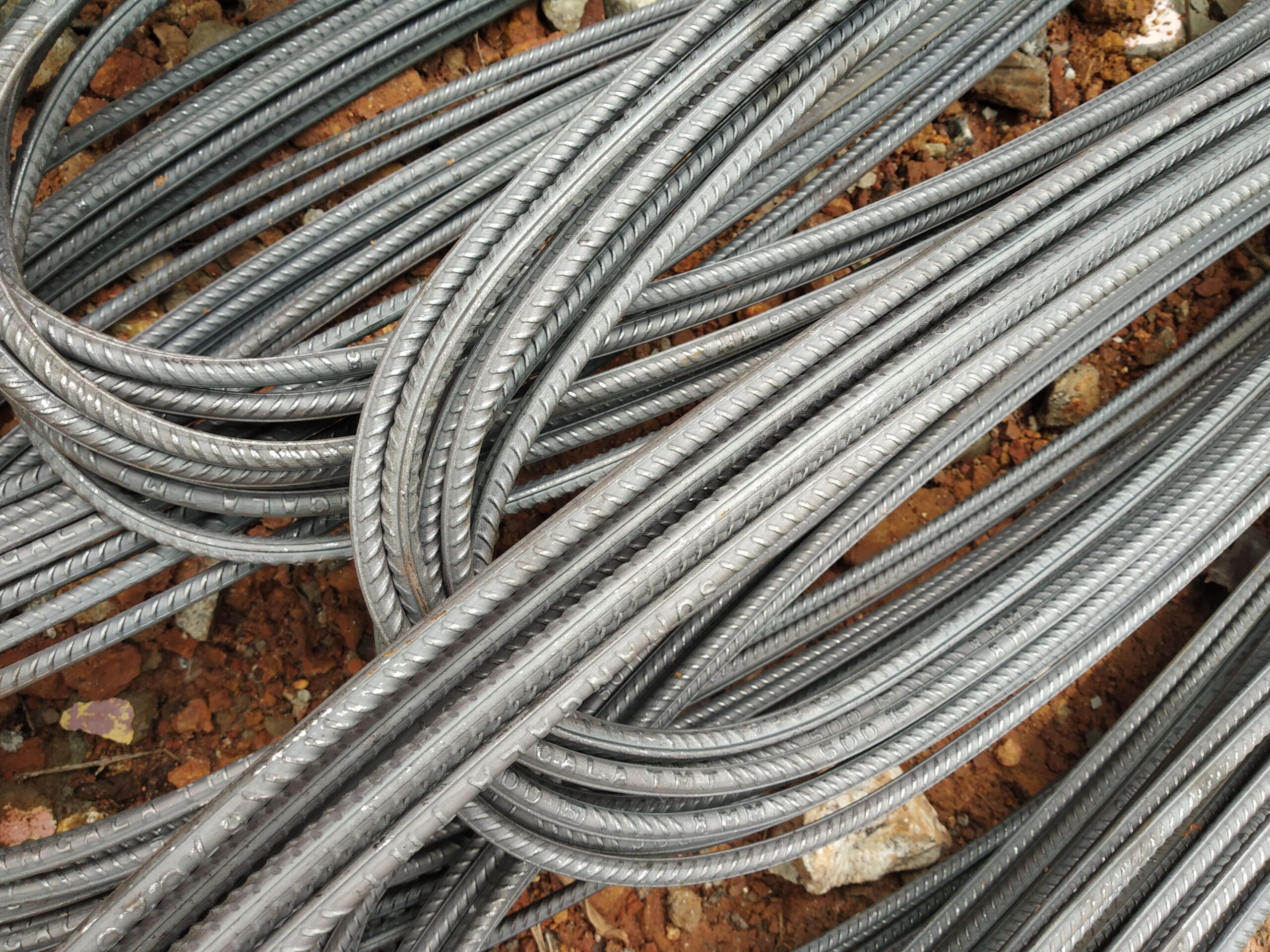
What Size Rebar for a Mat / Raft Slab?
Practical bar-size, spacing, and mat layout guidance for reinforced concrete mat and raft foundations — using B500B rebar to DIN 488 / EN 10080. Indicative figures only; confirm with a structural engineer.
What Is a Mat / Raft Slab and Why Is Rebar Layout Critical?
A mat foundation (also called a raft slab) is a continuous reinforced concrete slab that covers the entire footprint of a structure and transfers loads from columns, walls, or bearing frames to the soil below. Unlike discrete footings, a mat distributes loads over a large area — making it the foundation of choice for soft soils, heavy column loads, or structures where differential settlement must be minimised.
Because a mat slab acts as an inverted flat plate loaded upward by soil pressure and downward by column loads, it experiences both positive and negative bending moments across its area. Correct rebar sizing and mat layout — top and bottom mats in two orthogonal directions — is essential to structural performance.
B500B (hot-rolled, 500 MPa min yield, Agt ≥ 5.0%, k ≥ 1.08 per DIN 488 / EN 10080) is the standard reinforcing grade for mat slabs in Germany and the EU. All figures in this guide are indicative and intended for preliminary estimation only. A licensed structural engineer must perform the full design.
Typical Rebar Sizes for Mat / Raft Slabs
Mat slab reinforcement is usually supplied as individual bars forming an orthogonal grid (or as welded reinforcing mesh to DIN 488-4 for thinner mats). Typical bar sizes:
| Application | Slab Thickness | Typical Bar Dia. | Typical Bar Spacing |
|---|---|---|---|
| Residential raft (light loads) | 250–350 mm | 12–16 mm | 150–200 mm both directions |
| Commercial mat (medium column loads) | 350–600 mm | 16–20 mm | 150–200 mm both directions |
| Industrial / heavy-column mat | 600–1200 mm | 20–25 mm | 125–175 mm both directions |
| High-rise core / transfer mat | 1000–3000 mm | 25–32 mm | 100–150 mm, multiple layers |
Bar Properties and Mat Layout Reference
The standard weight formula is kg/m = d²(mm) × 0.00617. Key diameters for mat slabs:
| Diameter (mm) | Weight (kg/m) | Cross-section (mm²) | Bars/m² at 150 mm spacing |
|---|---|---|---|
| 12 | 0.888 | 113 | 6.67 bars → 752 mm²/m |
| 16 | 1.58 | 201 | 6.67 bars → 1,340 mm²/m |
| 20 | 2.47 | 314 | 6.67 bars → 2,093 mm²/m |
| 25 | 3.85 | 491 | 6.67 bars → 3,273 mm²/m |
Minimum Steel Ratios and Cover
Eurocode 2 requires a minimum flexural steel ratio for slabs of approximately:
- As,min = 0.26 × (fctm / fyk) × b × d, but ≥ 0.0013 × b × d
- For C25/30 concrete (fctm = 2.6 MPa) and B500B (fyk = 500 MPa), this gives approximately 0.00135 × b × d per face per direction
- For a 400 mm thick mat (d ≈ 355 mm): As,min ≈ 0.00135 × 1000 × 355 ≈ 479 mm²/m — satisfied by ø12 @ 200 mm (565 mm²/m)
Nominal cover for mat slabs cast on blinding concrete (XC2 exposure) is typically 40 mm. Cast directly against the ground (XC3/XC4): 50–75 mm. Cover is measured to the bottom mat outer bar.
Mesh vs. Individual Bars in Mat Slabs
For thinner residential raft slabs (250–350 mm), factory-welded reinforcing mesh to DIN 488-4 is commonly used. Mesh panels (standard size 6.0 × 2.3 m, Q or R types) offer faster placement and consistent spacing. For heavier commercial and industrial mats, individually placed B500B bars are preferred because bar size, spacing, and lap locations can be precisely matched to the design bending-moment diagram.
Steel Rebar Germany supplies both DIN 488 welded mesh panels and B500B straight bars in diameters from 8–40 mm, in 6–12 m stock lengths or cut-to-length.
Indicative Material Estimate (Preliminary Only)
Consider a 10 m × 12 m residential raft slab, 300 mm thick, ø12 @ 175 mm in both directions, top and bottom mat:
- Bars per metre (both directions) = 1000 / 175 ≈ 5.71 bars/m
- Area of steel per face per direction = 5.71 × 113 mm² ≈ 645 mm²/m (satisfies minimum)
- Total bar length (bottom X-direction): 12 m span × (10/0.175 + 1) ≈ 12 × 58 ≈ 696 m
- Total bar length (bottom Y-direction): 10 m span × (12/0.175 + 1) ≈ 10 × 70 ≈ 700 m
- Repeat for top mat: approximately 2 × (696 + 700) ≈ 2,792 m total ø12 bar
- Weight: 2,792 m × 0.888 kg/m ≈ 2,479 kg (indicative, excluding lap lengths and anchorage)
For projects using mechanical couplers to eliminate laps in thick mat slabs, or DBV spacers to maintain cover, contact us for a coordinated package quote.
Frequently Asked Questions — Rebar for Mat / Raft Slabs
What is the difference between a mat slab and a raft foundation?
Should I use mesh or individual bars for a mat slab?
How much concrete cover do I need under a mat slab?
Can I use B500A mesh in a mat slab?
Does Steel Rebar Germany supply rebar for large mat slab projects internationally?
Source German-standard rebar with full export documentation
Tell us your mat slab specification, destination port, and required standards — we’ll respond with a detailed quotation including MTC and CE documentation.