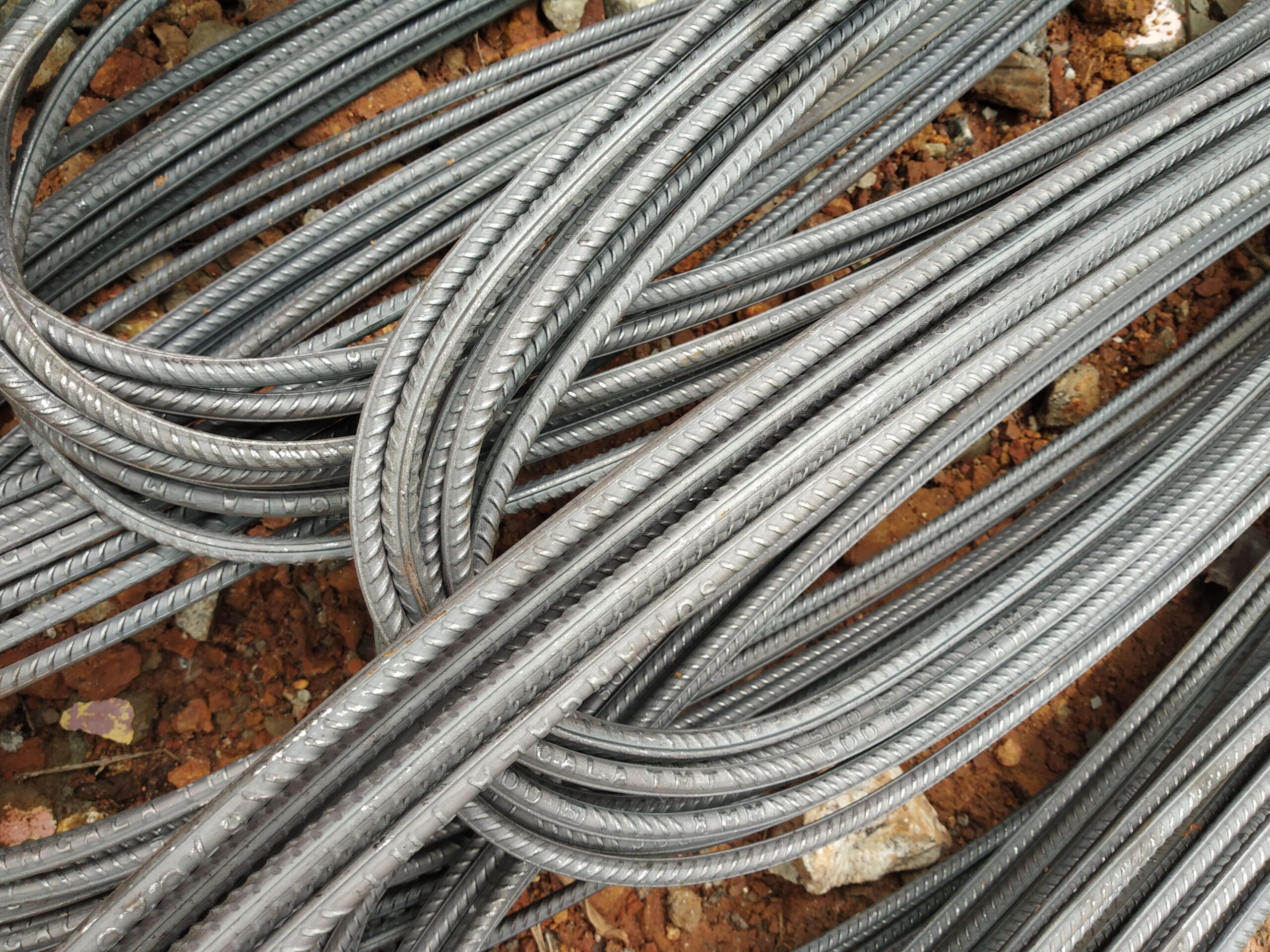
Rebar vs Post-Tensioning: Choosing the Right Concrete Reinforcement System
A technical B2B comparison of passive deformed rebar (B500B) and active post-tensioning — covering structural performance, ductility, durability, cost and the project types where each system delivers the best value.
Passive vs Active Reinforcement: The Core Distinction
Reinforced concrete structures can be strengthened by two fundamentally different mechanisms. Passive reinforcement — deformed rebar (B500B per DIN 488 / EN 10080) — is placed within the formwork before casting and relies on bond to the hardened concrete to resist tensile forces that develop under applied loads. The steel is stressed passively, only as the structure deflects.
Post-tensioning (PT) uses high-strength steel strands or bars (typically 1570–1860 MPa ultimate strength) threaded through ducts cast into the concrete. After the concrete achieves sufficient strength, the tendons are stressed by hydraulic jacks and anchored, actively compressing the concrete and pre-counteracting anticipated tensile loads.
In practice, most post-tensioned structures also contain conventional passive rebar — for confinement, shear reinforcement, edge ties and local detailing — so the two systems are complementary rather than mutually exclusive. The strategic choice is which system forms the primary tensile reinforcement for each structural element.
Side-by-Side Technical Comparison
Key parameters for structural engineers and procurement teams.
| Parameter | Passive Rebar (B500B) | Post-Tensioning (bonded/unbonded) |
|---|---|---|
| Steel grade / strength | 500 MPa yield (B500B) | 1570–1860 MPa (tendons) |
| How it works | Passive — stressed by deflection | Active — pre-stressed before live load |
| Ductility class | High (B500B: Agt ≥ 5.0 %) | Lower post-yield elongation (~3.5 %) |
| Crack control | Good — engineer-specified spacing | Excellent — concrete kept in compression |
| Span capability | Moderate (beams typically ≤ 12 m) | Long spans (20–40 m+ in flat slabs) |
| Slab thickness | Standard (depth ≈ span/20–25) | Reduced (depth ≈ span/35–45) |
| Construction complexity | Low — standard rebar placing skills | High — specialist tendon, stressing, grouting |
| Maintenance / inspection | Simple — inspectable, patchable | Complex — grouting failures risk corrosion |
| Export / supply chain | Straightforward bundles, DIN 488 docs | Specialist supply; tendons + anchorages |
| Seismic ductility | Excellent (B500B/B500C) | Limited — PT not preferred in high seismicity |
Strength and Ductility in Practice
Rebar’s B500B ductility (k ≥ 1.08, Agt ≥ 5.0 %) is a safety-critical property in seismic and impact scenarios: it allows the structure to undergo significant deformation and dissipate energy before fracture. Post-tensioning tendons, while far stronger in ultimate tensile strength (1860 MPa vs 500 MPa yield for rebar), have limited post-yield elongation and are typically loaded to 70–80 % of their characteristic tensile strength during stressing. Eurocode 8 (seismic design) generally requires conventional passive ductile rebar for primary energy-dissipating elements — PT systems are used mainly in low-to-moderate seismicity regions.
For long-span flat slabs in commercial buildings, PT reduces concrete volume (thinner slabs), controls deflections and eliminates unsightly cracking — clear wins over rebar-only design. For multi-storey frames, transfer beams or bridge girders, PT enables spans that would be uneconomical or impractical with passive reinforcement alone.
Durability and Long-Term Maintenance
Passive rebar encased in adequately covered, dense concrete offers excellent long-term durability. Repairs are straightforward — crack injection, concrete patching or bar replacement are well-understood techniques globally. Post-tensioned structures can be more vulnerable if grouting of bonded ducts is incomplete, as moisture intrusion can cause tendon corrosion that is difficult to detect and costly to repair. Unbonded PT (monostrand in PE sheath) eliminates duct-grouting risk but creates a single-tendon failure mode if the sheath is breached. For projects in aggressive environments (coastal, tropical), passive rebar’s repairability is a significant operational advantage.
Where Each System Wins
Passive rebar (B500B) is the preferred choice for:
- Columns, shear walls and cores — confinement, ductility and constructability
- Foundations, pile caps and basement walls — no stressing access required
- Seismic moment-resisting frames (DCM/DCH) — mandatory ductility requirements
- Short-to-medium spans (≤ 12 m) where PT adds complexity without offsetting benefit
- Export projects in regions with limited PT specialist contractors on site
Post-tensioning is preferred for:
- Long-span flat slabs in offices, car parks and retail structures (20–35 m spans)
- Bridge decks and viaducts with continuous girder action
- Transfer beams carrying heavy column loads over large openings
- Structures where reduced self-weight is critical (roof loads, soil conditions)
See also our articles on rebar vs structural steel sections and our B500B rebar product page for full dimensional and mechanical data.
Frequently Asked Questions
Does post-tensioning eliminate the need for conventional rebar entirely?
Why is conventional rebar preferred in seismic zones over post-tensioning?
Can I supply both rebar and PT tendons from Steel Rebar Germany?
What documentation does passive rebar require for an export project?
What rebar diameters are typically used alongside post-tensioned slabs?
Source German-standard rebar with full export documentation
Tell us your specification and destination port — we’ll respond with a detailed quotation for passive reinforcing steel to DIN 488 / EN 10080.