Rebar vs Welded Wire Mesh: Which Reinforcement Is Right for Your Project?
A technical side-by-side comparison of deformed reinforcing bar (B500B) and welded wire mesh (B500A/B500B) — covering strength, ductility, durability, installation speed and cost so you can specify correctly for every concrete element.
Understanding the Two Products
Reinforced concrete structures rely on either deformed rebar (ribbed bars, typically B500B under DIN 488) or welded wire mesh (WWM, factory-welded grids of B500A or B500B wire, per DIN 488-4) — and often both within the same project. Understanding where each excels prevents over-specification, reduces waste and speeds on-site execution.
Rebar (deformed bar) is hot-rolled in diameters from 8 mm to 40 mm and delivered in straight lengths of 6–18 m (commonly 12 m) or as cut-and-bent cages. Its high ductility grade B500B guarantees a characteristic yield strength of 500 MPa, a hardening ratio k ≥ 1.08 and a uniform elongation Agt ≥ 5.0 % — essential where seismic or impact ductility is required.
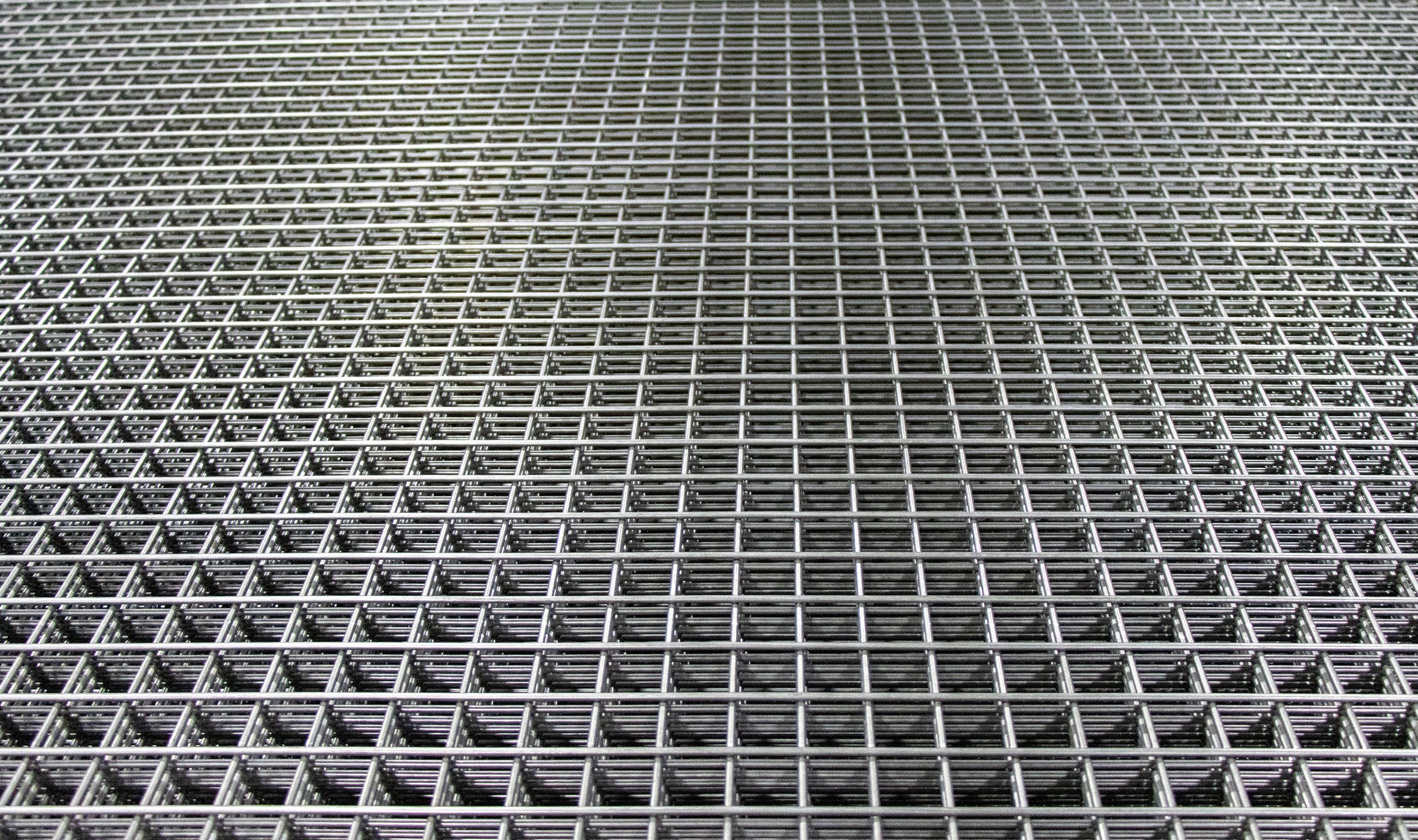
Welded wire mesh (Baustahlgewebe / BSG) is manufactured from cold-drawn or hot-rolled wire, typically B500A (Agt ≥ 2.5 %, k ≥ 1.05), in standard panels of 6.0 × 2.3 m or bespoke dimensions. The factory-welded intersections transfer force at every cross-point without relying on bar overlap, making mesh highly efficient for slabs, walls and pavements where reinforcement is distributed uniformly.
Head-to-Head Comparison: Rebar vs Welded Wire Mesh
Key technical and practical parameters side by side.
| Parameter | Deformed Rebar (B500B) | Welded Wire Mesh (B500A/B500B) |
|---|---|---|
| Yield strength (characteristic) | 500 MPa | 500 MPa |
| Ductility class | B (Agt ≥ 5.0 %, k ≥ 1.08) | A (Agt ≥ 2.5 %, k ≥ 1.05) or B |
| Standard | DIN 488-1/-2, EN 10080 | DIN 488-4, EN 10080 |
| Typical diameters | 8–40 mm | 4–16 mm wire |
| Lap splice length | Calculated per Eurocode 2 | Fixed overlap (typically 1 mesh spacing) |
| Installation speed | Moderate (bar-by-bar placement) | Fast (full panel in one lift) |
| Crack control | Good (engineer-specified spacing) | Excellent (close, uniform grid) |
| Seismic/impact ductility | Excellent (B500B, B500C) | Limited (B500A normal ductility) |
| Bending/shaping on site | Yes — stirrups, bends, hooks | No — flat panels only |
| Export packing | Bundles ~2 t, sea-worthy | Stacked panels, sea-worthy bundles |
Strength and Ductility in Depth
Both products share the same nominal yield strength of 500 MPa. The meaningful difference lies in post-yield behaviour. B500B rebar achieves Agt ≥ 5.0 % uniform elongation and k ≥ 1.08 hardening ratio, which Eurocode 2 (EN 1992-1-1) requires for structural elements in ductility class DCM/DCH seismic zones. Standard welded wire mesh in grade B500A is limited to Agt ≥ 2.5 %, sufficient for suspended slabs, ground-bearing slabs and walls in low-seismicity regions but not for moment-resisting frames or coupling beams.
Where higher ductility is mandatory, suppliers including Steel Rebar Germany can provide B500B mesh — a less common but available product meeting the same ductility requirements as rebar, typically used in seismic precast wall panels.
Where Each Product Wins
Rebar excels for:
- Columns, beams, pile caps and foundations with complex 3-D cage geometry
- Shear walls and moment frames requiring high ductility (B500B or B500C)
- Large-diameter elements (20–40 mm) carrying heavy concentrated loads
- Cut-and-bend schedules to BS 8666 or DIN 488 shape codes for precise detailing
- Projects where bar diameters and spacing vary significantly across sections
Welded wire mesh excels for:
- Ground-bearing floor slabs, industrial pavements and raft foundations with uniform reinforcement
- Precast concrete walls, filigree slab elements and tunnel linings
- Retaining walls with uniform curtain reinforcement
- Projects prioritising speed — a single-person team can place a 6 × 2.3 m panel in minutes
- Crack-control reinforcement in large concrete pours
Durability and Corrosion Considerations
Plain carbon rebar and standard wire mesh offer equivalent corrosion resistance once encased in adequate concrete cover (minimum cover per EN 1992-1-1, exposure class XC2/XS1 and above). Neither product is inherently more durable than the other in normal environments. For aggressive marine or de-icing-salt environments, specifying epoxy-coated rebar or stainless steel variants applies equally to both categories. In practice, rebar allows greater flexibility for mechanical splicing and adjusting cover, while mesh panels are manufactured to fixed cover-spacer compatibility dimensions.
Cost and Logistics
Per tonne of steel, rebar and mesh are priced within a similar range when sourced from the same mill. The practical cost difference often appears in installed cost: mesh reduces labour hours significantly for large flat areas, while rebar can be more economical for complex geometries where custom panels would generate significant offcut waste. For export shipments, both products pack into 20 ft or 40 ft containers in sea-worthy bundles of approximately 2 tonnes per lift, with full Mill Test Certificates (EN 10204 3.1) and Certificates of Origin available.
Learn more about our reinforcing steel mesh supply, our B500B deformed bar product range, and our export documentation and delivery process.
Frequently Asked Questions
Can welded wire mesh replace rebar in all structural elements?
Is B500A mesh ductility adequate for seismic design?
What standard governs welded wire mesh in Germany?
How are rebar and mesh shipped for export?
Can I order both rebar and mesh on the same shipment?
Source German-standard rebar and mesh with full export documentation
Tell us your specification and destination port — we’ll respond with a detailed quotation covering both deformed bar and welded wire mesh to DIN 488 / EN 10080.