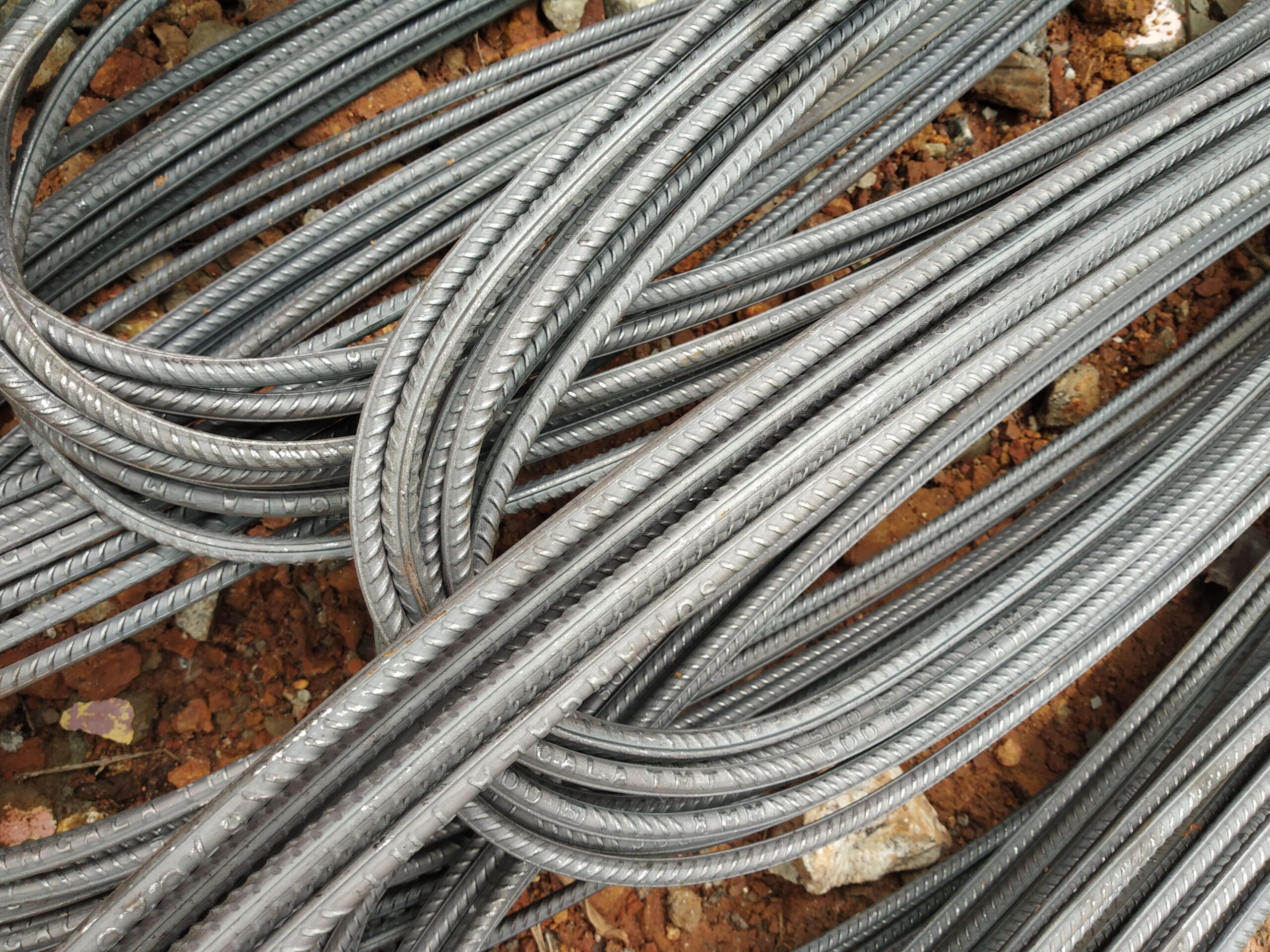
Standard (Parallel-Thread) Rebar Couplers
The everyday full-strength mechanical splice for in-line reinforcing bars — sizes 12–40 mm, developed to exceed bar yield strength, designed under Eurocode 2 and DIN 488.
What Is a Standard Parallel-Thread Rebar Coupler?
A standard rebar coupler — also called an inline coupler or parallel-thread coupler — is a cylindrical sleeve machined with parallel internal threads on both ends. Both bar ends are cold-rolled or cut-threaded to matching parallel threads, then torqued into the sleeve from opposite sides until the shoulders are flush. The result is a continuous splice that develops the full tensile and compressive capacity of the bar, with no reliance on concrete bond over a lap length.
Standard (parallel-thread) couplers are the most commonly specified coupler type in European reinforced concrete construction. They are ideal wherever both bars can be rotated freely during assembly — for instance, in column-to-column lap zones, wall starter bars, and foundation pile cages. For situations where bar rotation is not possible, see our Position Coupler range.
Size Range and Structural Performance
We supply standard parallel-thread couplers covering the full diameter range used in structural concrete work:
| Bar Dia (mm) | Bar Weight (kg/m) | Cross-Section (mm²) | Min Tensile Capacity (kN)* |
|---|---|---|---|
| 12 | 0.888 | 113 | ≥ 56.5 |
| 16 | 1.58 | 201 | ≥ 100.5 |
| 20 | 2.47 | 314 | ≥ 157 |
| 25 | 3.85 | 491 | ≥ 245.5 |
| 28 | 4.83 | 616 | ≥ 308 |
| 32 | 6.31 | 804 | ≥ 402 |
| 40 | 9.86 | 1257 | ≥ 628.5 |
*Indicative values based on B500B grade at 500 MPa yield; actual coupler test certificates state characteristic tensile strength. Always verify with the supplied Mill Test Certificate and coupler qualification test report.
Design Standard Compliance
Standard parallel-thread couplers for European structural applications must be demonstrated to satisfy the splice performance requirements of EN 1992-1-1 (Eurocode 2), which governs the design of reinforced and prestressed concrete structures. Under Eurocode 2, a mechanical coupler must develop at least the specified characteristic tensile strength of the bar being spliced, with defined limits on slip and elongation at failure.
The rebar itself conforms to DIN 488 (the German national reinforcing steel standard) and EN 10080 (European harmonised standard for steel for reinforcement). Our B500B bars carry characteristic yield strength fyk = 500 MPa, ductility class B (k ≥ 1.08, Agt ≥ 5.0%). Mill Test Certificates are issued to EN 10204 Type 3.1 by the producing mill’s inspector.
Advantages Over Lap Splices
- No lap length required — couplers reduce congestion in dense reinforcement zones by eliminating the 30–60 bar-diameter overlap common in lap splices.
- Reduced steel tonnage — shorter reinforcement cuts lower material weight and transport cost.
- Smaller concrete sections — eliminates the need to increase member width to accommodate double layers of lapping bars.
- Faster installation — threaded assembly is quick and does not require specialist welding (cf. weldable couplers) or additional equipment.
- Fully reversible joint — bars can be unscrewed for element repositioning before final pour, enabling phased construction without bar loss.
For a detailed technical comparison, see our guide on Mechanical Couplers vs. Lap Splice.
Related Coupler Types
Choose the right coupler for your site constraint
Position (Positional) Couplers
For fixed cages or congested zones where neither bar can be rotated. One half pre-fitted at the factory; the second bar screws in from one direction only.
Learn more →Transition / Reducer Couplers
Splice two bars of different diameters — commonly used at curtailment zones where the design load reduces.
Learn more →End-Anchor Couplers
Headed mechanical anchorage replacing a standard hook or 90° bend — reduces congestion at pile caps and corbels.
Learn more →Frequently Asked Questions — Standard Rebar Couplers
What is the difference between a parallel-thread and a taper-thread coupler?
Can standard couplers be used for seismic zones requiring B500C ductility?
What documentation do you supply with coupler orders?
How are the bars threaded — at the factory or on site?
Are standard couplers compatible with any rebar supplier’s bars?
Source German-standard rebar with full export documentation
Tell us your bar diameter, coupler type, quantity, and destination port — we’ll respond with a detailed quotation including Mill Test Certificate and export paperwork.