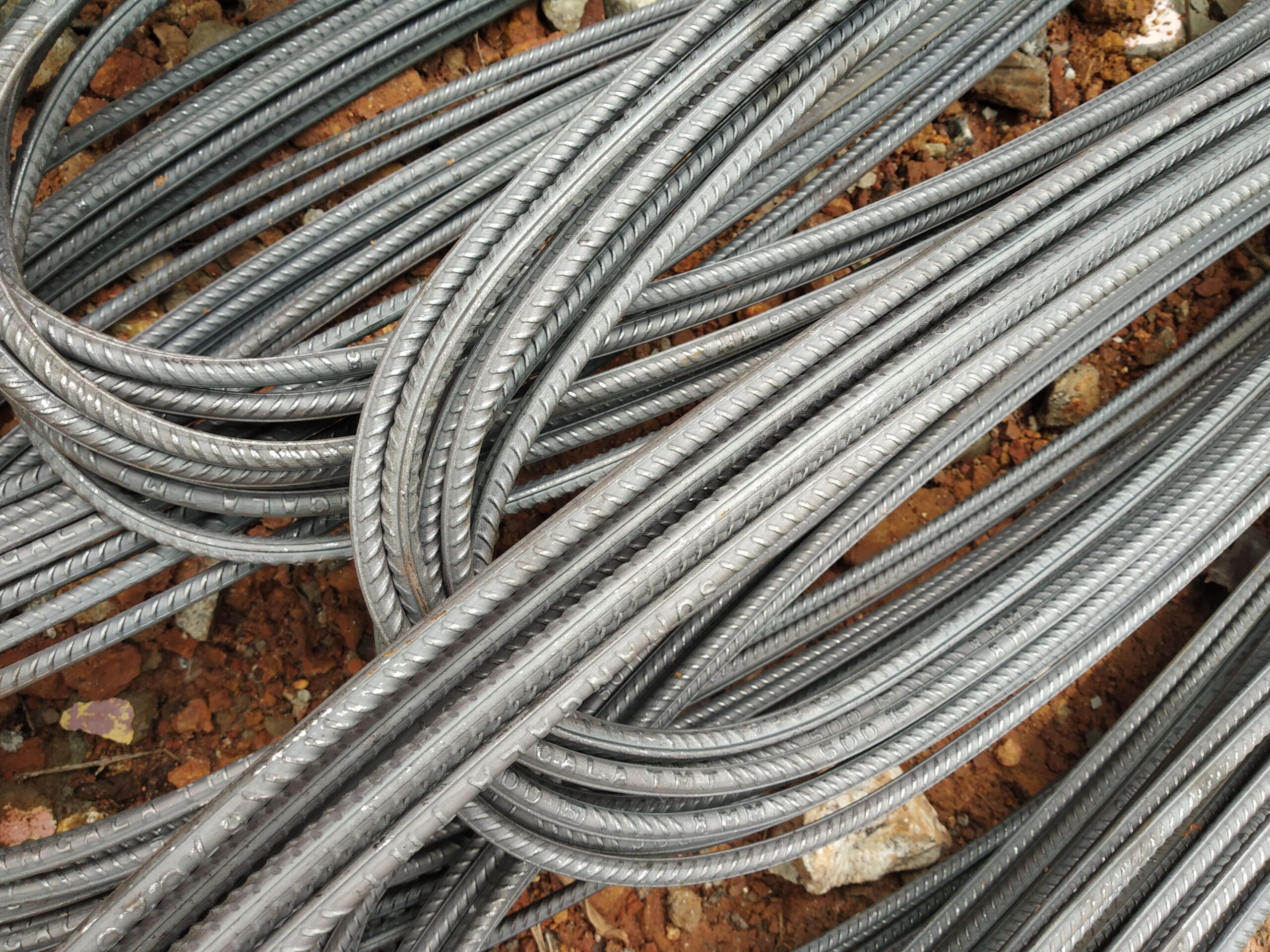
End-Anchor Rebar Couplers
A headed mechanical anchorage that replaces the traditional hook or 90° bend at a rebar end — sizes 12–40 mm, eliminates congestion at pile caps, corbels, and slab edges, fully compliant with Eurocode 2.
What Is an End-Anchor Rebar Coupler?
An end-anchor coupler — also known as a headed anchor, threaded head anchor, or mechanical end anchorage — is a device threaded onto the end of a reinforcing bar to provide a bearing plate or forged head that resists the bar’s tensile force by direct bearing against the concrete, rather than by bond over a development length or by the geometry of a traditional hook.
In conventional reinforcement detailing, the designer uses a standard hook (180° bend) or a 90° bend to develop the required anchorage force at bar ends in pile caps, corbels, beam-column joints, slab edge zones, and similar locations. These bends require a specific bend radius (typically 4d for B500B) and a straight tail length, consuming considerable concrete volume and creating crowded bar arrangements — particularly problematic at pile cap corners where multiple bar layers converge.
An end-anchor coupler eliminates the hook entirely. The bar is cut square, the end is threaded, and the anchor head — a forged steel washer or plate — is screwed on flush. The head diameter is typically 3–4 times the bar diameter, providing a bearing area sufficient to develop the bar’s anchorage force over a very short distance. This reduces required concrete section depth, clears congestion, and simplifies cage fabrication.
Primary Applications
- Pile caps — pile cage bars terminate at the underside of the pile cap; end-anchor heads replace the traditional 180° bend, reducing cap depth by up to 80–100 mm on heavily loaded piles and eliminating the complex hook geometry in a congested four-pile or six-pile cap arrangement.
- Corbels and brackets — horizontal tension bars in short corbels must be anchored within a very short element; end-anchors allow full development in the restricted space.
- Transfer beams and deep beams — high shear zones where stirrup and tension bar anchorage requirements create severely congested reinforcement; end-anchors on longitudinal bars free up space for stirrups.
- Slab edge and opening details — trimmer bars at large slab openings and edge beam tension bars where cover requirements restrict the bend geometry.
- Seismic beam-column joints — in earthquake-resistant frames (Eurocode 8 DCM/DCH), beam bars must develop full tensile strength within the joint; end-anchors can replace standard hooks and significantly reduce joint depth.
Size Range and Indicative Head Dimensions
| Bar Dia (mm) | Cross-Section (mm²) | Weight (kg/m) | Typical Head Dia (mm)* | Head Thickness (mm)* |
|---|---|---|---|---|
| 12 | 113 | 0.888 | ~40 | ~10 |
| 16 | 201 | 1.58 | ~52 | ~13 |
| 20 | 314 | 2.47 | ~64 | ~16 |
| 25 | 491 | 3.85 | ~80 | ~20 |
| 32 | 804 | 6.31 | ~100 | ~25 |
| 40 | 1257 | 9.86 | ~125 | ~30 |
*Head dimensions are indicative; actual dimensions depend on the anchor system and supplier. Confirm exact bearing areas at quotation stage to satisfy Eurocode 2 Annex I anchorage requirements.
Eurocode 2 and DIN 488 Compliance
Eurocode 2 Annex I (Annex I: “Headed bars”) provides guidance on the design of headed reinforcement as an alternative to standard hooks and bends. The key design parameter is the net bearing area of the head (Ah ≥ 10 times the bar cross-sectional area is a common minimum). Our end-anchor systems are sourced from manufacturers who can provide test-based qualification confirming compliance with these bearing requirements and the general performance criteria of EN 1992-1-1. All connected bars are B500B grade per DIN 488 and EN 10080, supplied with Mill Test Certificates to EN 10204 Type 3.1.
Explore the Full Coupler Range
From splice to anchorage — every bar-end detail covered
Standard (Parallel-Thread) Couplers
In-line splice for same-diameter bars — the most common type in European RC construction. Full bar-strength, Eurocode 2 compliant.
Learn more →Position Couplers
For column continuity joints, core walls, and precast connections where the existing cage bars cannot be rotated.
Learn more →Weldable Couplers
Couplers welded to structural steel plates for composite and hybrid steel-concrete connections — full fabrication and export service.
Learn more →Frequently Asked Questions — End-Anchor Rebar Couplers
How much can an end-anchor reduce anchorage length compared to a standard hook?
Are end-anchor heads compatible with high-ductility B500C seismic bars?
Can end-anchor heads be applied in the field, or only at the factory?
Does the head interfere with concrete cover requirements?
What documentation is supplied with end-anchor orders?
Source German-standard rebar with full export documentation
Tell us your bar diameter, anchor configuration, quantities, and destination — we’ll respond with a complete technical and commercial quotation.
