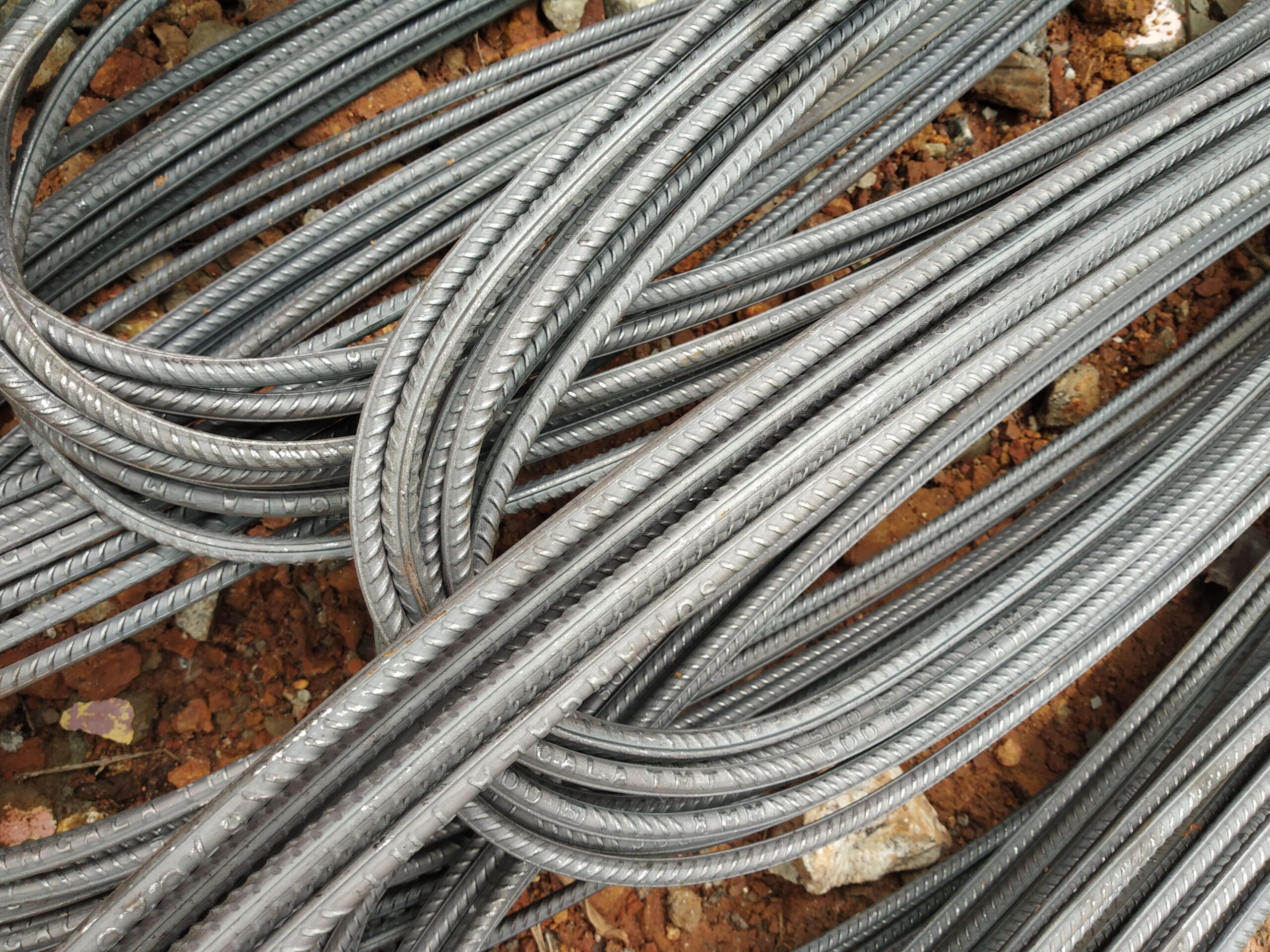
Reinforcing Steel for Lintels: Bar Sizes, Arrangement, and Supply
Lintels span openings in masonry and concrete walls, transferring load around doors, windows, and service penetrations. Correct reinforcement detailing — bar diameter, arrangement, concrete cover, and end anchorage — is essential for structural performance and durability. Steel Rebar Germany supplies B500B bar, mesh, and cut-and-bend lintel reinforcement to DIN 488 and EN 10080.
Structural Role of a Lintel
A lintel is essentially a short-span beam. It picks up the load of the wall (and any floor or roof loads distributed to it) above an opening and transfers that load to the supporting masonry or concrete on each side. Depending on the opening width, wall thickness, and superimposed load, a lintel can be a simple in-situ concrete beam, a precast unit, or a composite masonry-beam system.
In all cases the tensile reinforcement at the soffit, the shear links, and the anchorage at each bearing are the critical details. Under Eurocode 2 (EN 1992-1-1), lintels follow the same flexural and shear design principles as beams.
Typical Bar Sizes and Arrangement
Bar sizing depends on span, loading, and beam depth. The indicative figures below are typical for residential and light-commercial lintels — always design to project-specific calculations.
| Opening Width | Typical Tension Bar | Typical Shear Link | Indicative Bar Weight |
|---|---|---|---|
| Up to 900 mm | 2 × Ø10 mm B500B | Ø6 @ 150 mm | ≈ 0.617 kg/m per bar |
| 900 – 1 500 mm | 2 × Ø12 mm B500B | Ø6 @ 150 mm | ≈ 0.888 kg/m per bar |
| 1 500 – 2 400 mm | 3 × Ø12 or 2 × Ø16 mm B500B | Ø8 @ 150 mm | ≈ 1.58 kg/m per Ø16 bar |
| 2 400 – 3 600 mm | 3 × Ø16 or 2 × Ø20 mm B500B | Ø8 @ 125 mm | ≈ 2.47 kg/m per Ø20 bar |
| Over 3 600 mm | Engineer-designed — typically 2–4 × Ø20–25 mm | Ø10 @ 100–125 mm | ≈ 3.85 kg/m per Ø25 bar |
Concrete Cover Requirements
Concrete cover protects reinforcement from corrosion and provides fire resistance. For lintels, the nominal cover cnom is the sum of the minimum cover cmin and the construction tolerance Δcdev (typically 10 mm under EN 1992-1-1):
- Internal conditions (XC1): cmin,dur = 15 mm → cnom ≈ 25 mm
- External sheltered (XC3/XC4): cmin,dur = 25 mm → cnom ≈ 35 mm
- Exposed / near-coastal (XS1, XD1): cmin,dur ≥ 35 mm → cnom ≈ 45 mm
Spacers and chairs to DBV standard are available through Steel Rebar Germany to maintain correct cover at the soffit and sides of the lintel form.
End Anchorage and Bearing Length
The tension bars at the soffit must be anchored beyond the support centreline. EN 1992-1-1 requires that at simple end supports, at least 25 % of the mid-span tensile reinforcement is carried to the support and anchored with a basic anchorage length lbd. In practice, for lintels in masonry:
- A minimum bearing length of 150 mm on each side is commonly adopted.
- Standard 90° hooks or U-bars at each end achieve anchorage in compact lintel depths.
- For precast lintel systems, the manufacturer’s engineered anchorage details supersede general guidance.
Supply Options from Steel Rebar Germany
Lintel reinforcement can be supplied in several forms depending on project size and site capability:
- Straight bar stock (B500B, dia 8–40 mm, 6–18 m): cut on site to required lengths. Economical for large projects with capable site fabrication.
- Cut-and-bend service: bars cut to length and bent to DIN 488 shape codes (equivalent to BS 8666). Ready-to-place cages reduce site labour and waste. Suitable for any project scale.
- Welded mesh (B500A): for lintels with a wide, shallow beam cross-section where a mesh panel can be used as the reinforcement cage.
- B500A coil-fed stirrups: shear links produced from B500A coil on automated machines — cost-effective for high quantities of identical link sizes.
See our cut-and-bend service and B500B bar product pages for full specification details.
Export Packaging for Lintel Reinforcement
Cut-and-bend lintel cages and straight bar bundles are packed in seaworthy bundles suitable for container loading. Each bundle is labelled by diameter, heat number, and cut/bend schedule reference. EN 10204 3.1 Mill Test Certificates are issued per heat, with traceability through to the finished bar. Consignments are typically consolidated into 20 ft or 40 ft containers for export, with a full packing list and Certificate of Origin for customs clearance in the destination country.
Frequently Asked Questions
Common questions about reinforcing steel for lintel applications.
What grade of rebar is standard for lintels?
How is the correct bar diameter for a lintel determined?
Can you supply pre-bent lintel cages ready to place?
What is the minimum bearing length for a lintel on masonry?
Do you supply spacers and chairs to maintain cover in lintels?
Source German-standard rebar with full export documentation
Tell us your specification and destination port — we’ll respond with a detailed quotation.