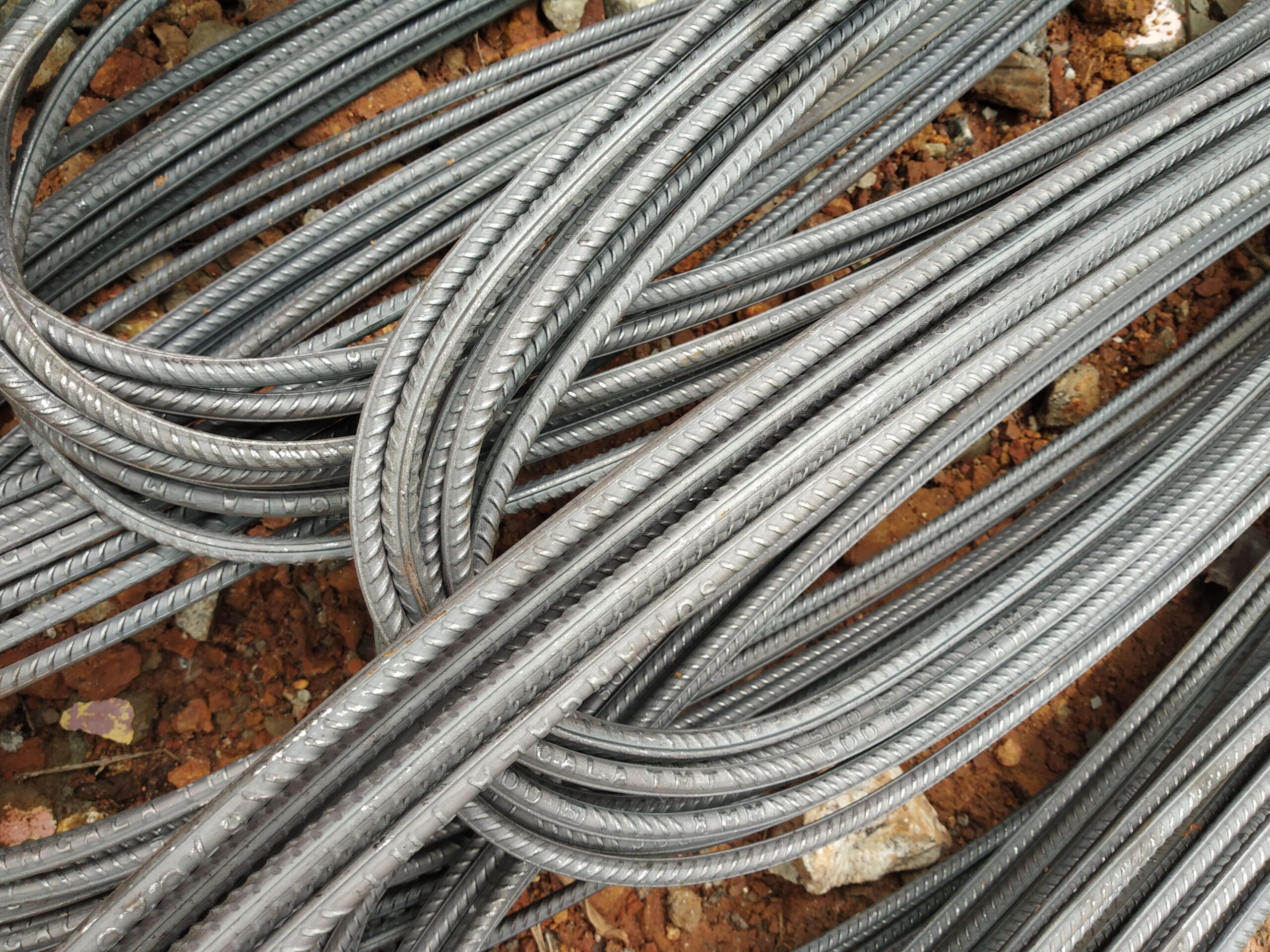
Reinforcing Steel for Ramps — DIN 488 / EN 10080 Supply
Reinforcing steel for ramps demands careful detailing: correct bar sizes, appropriate arrangement, adequate concrete cover, and compliance with DIN 488 and EN 10080. Steel Rebar Germany supplies B500B bars, reinforcing mesh, and cut-and-bend elements for ramp structures worldwide.
Why Ramp Reinforcement Requires Specialist Detailing
Concrete ramps — whether in multi-storey car parks, loading bays, access roads, or pedestrian infrastructure — are among the most mechanically demanding reinforced concrete elements. They carry combined bending, shear, and in many cases repeated dynamic loading from vehicle traffic. The inclined geometry introduces additional considerations: longitudinal bars must resist thrust forces at supports, transverse bars control cracking across the slope width, and distribution steel prevents temperature and shrinkage cracking in the slab plane.
Compliant detailing to DIN 488 (German reinforcing steel standard) and EN 10080 (European harmonised standard) ensures that the steel supplied meets the mechanical property requirements your structural engineer has specified. The dominant grade used in German and EU ramp construction is B500B: 500 MPa minimum yield strength, high ductility (characteristic strain at maximum force Agt ≥ 5.0 %, ratio k ≥ 1.08), hot-rolled ribbed bar. These ductility properties are critical where ramp structures must accommodate significant deformation under traffic or seismic loading.
Typical Bar Sizes and Arrangement for Ramp Slabs
Indicative figures below are illustrative of common engineering practice; your structural engineer must specify actual diameters and spacings based on project loads, span, and design code calculations.
| Element | Typical dia. (mm) | Weight kg/m | Section mm² | Role |
|---|---|---|---|---|
| Main longitudinal bars | 12–20 | 0.888–2.47 | 113–314 | Bending resistance along slope |
| Transverse distribution bars | 8–12 | 0.395–0.888 | 50.3–113 | Load distribution, crack control |
| Top mesh / anti-crack layer | 6–10 | 0.222–0.617 | 28.3–78.5 | Shrinkage and temperature reinforcement |
| Edge beams / kerb bars | 16–25 | 1.58–3.85 | 201–491 | Longitudinal edge stiffening |
Weight per metre is calculated using the standard formula: kg/m = d²(mm) × 0.00617. These figures are for specification planning; confirm final quantities with your structural engineer and project take-off.
Concrete Cover Requirements
Adequate concrete cover is essential to protect reinforcement from carbonation, chloride ingress, and mechanical damage — all heightened risks in ramp environments exposed to deicing salts and traffic wear. Eurocode 2 (EN 1992-1-1) governs cover design in German and EU projects:
- Exposure class XD2/XD3 (cyclic wet/dry with chlorides, e.g. car park ramps): minimum cover cmin typically 40–45 mm for B500B bars, plus construction tolerance Δcdev = 10 mm → nominal cover cnom ≈ 50–55 mm.
- Exposure class XC3/XC4 (moderate to high humidity, outdoor ramps without direct deicing salt): cnom typically 30–40 mm.
- Spacers conforming to DBV guidelines should be specified to maintain nominal cover consistently across the slab.
We supply rebar spacers and accessories suitable for ramp slab applications, including plastic and mortar block chairs for both horizontal and inclined formwork.
Cut-and-Bend Supply for Ramp Elements
Ramp reinforcement rarely uses straight stock bars without modification. Cranked bars at slab supports, bent starter bars at kerb edges, and shaped stirrups for edge beams are standard. Our cut-and-bend service produces elements to DIN 488 shape codes (equivalent to BS 8666 for international projects), including:
- Cranked (bent) main bars for continuity over internal supports
- U-bars and L-bars for edge and kerb reinforcement
- Closed stirrups for edge beams and upstand walls adjacent to ramps
- Spacer bars and link sets for double-layer slab mats
Cut-and-bend elements are bundled by bar mark and labelled for direct placement, reducing on-site labour and material waste.
Mesh vs. Bar Supply for Ramp Slabs
For distribution reinforcement and anti-crack layers, reinforcing mesh (fabric reinforcement to DIN 488-4) can offer significant placement efficiencies on large ramp areas. Standard Q-type mesh panels (square mesh) are commonly used for slab distribution steel; R-type (longitudinal-heavy) panels suit single-span ramp slabs where the principal bending axis is dominant. Bespoke panel sizes are available where standard 6.0 × 2.3 m sheets do not suit the ramp geometry.
For the primary structural layer — particularly where bar diameters exceed 16 mm or bar spacings are project-specific — loose B500B bars placed to drawing remain the standard approach.
Export Documentation and Ordering
All rebar supplied by Steel Rebar Germany is accompanied by the full export documentation package: Mill Test Certificate to EN 10204 3.1 confirming chemical composition and mechanical properties per DIN 488 / EN 10080, Certificate of Origin, CE marking / Declaration of Performance, packing list, and seaworthy bundle specification. Materials are typically bundled in approximately 2-tonne seaworthy bundles suitable for container or break-bulk shipment.
See also: Reinforcing Steel for Foundations & Piling and Reinforcing Steel for Retaining Walls.
Frequently Asked Questions — Ramp Reinforcement
What rebar grade is standard for concrete ramp slabs in Germany?
What concrete cover is required for car park ramp reinforcement?
Can you supply pre-bent cranked bars for ramp continuity reinforcement?
Is reinforcing mesh suitable for ramp slab construction?
What documentation do you provide with ramp reinforcement orders?
Source German-standard rebar with full export documentation
Tell us your ramp reinforcement specification and destination port — we’ll respond with a detailed quotation.