What Size Rebar for Concrete Fence Posts?
Practical B500B bar-diameter, cage layout and cover guidance for precast and in-situ concrete fence posts — with a worked material estimate and DIN 488 / EN 10080 supply information.
Why Concrete Fence Posts Need Rebar
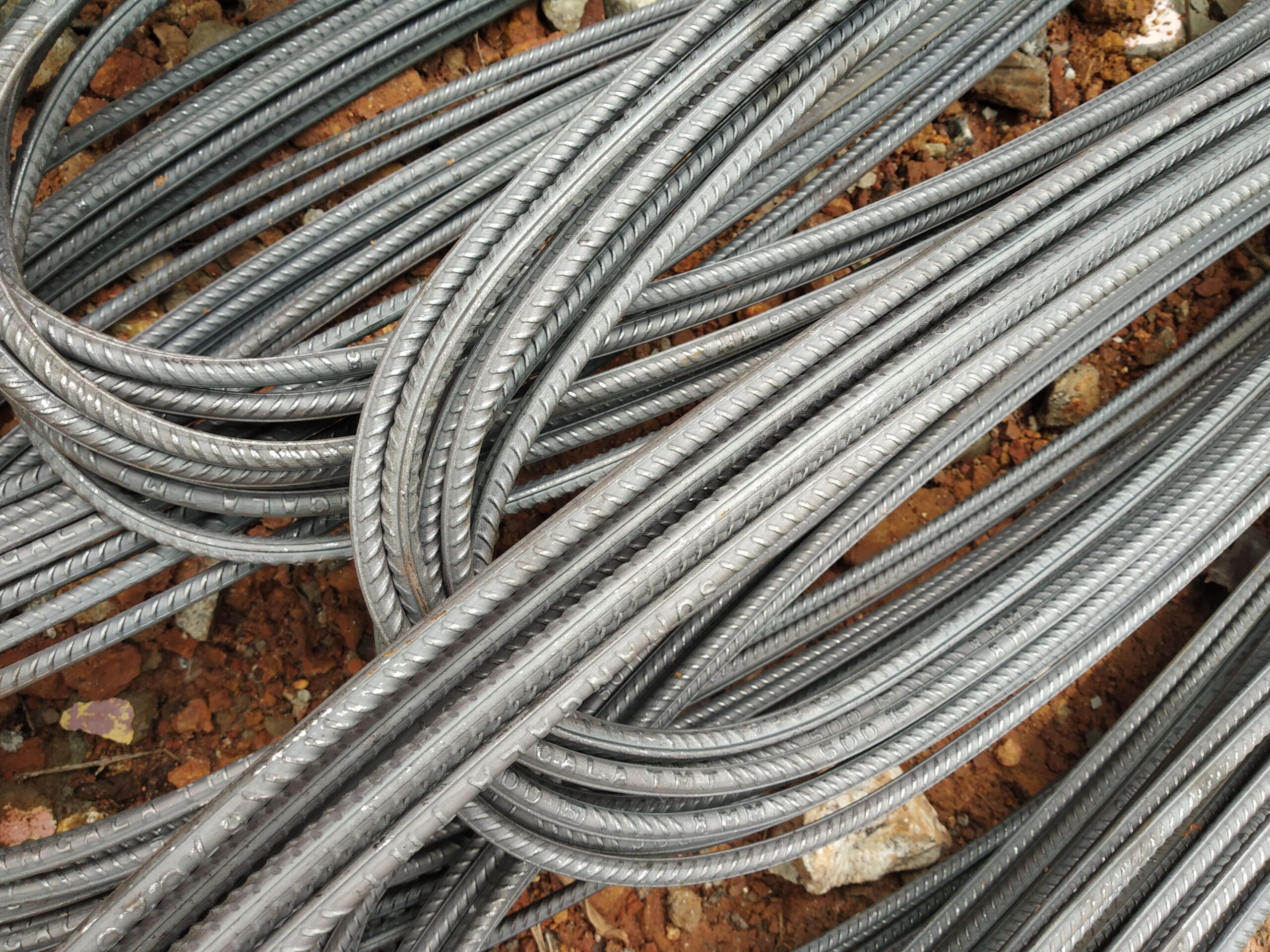
A concrete fence post is a slender, tall member subject primarily to bending — wind pressure on the fence panels acts as a lateral load, creating tension on the windward face and compression on the leeward face. Plain (unreinforced) concrete has very low tensile strength; a post that relies solely on concrete in bending will crack and fail rapidly under wind load. B500B ribbed bars running longitudinally through the post cross-section resist this tensile demand.
Fence posts are manufactured in two ways:
- Precast concrete fence posts: factory-made, typically 100 × 100 mm or 125 × 125 mm cross-section, 1.8–2.4 m long. The reinforcement cage is standard and set during production.
- In-situ concrete posts: formed and cast on-site, or as concrete-filled steel/timber composite posts. Less common but used in bespoke boundary and agricultural fencing.
Typical Rebar for Concrete Fence Posts
General guidance by post type — B500B ribbed bar, standard residential fencing loads.
| Post Type | Cross-section | Longitudinal Bars | Links / Ties | Bar Grade |
|---|---|---|---|---|
| Light garden fence (up to 1.2 m) | 75×75 mm | 4 × Ø6 mm | Ø6 @ 250 mm | B500B |
| Standard domestic fence (1.2–1.8 m) | 100×100 mm | 4 × Ø8 mm | Ø6 @ 200 mm | B500B |
| Boundary / privacy fence (1.8–2.1 m) | 100×100 mm | 4 × Ø10 mm | Ø6–8 @ 200 mm | B500B |
| Heavy fence / gate post (2.1–2.4 m) | 125×125 mm | 4–6 × Ø10–12 mm | Ø8 @ 150–200 mm | B500B |
| Corner / straining post | 125×150 mm+ | 6 × Ø12 mm | Ø8 @ 150 mm | B500B |
Indicative figures. Wind load, panel type and soil conditions determine actual requirements. Engineering design required for high-security and agricultural fencing.
Rebar Layout in a Concrete Fence Post
Longitudinal bars
Four longitudinal bars placed near the corners of the post cross-section is the standard layout for a square precast post. The bars provide bending resistance about both axes. For a 100 × 100 mm post with 20 mm cover, the bar cage is typically 60 × 60 mm (4 corners). Cover of 20–25 mm is standard for precast posts in sheltered conditions; increase to 30 mm for posts exposed to de-icing salt or coastal environments.
Links and stirrups
Rectangular links (ties) hold the longitudinal bars in position during casting and provide a degree of confinement. For small precast posts, Ø6 mm links at 200–250 mm centres are typical. For heavier gate or straining posts, Ø8 mm links at 150 mm centres improve ductility under impact loading.
Embedment depth
A concrete fence post must be embedded deep enough to develop a cantilever moment arm against the wind load. A commonly cited rule of thumb is 1/3 of total post length — so a 2.4 m post should be embedded approximately 600–800 mm. Clay soils with poor bearing capacity or waterlogged ground require deeper embedment or a concrete collar / pad footing at the base.
Concrete cover
Minimum cover for precast fence posts: 20–25 mm in XC1 (dry, interior) to 30–40 mm in XC3/XC4 (outdoor, cyclic wet/dry). Use cover spacers or plastic end caps when assembling the cage before the pour.
Worked Estimate: 20 Precast Posts, 100×100×2400 mm
Indicative material take-off only. Verify against your design drawings.
- Post spec: 100×100 mm cross-section, 2.4 m long, 4 × Ø10 mm longitudinal + Ø6 links @ 200 mm.
- Longitudinal bars per post: 4 × 2.4 m × 0.617 kg/m = 5.92 kg × 20 posts = 118.4 kg
- Links per post: 2400 ÷ 200 = 12 links; perimeter = 4 × (100 − 2×20 mm cover) ≈ 4 × 60 mm = 0.24 m; 12 × 0.24 m × 0.222 kg/m (Ø6) = 0.64 kg × 20 = 12.8 kg
- Add 8 % for laps, tying wire & wastage: ≈ 10.5 kg
- Indicative total: ~142 kg
We supply B500B in 6 m standard lengths which can be gang-cut to your post bar length. Pre-bent links to your exact cage dimensions are available via our cut-and-bend service. See also our deck footing rebar guide for related small-column cage applications.
Frequently Asked Questions
What size rebar is used in concrete fence posts?
How deep should a concrete fence post be set?
What concrete cover is needed for fence post rebar?
Can I use B500A coil wire instead of B500B bars in fence posts?
Can Steel Rebar Germany supply rebar for fence post production?
Source German-standard rebar with full export documentation
Tell us your fence post cage specification and destination port — we’ll respond with a detailed quotation.