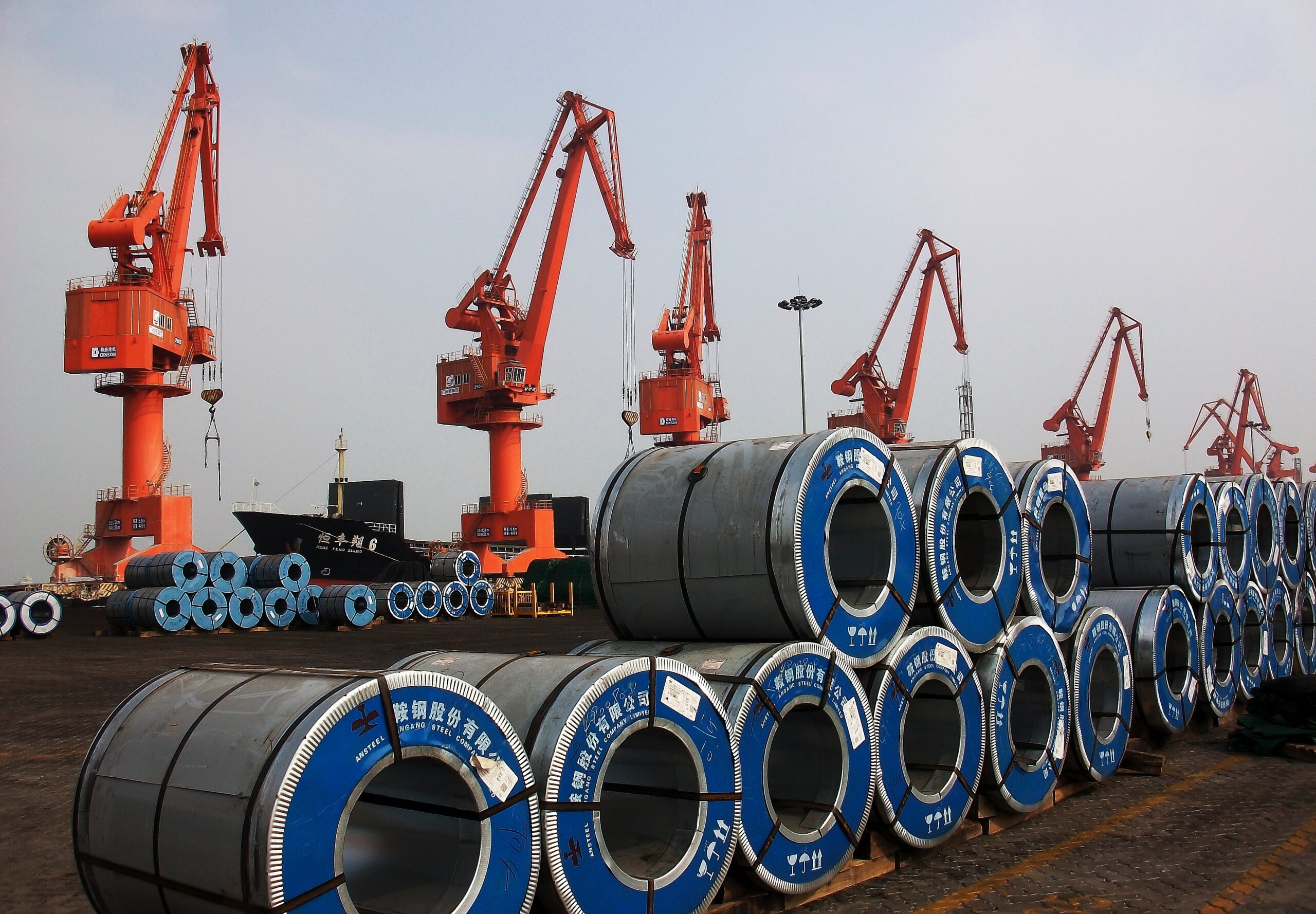
Steel Export Market Kuwait
A wholesale buyer’s view of the Kuwait steel export market — what drives demand, how prices move, where cargo lands at Shuaiba and Shuwaikh, and how to source bulk B500B and Gr60 rebar direct from a German exporter with no middlemen.
Why Kuwait is an active steel import market
Kuwait is a high-income Gulf economy whose appetite for steel is set almost entirely by construction and the oil-and-gas sector. New housing cities, road and bridge programmes, water and power facilities, and a continuous pipeline of public works under the national development plans all consume large volumes of reinforcing bar, structural sections, plate and coil. That makes rebar and long products the backbone of local steel consumption and a recurring line item for contractors, importers and distributors planning bulk orders.
Domestic supply is anchored by electric-arc-furnace production in the Shuaiba Industrial Area, which gives Kuwait meaningful local rebar and billet capacity. Even so, the market stays partly import-dependent for many flat products, special sections, alloy grades and project-specific tonnages that local mills do not roll. For procurement teams, that gap is exactly where an export supplier earns its place — delivering certified TMT steel rebar and complementary products on larger and more specialised builds. Buyers benchmarking the wider region can compare Kuwait against neighbouring markets such as steel in Oman, steel in Qatar and steel in Bahrain, all covered in our steel by country directory.
What moves rebar prices in Kuwait
Steel prices in the Kuwait export market are never set in isolation — they track global benchmarks adjusted for ocean freight, duty and local supply and demand. For wholesale buyers comparing export prices, the drivers worth watching are:
- Rebar: shaped by scrap and billet costs (local EAF output is scrap-fed), regional mill activity, and project demand across the construction and infrastructure cycle.
- Structural sections & plate: more import-exposed, so moves in Turkish, Asian and European mill prices plus freight feed straight into landed cost.
- Flat steel (coil/sheet): tied to global HRC/CRC benchmarks and currency, since most is imported.
Rather than fixate on a single quoted figure, track ranges and direction of travel using independent market intelligence such as SteelOrbis, Fastmarkets and worldsteel, cross-checked against the local trade figures from Kuwait’s Central Statistical Bureau. For a delivered-to-Kuwait number on certified material, request a current quotation rather than relying on spot indices alone — we quote bulk export prices direct, not distributor mark-ups.
Your bulk rebar wholesaler & exporter to Kuwait
Steel Rebar Germany supplies Kuwait importers, contractors and distributors directly — bulk reinforcing steel at export prices, mill-certified, with no middlemen between the mill and your site.
Certified bulk grades
B500B / B500C and ASTM A615 Grade 60 (Gr60) reinforcing bar from 8–40 mm, plus welded mesh, coils and cut-and-bend — each consignment with a 3.1 Mill Test Certificate under EN 10204. See the full rebar products range.
Bulk & break-bulk shipping
Containerised loads and chartered break-bulk vessels into Shuaiba and Shuwaikh, with documentation prepared for clean clearance through the General Administration of Customs.
Export prices, no middlemen
Direct mill-to-site pricing on bulk orders — welded mesh, coils, structural sections and cut-and-bend scheduled to your project. Request a bulk quote →
How steel reaches Kuwait
Imported steel enters Kuwait predominantly by sea through two principal commercial gateways operated by the Kuwait Ports Authority. Shuwaikh Port, near Kuwait City, is the main general-cargo and container terminal and handles a broad mix of project and construction materials. Shuaiba Port, in the south, serves the Shuaiba industrial zone and suits bulk and heavy steel cargoes, while Doha Port takes supplementary regional traffic.
On the supply side, Kuwait draws on a familiar set of origins for Gulf buyers: regional GCC and wider Middle East mills, Turkey, China and other Asian producers, and European suppliers for higher-specification, fully certified material. Cargo from Europe typically routes through the Suez Canal into the Arabian Gulf. Because Kuwait sits inside the GCC customs union, intra-GCC flows and tariff treatment are an important part of any landed-cost calculation — always confirm the current position with customs before committing a bulk order.
Official government & trade data sources
Steel Rebar Germany is a direct wholesale rebar supplier & exporter — bulk B500B/Gr60 to Kuwait at export prices, no middlemen. The organisations below are official government, customs & statistics sources only.
Always verify duties, standards and statistics against primary government sources before committing to a purchase. These Kuwaiti authorities publish the regulations and data that govern steel imports:
- Ministry of Commerce and Industry (MOCI) Regulates commercial and industrial activity, import licensing and trade policy. moci.gov.kw/en
- General Administration of Customs Customs tariffs, clearance procedures and the automated customs system for imports. customs.gov.kw
- Central Statistical Bureau (CSB) Kuwait’s national statistics office — foreign trade, industry and economic data. csb.gov.kw
- Kuwait Ports Authority (KPA) Operates Shuwaikh, Shuaiba and Doha ports — vessel, container and tariff information. kpa.gov.kw
- Public Authority for Industry (PAI / KOWSMD) Industrial development plus Kuwait’s standards, metrology and conformity services. pai.gov.kw
- Central Bank of Kuwait (CBK) Macroeconomic and statistical bulletins useful for cost, FX and demand context. cbk.gov.kw/en
For a fuller country profile, see our dedicated Kuwait steel suppliers guide.
Kuwait bulk steel export — frequently asked questions
What is the minimum order quantity (MOQ) for export to Kuwait?
What is the typical lead time to Kuwait’s main port?
How is bulk pricing set for export orders?
Request a bulk quote for Kuwait
Tell us your grades, diameters, tonnage and delivery port — we will return a certified, delivered-to-Kuwait export quotation.