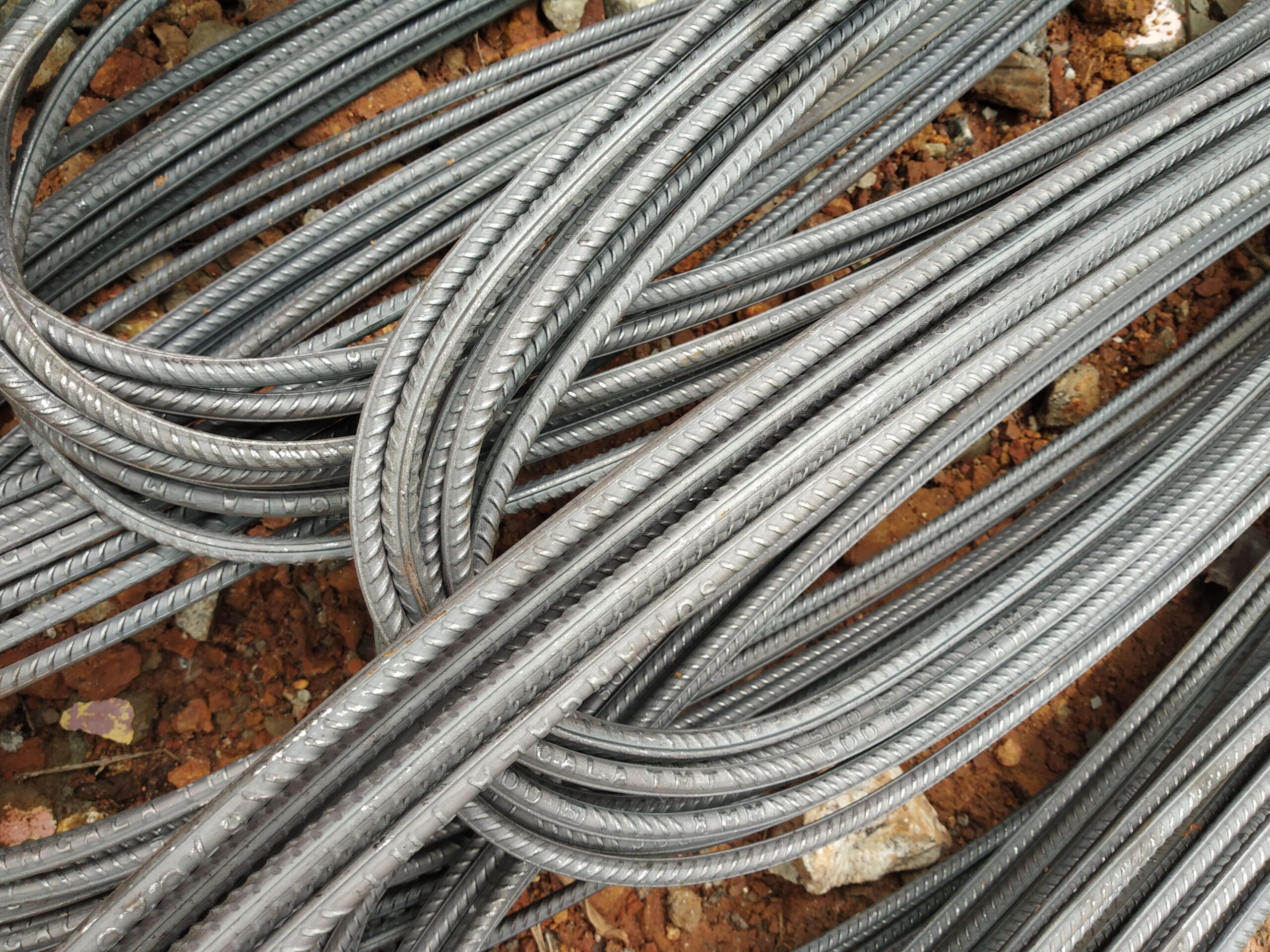
40mm Rebar: Typical Uses & Where It Is Specified
A technical guide to the structural applications that call for 40 mm B500B deformed rebar — the largest diameter in common structural use — covering the elements, design rationale, and specification standards under DIN 488 and EN 10080.
40mm Rebar in the Diameter Hierarchy
The standard reinforcing bar range runs from 6 mm to 40 mm. The 40 mm diameter is the apex — the largest bar routinely produced to EN 10080 and DIN 488 for general structural reinforced concrete work. Its cross-sectional area is 1,256.6 mm² and its unit weight is 9.872 kg/m, making a 12-metre bar approximately 118.5 kg. That weight means mechanical handling equipment is not optional on site — it is an engineering requirement.
Because of its size and handling demands, 40 mm rebar is not specified as a general-purpose bar. It is reserved for elements where the structural force demand is so high that smaller diameters would require an impractical number of bars, create severe congestion, or compromise constructability. When 40 mm is on a bar schedule, it signals a heavily loaded structural element where section area efficiency is the governing design consideration.
Primary Structural Applications for 40mm Rebar
Heavily Loaded Columns in High-Rise Construction
The most common home for 40 mm bars is the vertical reinforcement of large columns in the lower levels of tall or supertall buildings. As floors accumulate above, the cumulative axial load arriving at ground-level and basement columns can be enormous. A structural engineer targeting a specific reinforcement ratio in a column of 600–900 mm dimension will find that 40 mm bars at wide centres achieve the required steel area with far less bar congestion than an equivalent number of smaller-diameter bars. B500B grade provides the 500 MPa minimum characteristic yield strength together with the high-ductility classification (k ≥ 1.08, Agt ≥ 5.0%) required under Eurocode 2 for ductility classes DCM and DCH — critical in seismic zones.
Major Transfer Beams and Transfer Slabs
Transfer structures carry column or wall loads over an open podium storey — a configuration common in mixed-use towers, hotels, and hospitals where the upper residential grid does not align with the lower commercial grid. The tension zone of a transfer beam can require steel areas in the range of 10,000–20,000 mm² or more. Specifying 40 mm bars, often combined with mechanical couplers to eliminate lap splices within the beam depth, is one of the few practical ways to deliver that steel area within the available concrete section. Parallel-thread or taper-thread couplers for 40 mm bars eliminate laps that could otherwise run to 2 metres or more, saving concrete volume and avoiding bar congestion at connection zones.
Large Pile Caps and Deep Raft Foundations
Pile caps for large-diameter bored piles — particularly in high-rise foundations or bridge abutments — develop very large tension tie forces. The bottom mat reinforcement in both orthogonal directions is frequently specified as 40 mm at 150–200 mm centres, delivering section areas that match the strut-and-tie force diagram without requiring multiple reinforcement layers. Deep raft foundations under supertall towers show the same pattern: the structural engineer’s target reinforcement ratio resolves to a bar diameter and spacing that naturally lands on 40 mm when section areas are very large.
Bridge Piers, Abutments, and Caissons
In heavy civil infrastructure — highway bridges, rail viaducts, marine structures — the main longitudinal and transverse reinforcement in piers and abutments routinely reaches 40 mm. High concrete cover requirements for aggressive exposure (XS, XD, and XF exposure classes under EN 206) mean that a larger bar at wider spacing is both structurally efficient and easier to place while maintaining required cover. Bridge columns in seismic regions may use B500C (seismic grade, 1.15 ≤ k < 1.35, Agt ≥ 7.5%) in 40 mm, providing the additional ductility reserve demanded by national seismic annexes.
Marine, Offshore, and Industrial Structures
Quay walls, jetty decks, offshore platform foundations, and industrial silos or bunkers are further applications. These structures combine large cross-sections, aggressive environments, and high force demands. The combination consistently points to heavy-diameter bars: fewer bars simplify placing in congested reinforcement cages and reduce the number of laps or couplers required in long continuous elements.
B500B Specification Data for 40mm Rebar
| Property | B500B Requirement | 40mm Bar Value |
|---|---|---|
| Nominal diameter | — | 40 mm |
| Cross-sectional area | — | 1,256.6 mm² |
| Unit weight | — | 9.872 kg/m |
| Characteristic yield strength (fyk) | ≥ 500 MPa | 500 MPa |
| Tensile/yield ratio (k) | ≥ 1.08 | ≥ 1.08 |
| Uniform elongation (Agt) | ≥ 5.0% | ≥ 5.0% |
| Governing standard | EN 10080 / DIN 488 | Hot-rolled deformed |
| Eurocode 2 ductility class | Class B | Class B |
| Weight per 12 m bar | — | ≈ 118.5 kg |
| Bars per tonne (12 m) | — | ≈ 8 bars |
Comparing 40mm to 32mm: When to Step Up
The design decision between 32 mm and 40 mm bars comes down to whether the required steel area can be delivered without excessive congestion at 32 mm spacing. The table below shows why 40 mm is selected when section area demands are extreme:
| Diameter | Area (mm²) | kg/m | Bars/tonne (12 m) | Metres/tonne |
|---|---|---|---|---|
| 25 mm | 491 | 3.854 | ≈ 22 | ≈ 259 m |
| 28 mm | 616 | 4.834 | ≈ 17 | ≈ 207 m |
| 32 mm | 804 | 6.318 | ≈ 13 | ≈ 158 m |
| 40 mm | 1,257 | 9.872 | ≈ 8 | ≈ 101 m |
The 40 mm bar delivers 56% more cross-sectional area than 32 mm in a single bar. In a congested column or beam face, replacing multiple 32 mm bars with fewer 40 mm bars can resolve congestion problems while maintaining or exceeding the structural design area. The trade-off is site handling: a single 12 m bar at 118.5 kg requires crane or telehandler assistance for positioning.
For weight and quantity data across the full diameter range, see the rebar weight chart. For the parallel guide covering 32 mm applications, see 32mm rebar uses. For bar count and tonne calculations, see how many 40mm bars are in a tonne.
Bending, Couplers, and Fabrication Notes
Fabricating 40 mm bars introduces constraints that buyers and project teams should plan for early:
- Bending: Heavy-duty bending machines with 40 mm mandrel tooling are required. Not all reinforcement fabricators carry this equipment — confirm bending capability before placing orders with cut-and-bend schedules. Minimum mandrel diameters for bends and hooks are set by EN 10080 and the project’s bar schedule per Eurocode 2.
- Mechanical couplers: Parallel-thread and taper-thread couplers are available for 40 mm B500B bars. These are frequently used in transfer beams and columns to eliminate lap splices that would otherwise add 2–2.5 metres of additional bar length per connection. Steel Rebar Germany can supply couplers alongside bar orders.
- Welding: Where welding of reinforcement is specified, the applicable standard is DIN EN ISO 17660. B500B bars are generally weldable, but the carbon equivalent of the specific heat should be confirmed via the Mill Test Certificate before welding procedures are qualified.
- Concrete cover: Large-diameter bars require sufficient concrete cover to ensure bond and durability. EN 1992-1-1 Table 4.2 sets minimum cover values by exposure class; for XS2/XD3 exposures typical in marine and industrial structures, nominal cover of 50–65 mm is common for 40 mm bars.
Supplying 40mm Rebar for Export Projects
Steel Rebar Germany supplies 40 mm B500B hot-rolled deformed rebar to EN 10080 and DIN 488 in standard 12-metre stock lengths, alternative lengths to order, and as cut-and-bend to DIN 488 and BS 8666 shape codes. Every consignment ships with an EN 10204 3.1 Mill Test Certificate, Certificate of Origin, CE Declaration of Performance, and a commercial packing list. Export bundles are assembled to approximately 2 tonnes for seaworthy shipment, with container or break-bulk options available to any destination port. Request a quote with your tonnage, lengths, bar schedule, and destination port.
Frequently Asked Questions — 40mm Rebar Uses
What structures typically use 40mm rebar?
Why is 40mm rebar used instead of more 32mm bars?
What grade is 40mm rebar supplied in?
Can 40mm rebar be connected with mechanical couplers?
What is the minimum bend diameter for 40mm B500B bars?
Source German-standard rebar with full export documentation
Tell us your specification and destination port — we’ll respond with a detailed quotation.