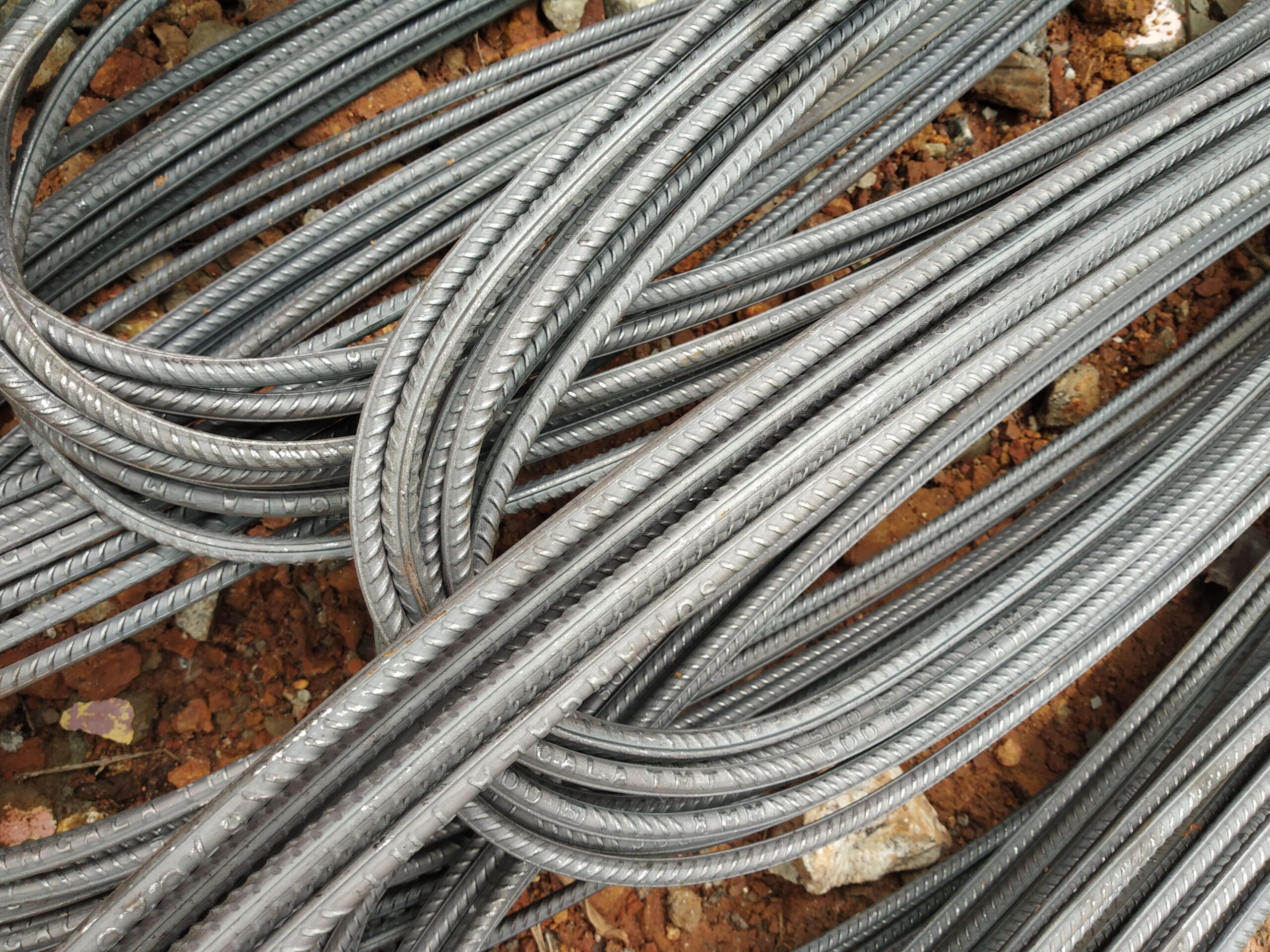
12mm vs 16mm Rebar: Which Diameter to Use and When
A practical technical guide to choosing between 12mm and 16mm deformed reinforcing bar (B500B, DIN 488 / EN 10080) — comparing cross-section, weight per metre, tensile force capacity, lap lengths, and the structural applications where each diameter excels.
12mm vs 16mm Rebar: The Key Physical Difference
Both 12mm and 16mm deformed reinforcing bar are manufactured to DIN 488 / EN 10080 in grade B500B (500 MPa characteristic yield strength). The critical difference is cross-sectional area and the consequences that flow from it. Cross-sectional area scales with the square of the diameter, so the 16mm bar has a cross-section 78 % larger than 12mm — a substantial increase in tensile force capacity per bar.
Using the standard formula A = π/4 · d²:
- 12mm bar: A = 113 mm²
- 16mm bar: A = 201 mm²
This difference in cross-section directly determines the tensile design force each bar can carry, the required spacing in a slab or beam, the lap splice length, and the weight of steel to be ordered and handled on site.
12mm vs 16mm Rebar: Side-by-Side Technical Comparison
Standard DIN 488 / EN 10080 nominal values for B500B grade.
| Parameter | 12mm Rebar (B500B) | 16mm Rebar (B500B) |
|---|---|---|
| Nominal diameter | 12 mm | 16 mm |
| Cross-sectional area (A) | 113 mm² | 201 mm² |
| Weight per metre | 0.888 kg/m | 1.58 kg/m |
| Weight per 12m bar (indicative) | ~10.7 kg | ~19.0 kg |
| Characteristic yield force (fyk × A) | 56.5 kN per bar | 100.5 kN per bar |
| Tensile area ratio vs 12mm | Baseline (1.00×) | 1.78× |
| Relative steel weight per bar | Baseline | ~1.78× heavier |
| Grade | B500B (DIN 488) | B500B (DIN 488) |
| Ductility class | B (Agt ≥ 5.0 %, k ≥ 1.08) | B (Agt ≥ 5.0 %, k ≥ 1.08) |
| Standard lengths available | 6–18 m (commonly 12 m) | 6–18 m (commonly 12 m) |
| Typical on-site handling | Easy — two-person lift for 12 m bar | Moderate — heavier, requires care |
Tensile Capacity and Bar Spacing
At a characteristic yield strength of 500 MPa (B500B), the design tensile force per bar (indicative, before partial factors) is:
- 12mm: 113 mm² × 500 MPa = 56.5 kN
- 16mm: 201 mm² × 500 MPa = 100.5 kN
To provide equivalent total tensile reinforcement using 12mm bars instead of 16mm bars at a given spacing, the engineer must increase either the number of bars or reduce their spacing. For example, to match the tensile area provided by 16mm bars at 200mm centres (As = 1005 mm²/m), 12mm bars would need to be placed at approximately 113mm centres (As = 1000 mm²/m) — nearly doubling the bar count and the site fixing labour. Conversely, choosing 16mm bars often allows wider bar spacings, reducing the number of individual bars and fixing operations.
Lap Splice Lengths
Lap splice lengths under Eurocode 2 (EN 1992-1-1) are proportional to bar diameter (l₀ = α × lbd, where lbd is the anchorage length and itself proportional to diameter). As a rough illustrative guide, for a typical RC slab in C25/30 concrete with 35mm cover and good bond conditions, basic anchorage lengths are indicatively in the range of 35–50 diameters. This gives indicative lap lengths of:
- 12mm bar: approximately 420–600 mm
- 16mm bar: approximately 560–800 mm
Actual lap lengths depend on concrete class, exposure, percentage of bars lapped at one section, cover and transverse reinforcement — always calculated by the structural engineer for the specific project.
Where 12mm Rebar Is Typically Used
- Ground-bearing and suspended slabs (residential, light commercial) — close bar spacing, uniform distributed load
- Retaining wall faces and thin wall curtains where uniformly distributed reinforcement is required
- Stirrups and links in beams and columns (though 8–10mm is more common for links)
- Secondary distribution and anti-crack steel in large RC elements
- Light-duty foundations and ground slabs with moderate loading
- Precast panels and filigree slab lattice reinforcement
Where 16mm Rebar Is Typically Used
- Beams (main tension reinforcement) in mid-span and at supports
- Column cages — longitudinal bars in medium-load columns
- Pile caps and raft foundations — higher concentrated loads require larger bars
- Shear walls — boundary element and distributed reinforcement
- Bridge deck slabs and parapet walls
- Moderate-to-heavy industrial floor slabs subject to forklift or racking loads
- Any application where the structural engineer specifies 16mm based on design force demands
For full diameter options, see our B500B rebar product page covering diameters 8–40mm, and our cut-and-bend service for supply of shaped cages in any diameter.
Extended Diameter Weight and Area Reference Table
Standard DIN 488 nominal values. Indicative figures — confirm with your structural engineer for design calculations.
| Dia (mm) | Weight (kg/m) | Cross-section (mm²) | Indicative yield force (kN) |
|---|---|---|---|
| 8 | 0.395 | 50.3 | 25.2 |
| 10 | 0.617 | 78.5 | 39.3 |
| 12 | 0.888 | 113 | 56.5 |
| 14 | 1.21 | 154 | 77.0 |
| 16 | 1.58 | 201 | 100.5 |
| 20 | 2.47 | 314 | 157 |
| 25 | 3.85 | 491 | 246 |
| 32 | 6.31 | 804 | 402 |
| 40 | 9.86 | 1257 | 629 |
Frequently Asked Questions
Can I substitute 12mm bars for 16mm bars in an existing design?
Which diameter is more economical — 12mm or 16mm?
What is the weight per 12-metre bar for 12mm and 16mm rebar?
Are 12mm and 16mm bars available as cut-and-bent shapes?
What documentation is provided with 12mm and 16mm rebar for export?
Source German-standard rebar with full export documentation
Tell us your specification — diameter, lengths, grade, destination port — and we’ll respond with a detailed quotation for B500B rebar to DIN 488 / EN 10080.