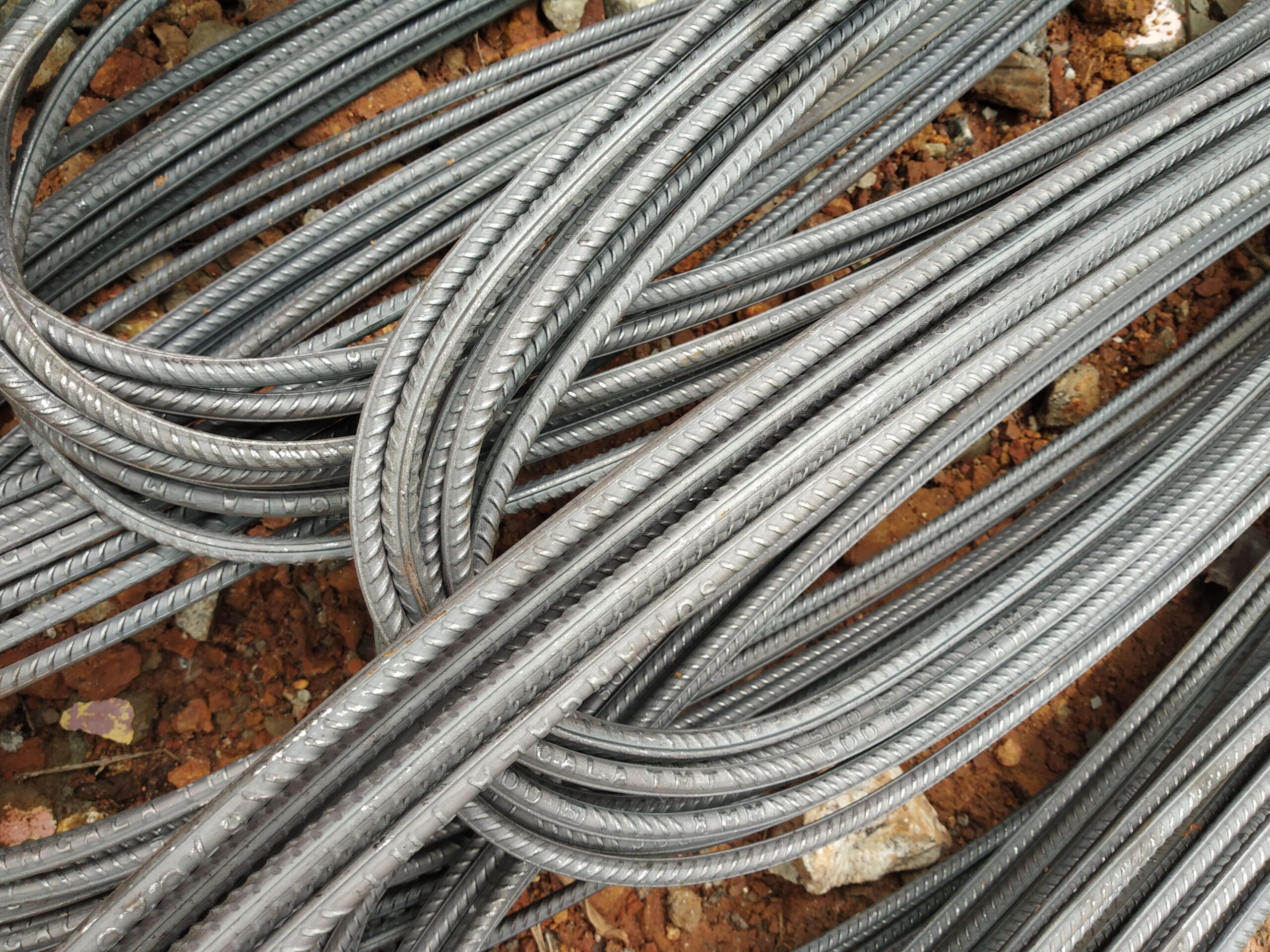
Black vs Epoxy-Coated Rebar: Corrosion Protection, Performance and Cost Compared
A technical guide comparing standard uncoated (black) reinforcing bar and epoxy-coated rebar — covering corrosion resistance, bond strength, ductility, handling requirements, durability in aggressive environments, and cost implications for international procurement.
What Is Black Rebar?
“Black rebar” is the industry term for standard uncoated, hot-rolled deformed reinforcing bar — the dominant global specification. The “black” refers simply to the mill scale present on the bar surface after rolling, not to any coating or treatment. Black rebar to DIN 488 / EN 10080 in grade B500B is hot-rolled from billets, air-cooled, and supplied with a ribbed (deformed) surface profile that provides mechanical interlock with the surrounding concrete.
In normal concrete environments — structures with adequate cover depth (typically 20–50 mm per EN 1992-1-1) and good concrete quality (low water-cement ratio, dense aggregate) — the alkaline environment of concrete (pH 12–13) forms a passive oxide layer on the steel surface that prevents corrosion indefinitely. Black rebar is used in the vast majority of reinforced concrete structures worldwide, including bridges, high-rise buildings, foundations, retaining walls and marine infrastructure when designed and built to code.
What Is Epoxy-Coated Rebar?
Epoxy-coated rebar (ECR) has a factory-applied fusion-bonded epoxy (FBE) coating — typically 130–300 µm thick — applied electrostatically to the cleaned, grit-blasted steel surface and cured in an oven. The coating acts as a physical barrier between the steel and the concrete pore solution, significantly slowing chloride-induced corrosion in structures exposed to de-icing salts (road bridges in temperate climates) or seawater chlorides (marine wharves, coastal structures).
The predominant standard for ECR in North America is ASTM A775 / A775M. In Europe, epoxy-coated rebar is less commonly specified; EN 10080 does not define a coating standard, and European design guidance (e.g. fib Model Code) generally prefers increasing concrete cover depth and reducing water-cement ratio as the primary corrosion mitigation strategy over coating.
Technical Comparison: Black vs Epoxy-Coated Rebar
| Parameter | Black Rebar (B500B, DIN 488) | Epoxy-Coated Rebar (FBE, ASTM A775) |
|---|---|---|
| Base material grade | B500B (500 MPa yield, DIN 488) | Same base grade (A615/A706 or equivalent) |
| Corrosion resistance in normal concrete | Excellent — passive oxide layer | Excellent + additional barrier |
| Resistance to chloride attack | Good with adequate cover + dense concrete | Superior — coating delays Cl⁻ penetration |
| Bond strength to concrete | Full mechanical interlock via deformations | Reduced ~20 % (lap lengths must be increased) |
| Ductility | Agt ≥ 5.0 %, k ≥ 1.08 (B500B) | Same base ductility; coating does not affect yield |
| Handling sensitivity | Robust — minor surface rust acceptable | Fragile — coating damage compromises protection |
| Repair of damage | N/A | Patch with liquid epoxy; holidays >0.1 % area may be rejected |
| Relative cost | Baseline | Typically 30–60 % premium over black |
| Dominant market | Europe, most of world | North America (US, Canada, Caribbean) |
| Primary standard | DIN 488, EN 10080 | ASTM A775, ASTM A934 |
The Bond Strength Penalty of Epoxy Coating
This is the most technically important trade-off when specifying ECR. The epoxy coating reduces the friction and adhesion component of the bar-to-concrete bond, leaving only mechanical interlock from the deformations. ACI 318 (US concrete code) accounts for this by requiring a bond modification factor of 1.2–1.5 applied to development and lap splice lengths when ECR is used — meaning lap lengths increase by 20–50 %, consuming more bar steel and site labour. Engineers specifying ECR must therefore recalculate all development lengths; simply substituting ECR for black bar on an existing design is a code violation.
European design codes (Eurocode 2 / EN 1992-1-1) do not contain provisions for ECR; they are primarily written around uncoated bar. Specifying ECR on a European-code project requires special study and agreement with the project engineer and certifying body.
When Black Rebar Is the Right Choice
- All standard structural applications in temperate and tropical environments with adequate concrete quality and cover
- Projects specified to DIN 488 / EN 10080 or any Eurocode-based national standard
- Any situation where long lap splices or development lengths must be minimised
- Seismic applications where full ductility and bond reliability are paramount
- Export projects where site handling quality cannot be guaranteed (coating damage risk)
When Epoxy-Coated Rebar May Be Justified
- Road bridge decks in North America subject to heavy de-icing chloride exposure (AASHTO / ACI specifications)
- Marine substructure (piles, pile caps) where chloride levels are extreme and cover is limited
- Projects explicitly specified to ASTM standards where ECR is a standard clause
- Life-cycle cost analysis demonstrates coating premium is offset by reduced future repair costs
For further reading on DIN 488 standards and certification, see our standards and certification page and our B500B product overview. For structural comparisons, see rebar vs welded wire mesh.
Frequently Asked Questions
Is epoxy-coated rebar available to DIN 488 / Eurocode specifications?
Does epoxy coating affect the yield strength or ductility of rebar?
What happens if the epoxy coating is damaged on site?
Which is more cost-effective: epoxy-coated rebar or increased concrete cover?
What corrosion protection does black rebar rely on in normal concrete?
Source German-standard rebar with full export documentation
Tell us your specification and destination port — we’ll respond with a detailed quotation for B500B deformed bar to DIN 488 / EN 10080 with complete corrosion and certification documentation.