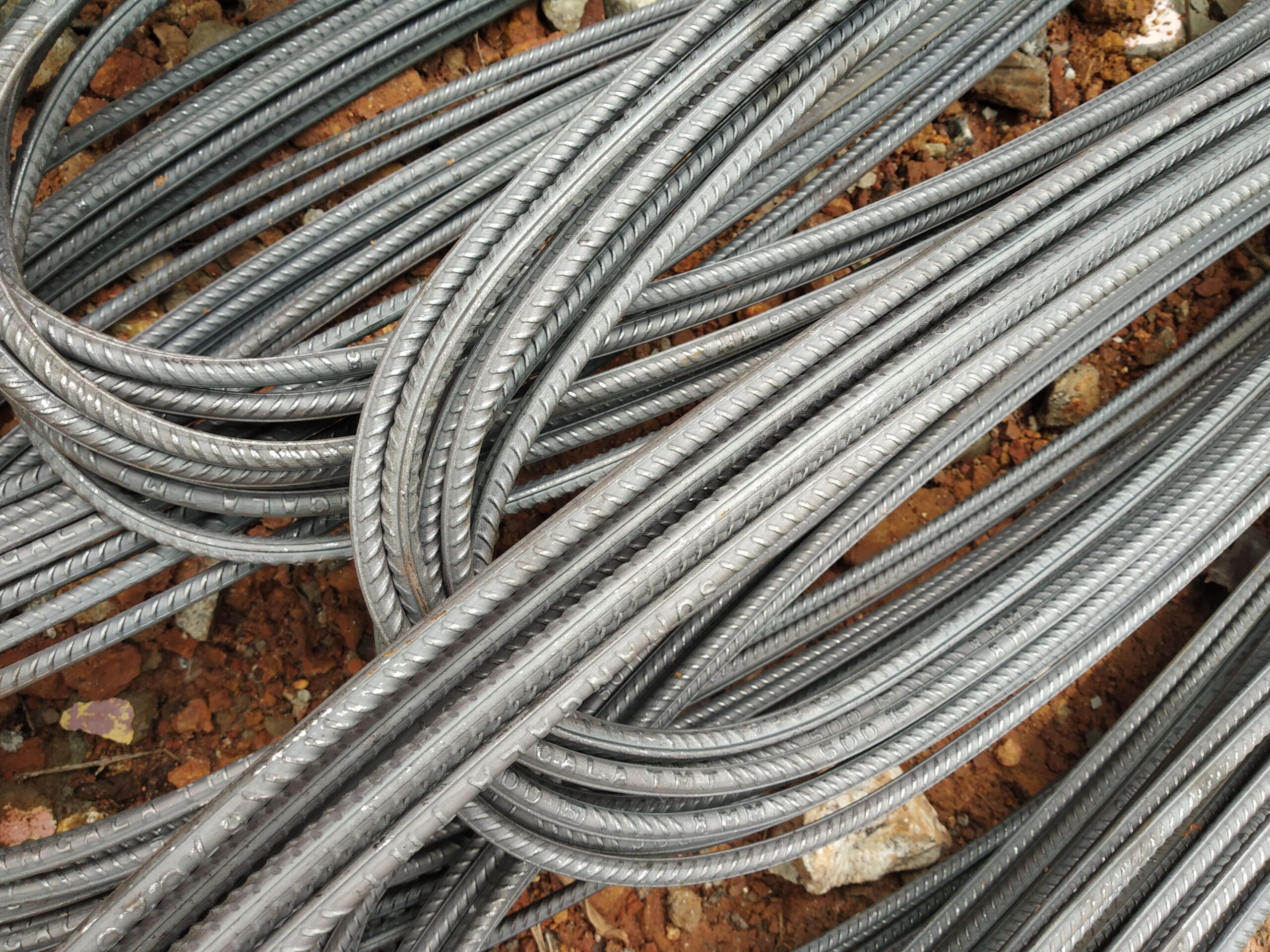
Reinforcing Steel for Chimneys: DIN 488 / EN 10080 Supply Guide
Reinforced concrete chimneys carry complex combinations of wind-induced bending, thermal gradients, and seismic forces. This guide explains reinforcement detailing for chimney shafts — bar sizes, arrangement, concrete cover — and how Steel Rebar Germany supplies B500B bar, mesh, and cut-and-bend elements to DIN 488 / EN 10080 for chimney projects worldwide.
Structural Demands on Chimney Reinforcement
Reinforced concrete chimneys — from industrial plant stacks to power station cooling towers and process chimneys — are slender structures that experience extreme loading conditions throughout their service life. The primary structural actions include: wind-induced cantilever bending (governed by EN 1991-1-4 and specialist chimney codes such as VGB-R 610), thermal expansion and temperature gradients through the wall, self-weight compression, and seismic action in applicable zones. Taller chimneys also exhibit dynamic wind-induced oscillation (vortex shedding) that must be dampened or reinforced against.
The resulting reinforcement scheme is bi-axial: vertical bars carry the bending tension and compression, while horizontal (hoop) rings control cracking from thermal effects and horizontal shear. Correct grade, bar diameter, spacing, and concrete cover are non-negotiable for long-term structural integrity and corrosion resistance in the aggressive flue-gas environment.
Typical Bar Sizes and Arrangement
The following indicative figures reflect common practice for RC chimney shafts designed to EN 1992-1-1 and relevant chimney standards. Actual values depend on height, wall thickness, diameter, thermal load, and site seismicity.
| Reinforcement Zone | Typical Bar Dia (mm) | Typical Spacing (mm) | Weight kg/m | Section mm² |
|---|---|---|---|---|
| Vertical bars (outer curtain) | 16–25 | 100–150 | 1.58–3.85 | 201–491 |
| Vertical bars (inner curtain) | 12–20 | 150–200 | 0.888–2.47 | 113–314 |
| Horizontal hoop bars | 10–16 | 150–200 | 0.617–1.58 | 78.5–201 |
| Opening / aperture reinforcement | 16–20 | 100–125 | 1.58–2.47 | 201–314 |
| Base / foundation connection | 25–32 | 100–150 | 3.85–6.31 | 491–804 |
Concrete Cover in Chimney Environments
Chimneys present some of the most aggressive exposure environments for embedded reinforcement. The outer face is exposed to weather (XC3/XC4, potentially XS or XD near coastal or road environments), while the inner face is subject to condensate from flue gases that can be highly acidic (sulphur compounds, chlorides). EN 1992-1-1 combined with specialist chimney standards typically requires:
- Outer face: c_nom 40–50 mm (XC4/XF1 exposure class typical)
- Inner face: c_nom 50–70 mm or acid-resistant liner where condensate is aggressive
- Opening edges: c_nom increased by 10 mm minimum
- Foundation: c_nom 50–75 mm (XC4/XD2 or soil exposure)
Where chemical attack is severe, stainless steel or epoxy-coated rebar may be required for the inner curtain — these are project-specific procurements. Standard B500B to DIN 488 covers the structural outer curtain in the vast majority of chimney designs.
Cut-and-Bend Supply for Chimney Projects
The circular cross-section and varying wall thickness along a chimney’s height make cut-and-bend rebar supply highly advantageous. Factory-produced bent elements include:
- Vertical bars cut to precise lengths for each wall lift, with end bends for foundation connections
- Hoop rings bent to the correct radius for each wall section (wall diameter typically reduces with height)
- Stirrups and U-bars for chimney openings and bracket supports
- Couplers with threaded parallel connections for vertical bar continuity without long laps in congested wall sections
Mechanical rebar couplers are particularly valuable in chimney walls where wall thickness is limited and traditional lapping of large-diameter bars would create unacceptable congestion. Parallel-thread or taper-thread couplers to 40 mm diameter are available.
Standards and Certification for Chimney Rebar Supply
Chimney projects — often for power, petrochemical, or cement plants — are subject to rigorous quality assurance. Steel Rebar Germany supplies B500B and B500C rebar with full traceability to DIN 488 / EN 10080, with Mill Test Certificates (EN 10204 3.1) identifying:
- Heat/cast number for full traceability
- Yield strength Re and tensile strength Rm
- Uniform elongation Agt and strength ratio k = Rm/Re
- Chemical composition (C, S, P, N, CE values)
- Bar diameter and nominal mass per metre
For export shipments, we additionally provide CE/DoP under EN 10080, Certificate of Origin, and seaworthy bundled packing to ~2 t per bundle. Full detail is available on our export and delivery page.
Related Products for Chimney Projects
Beyond straight bar and cut-and-bend, chimney projects often require complementary supply items: cover spacers and chairs for correct c_nom during placement, mesh panels for uniform lining and base slab zones, and B500B bar stock in full 12 m lengths for on-site cutting where the contractor prefers to manage bending. Contact us to discuss a combined supply package.
Frequently Asked Questions — Rebar for Chimneys
Technical and procurement questions answered for chimney reinforcement projects.
Which rebar grade is recommended for chimney shafts?
Can you supply hoop bars bent to multiple radii for a tapered chimney?
What concrete cover is required for chimney reinforcement?
Are couplers available for large-diameter vertical bars?
What export documentation is provided for chimney project shipments?
Source German-standard rebar with full export documentation
Tell us your specification and destination port — we’ll respond with a detailed quotation.