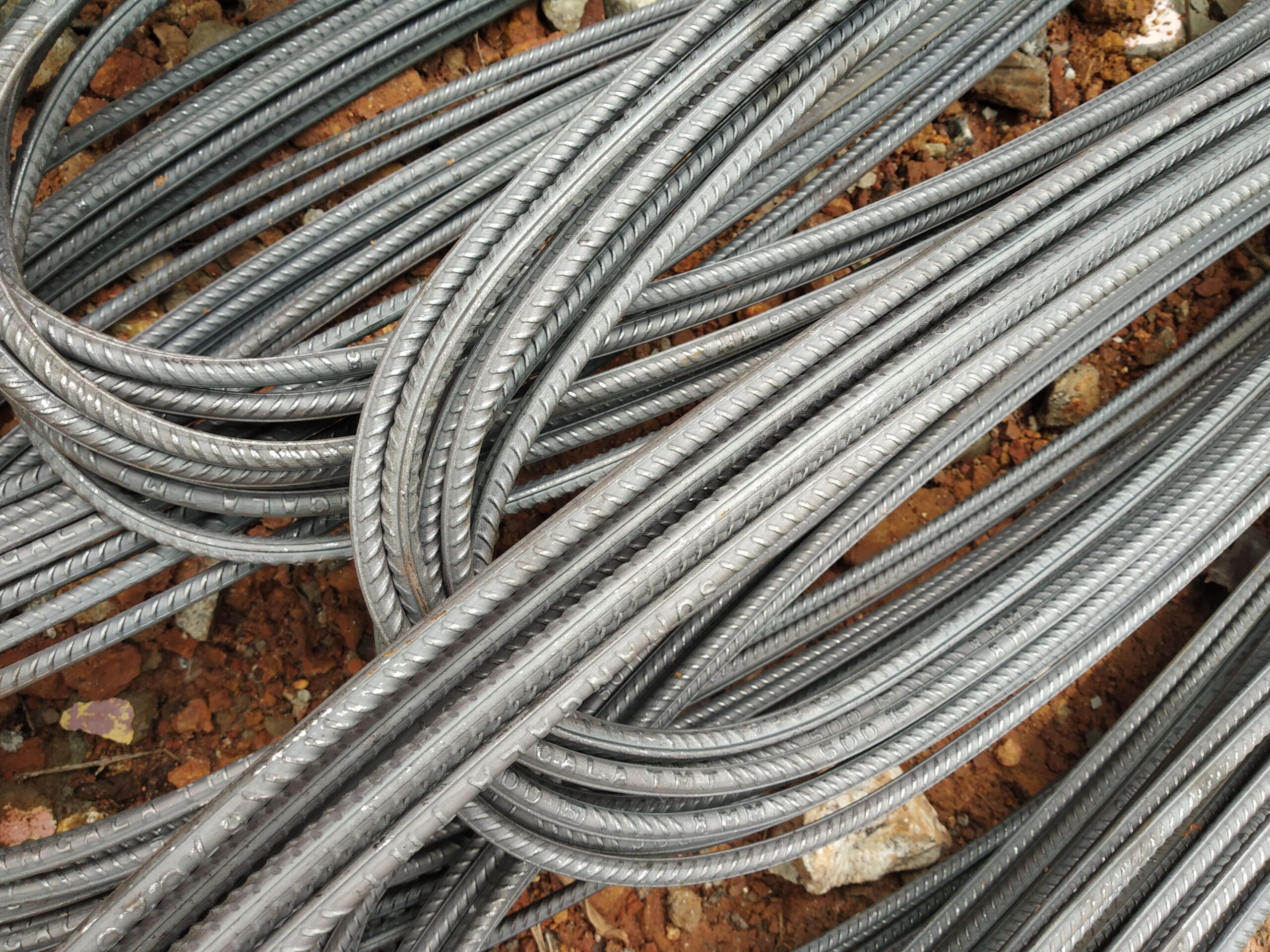
Reinforcing Steel for Jetties: DIN 488 / EN 10080 Marine Supply Guide
Jetties operate in one of the most corrosive environments reinforced concrete faces: tidal splash, chloride saturation, and cyclic wetting-drying cycles. This guide covers reinforcement detailing for jetty decks, piles, and beams — bar sizes, arrangement, critical concrete cover — and how Steel Rebar Germany supplies B500B bar, mesh, and cut-and-bend to DIN 488 / EN 10080 for marine port projects worldwide.
Structural and Durability Challenges in Jetty Construction
Jetties — fixed structures projecting into water to allow vessels to berth and load/unload cargo or passengers — are among the most demanding environments for reinforced concrete. Elements include piled foundations, pile caps, longitudinal beams, transverse beams, and deck slabs, all of which are permanently exposed to seawater in the splash, tidal, or submerged zone. The primary structural actions are berthing impact, mooring pull, traffic loads on the deck, wave action, and dynamic uplift from storm surges.
Corrosion of reinforcement driven by chloride ingress (XS2/XS3 exposure classes per EN 206) is the primary durability threat and the principal driver of concrete cover specification and material selection. Properly certified B500B to DIN 488 / EN 10080 with rigorous cover and crack-width control per EN 1992-1-1 remains the baseline structural material; stainless or GFRP rebar may be specified for the outermost bars in extremely aggressive splash zones on project-specific basis.
Typical Bar Sizes and Arrangement for Jetty Elements
The following indicative sizes reflect typical jetty design practice to EN 1992-1-1 and EN 1337 / BS 6349 marine standards. Actual quantities depend on jetty width, span, berthing load, pile diameter, and environmental exposure.
| Jetty Element | Typical Bar Dia (mm) | Typical Spacing (mm) | Weight kg/m | Section mm² |
|---|---|---|---|---|
| Deck slab — top reinforcement | 16–20 | 150–200 | 1.58–2.47 | 201–314 |
| Deck slab — bottom reinforcement | 16–25 | 125–175 | 1.58–3.85 | 201–491 |
| Main longitudinal beam | 25–32 | 4–8 bars (count) | 3.85–6.31 | 491–804 |
| Beam shear links / stirrups | 12–16 | 100–175 | 0.888–1.58 | 113–201 |
| Pile — vertical bars | 20–32 | 6–14 bars (count) | 2.47–6.31 | 314–804 |
| Pile — helical links | 10–12 | 100–150 pitch | 0.617–0.888 | 78.5–113 |
| Pile cap | 20–25 | 150–200 | 2.47–3.85 | 314–491 |
Concrete Cover in Marine Exposure
Concrete cover in jetty construction is governed above all by durability. EN 1992-1-1 Table 4.4N and EN 206 define minimum cover for XS exposure classes:
- XS1 (airborne salt, not directly in contact): c_nom ≥ 40 mm
- XS2 (permanently submerged): c_nom ≥ 40–50 mm
- XS3 (tidal, splash, spray zone — most severe): c_nom ≥ 50–65 mm
In practice, jetty decks and pile tops in the splash/tidal zone typically use c_nom = 60–70 mm. Low water/cement ratio concrete (< 0.40) and Type II/V cement (sulphate and alkali-resistant) are mandatory in seawater exposure. Cover spacers must be chloride-resistant plastic or stainless-steel-tipped. Rebar spacers and accessories suitable for marine use are available from Steel Rebar Germany.
Cut-and-Bend Supply for Jetty Projects
Cut-and-bend rebar simplifies programme management on marine projects where access is tidal-window-dependent:
- Pile cage elements (pre-cut verticals, formed helical links) ready for cage assembly in a dry yard, then craned into position
- Deck slab reinforcement mats cut to bay dimensions, with hairpin and U-bar edge details
- Beam stirrups formed to precise dimensions with correct end hooks
- Pile cap mat reinforcement with bent end hooks for pile dowel connections
Pre-fabricated cages and mats allow jetty construction to proceed with minimum tidal window delays, as placement becomes a crane-and-fix operation rather than on-site cutting and bending. Mechanical couplers can also eliminate pile-to-pile-cap connection congestion.
Export Documentation for Marine Port Projects
Jetty and port infrastructure projects are often internationally funded (World Bank, AfDB, ADB, bilateral) and require comprehensive material traceability. Steel Rebar Germany provides Mill Test Certificate (EN 10204 3.1) for every heat, CE/DoP under EN 10080, Certificate of Origin, seaworthy packing (~2 t bundles, bundle-tagged with diameter and heat number), and a full packing list. We ship to ports globally — see our Middle East and Africa export pages for regional logistics. Contact us via Request a Quote to discuss your jetty project requirements.
Frequently Asked Questions — Rebar for Jetties
Technical and procurement questions for marine jetty reinforcement supply.
What concrete cover is required for jetty piles in the tidal zone?
Which rebar grade is specified for marine jetty structures?
Can you supply pile cage reinforcement for marine piles?
What mill test documentation is provided for jetty project rebar?
Do you supply rebar spacers suitable for marine concrete?
Source German-standard rebar with full export documentation
Tell us your specification and destination port — we’ll respond with a detailed quotation.