Rebar Packing, Bundling & Marking: What Every Importer Must Know
How reinforcing steel is prepared for export — bundle weights, tag data, seaworthy packaging, and the EN 10080 marking requirements that protect your shipment and your project.
Why Rebar Packing Standards Matter for International Procurement
When reinforcing steel travels from a German or EU mill to a construction site in Africa, the Middle East, or Southeast Asia, it passes through multiple handling stages — mill yard, export port, ocean freight, destination port, and final delivery. Each stage imposes mechanical stress, moisture exposure, and documentation scrutiny. Inadequate bundling leads to bar separation, corrosion, and customs holds. Understanding how rebar is correctly packed, marked, and documented before it leaves the mill gives procurement managers a clear checklist to verify — and a basis for rejecting non-conforming deliveries.
German and EU mills packing to DIN 488 and EN 10080 follow consistent practices that are well understood by international freight forwarders. The guidance below reflects standard industry practice for export-grade reinforcing steel.
Bundle Construction: Dimensions, Weight, and Tie-Wire
Straight reinforcing bars (dia 8–40 mm, lengths 6–18 m, most commonly 12 m) are grouped into bundles for handling by forklift, crane, and sling. Typical bundle parameters:
- Bundle weight: approximately 2 metric tonnes (2 000 kg) per bundle — optimised for sling capacity and container floor loading.
- Number of ties: at least three wire ties per bundle for lengths up to 12 m; four or more ties for 15–18 m bars.
- Tie-wire: annealed steel wire, twisted and secured so bundles cannot shift or splay during ocean transit.
- Cross-section shape: hexagonal or rectangular cross-section, depending on bar diameter and mill practice, to minimise wasted space in container.
For smaller-diameter bars (8–12 mm) supplied as coils, each coil is banded with steel strapping and stacked on a timber pallet or bundled in groups of two to four coils, with total pallet weights kept within forklift safe working loads.
Seaworthy Packaging for Container and Break-Bulk Shipments
Export-grade packing must survive the specific conditions of ocean freight. Standard seaworthy preparation includes:
- Rust-inhibiting oil or passivation: a light protective coating on bar surfaces where required by the buyer’s specification. Note that mill scale (the dark oxide layer on hot-rolled B500B bars) provides inherent short-term corrosion protection.
- Timber dunnage: hardwood or softwood bearers placed beneath bundles inside containers to allow air circulation, prevent moisture pooling, and avoid direct steel-to-steel contact.
- Lashing and bracing: certified lashing straps or chains secure bundles to container floor rings, preventing longitudinal shift under ship motion. Bundles are typically loaded lengthwise in 20 ft or 40 ft containers, or flat-racked if bar length exceeds container internal dimensions.
- Plastic end caps: applied to bundle ends to prevent thread or chamfer damage on cut-to-length bars and to keep identification tags visible.
Break-bulk shipments (for very large volumes) use stevedore-approved sling loading directly into cargo holds, with timber separation between layers and steel lashing to prevent movement.
EN 10080 Rolled-In Marking: Reading the Bar
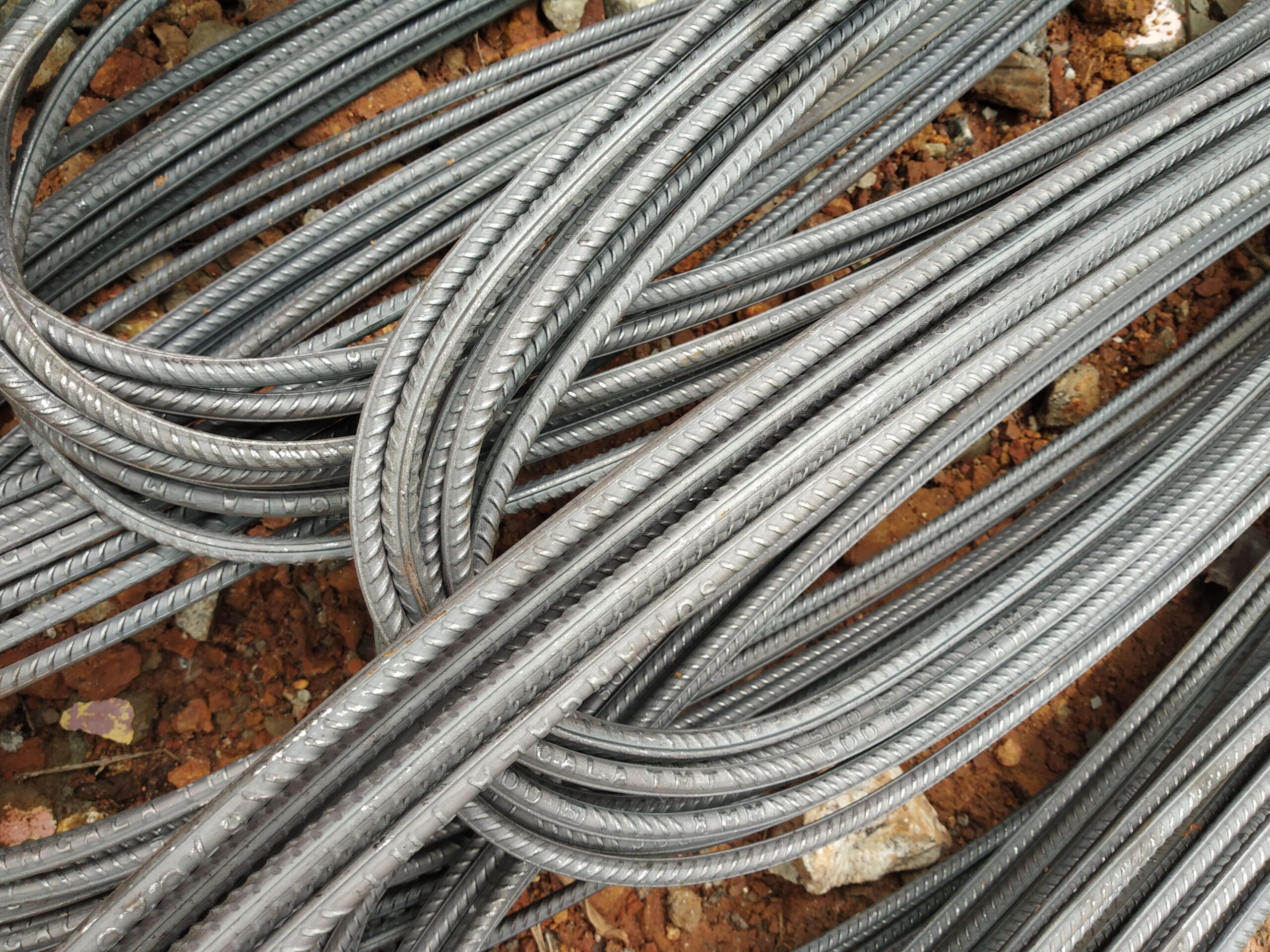
Every hot-rolled reinforcing bar produced to EN 10080 carries a permanent rolled-in identification on its surface — a sequence of ribs and symbols that encodes the producer, steel grade, and nominal diameter without requiring a label. The marking system is defined in EN 10080 Annex C and DIN 488 Part 1:
| Mark Element | Meaning | Example |
|---|---|---|
| Producer mark | Unique symbol identifying the mill | One or two gap-rib codes |
| Diameter indicator | Number of consecutive ribs = nominal dia in mm ÷ 4 (or direct numeral) | 5 ribs = 20 mm |
| Ductility class | A = B500A, B = B500B, C = B500C | “B” stamped between rib sets |
| Country of origin | National code (DE for Germany) | Two-letter abbreviation |
This rolled-in marking provides permanent traceability even if paper tags are lost in transit — a key advantage for customs inspection and project quality audits.
Bundle Tags and Mill Documentation
Each bundle is fitted with a durable metal or plastic tag (wired through one of the tie points) carrying the following data:
- Mill name and plant location
- Heat / cast number (linking bundle to the Mill Test Certificate)
- Steel grade: B500B, B500A, or B500C per EN 10080 / DIN 488
- Nominal diameter (mm) and length (m)
- Number of bars and bundle weight (kg)
- Production date and shift code
- EN 10204 3.1 certificate reference number
The Mill Test Certificate (EN 10204 Type 3.1) — issued by the mill’s inspection authority — lists chemical composition (C, Si, Mn, P, S, N, CE) and mechanical test results (yield strength ReH, tensile strength Rm, ratio k = Rm/ReH, elongation Agt) for the specific heat. Verifying that the heat number on each bundle tag matches an entry in the MTC is the most critical quality control step an importer can perform on arrival.
Packing List and Export Documentation Set
A complete export packing list for a rebar shipment includes:
- Number of bundles and coil packs per container / break-bulk lot
- Net weight and gross weight per bundle and total
- Dimensions of bundles (length × width × height in mm)
- Container number(s) and seal number(s)
- Marks and numbers matching the Bill of Lading
This packing list accompanies the full export documentation set — including Certificate of Origin, CE Declaration of Performance, and the EN 10204 3.1 MTCs — required for customs clearance in most destinations. See also our post on Importing Rebar: Documentation Checklist for a step-by-step arrival guide.
Frequently Asked Questions
Common questions from importers about rebar packing and marking.
What does a standard rebar bundle weigh?
How do I read the rolled-in marking on a rebar?
Is rust-inhibiting oil always applied for export?
What is the minimum documentation I should receive with a rebar shipment?
Can I request custom bundle weights or lengths?
Source German-standard rebar with full export documentation
Tell us your specification and destination port — we’ll respond with a detailed quotation.