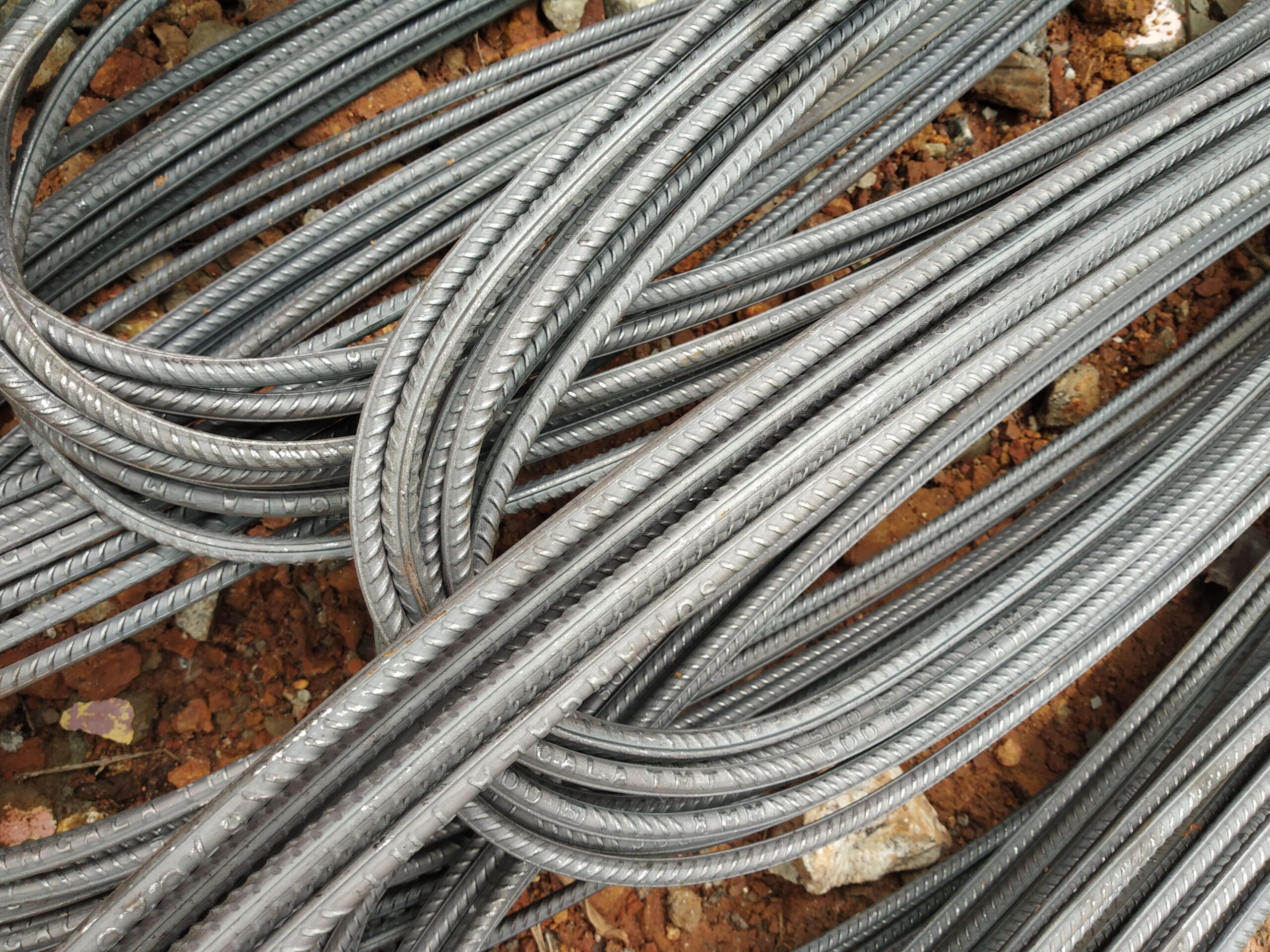
Rebar Rib Geometry and Bond with Concrete
Rebar rib geometry is the primary mechanical mechanism that transfers stress between reinforcing steel and concrete. Understanding how rib height, spacing, and relative rib area fR affect bond performance is essential for structural engineers and procurement teams specifying DIN 488 / EN 10080 compliant bars.
How Rebar Bonds to Concrete: The Three Mechanisms
Steel-to-concrete bond is the fundamental principle that makes reinforced concrete work. Without reliable bond, tensile forces cannot be transferred from the concrete matrix to the reinforcing bar, and the composite action assumed in design is lost. Three mechanisms contribute to bond:
- Adhesion — chemical bonding between the cement paste and the bar surface, which acts in the early loading stages but is exhausted at very low slip values.
- Friction — surface roughness provides frictional resistance after adhesion fails; mill scale and minor surface irregularities contribute.
- Mechanical interlock — the dominant mechanism in deformed (ribbed) bars. The transverse ribs bear against the surrounding concrete, creating compressive struts that transfer load. This mechanism sustains bond at large slip values.
In modern structural design using deformed bars conforming to DIN 488 or EN 10080, mechanical interlock via rib geometry provides the overwhelming majority of usable bond capacity. This is why smooth bars are no longer permitted in structural concrete under Eurocode 2.
Rib Geometry Parameters Defined in EN 10080
EN 10080 and DIN 488 define a set of geometric parameters that must be measured and reported on the Mill Test Certificate. These parameters collectively determine the bar’s bond performance:
| Parameter | Symbol | Description | EN 10080 Minimum |
|---|---|---|---|
| Relative rib area | fR | Ratio of rib bearing area to bar surface area | ≥ 0.056 (d ≤ 12 mm) / ≥ 0.075 (d > 12 mm) |
| Rib height | h | Measured from bar surface to rib crest | ≥ 0.03d (typically) |
| Rib spacing | c | Centre-to-centre spacing of transverse ribs | ≤ 0.7d (max) |
| Rib inclination | α | Angle of rib face relative to bar axis | 45° – 75° (to bar axis) |
| Longitudinal rib | — | Continuous longitudinal rib for identification | Required |
The relative rib area fR is the most important single parameter. It is a dimensionless ratio that captures the combined effect of rib height, spacing, and flank angle. The EN 10080 minimum values (0.056 for smaller diameters, 0.075 for larger) correspond to the bond category that enables the anchorage and lap splice lengths tabulated in Eurocode 2 Annex C.
How Rib Geometry Affects Anchorage and Lap Length
EN 1992-1-1 (Eurocode 2) calculates anchorage length lbd using a basic anchorage length lb,rqd multiplied by several alpha coefficients that account for bar position, concrete cover, confinement, and — crucially — the bond condition. The design bond stress fbd is directly linked to the concrete tensile strength and the bond condition (good or poor), but the underlying assumption is that the rebar meets or exceeds the minimum fR of EN 10080.
Bars with higher fR values (above the EN 10080 minimum) can develop shorter anchorage lengths in principle, but Eurocode 2 does not automatically reward this; the standard bond stress assumption remains the basis for tabulated values. Some national annexes and specialist applications use higher bond models when fR is confirmed on the MTC.
Surface Condition and Its Effect on Bond
Surface condition at the time of concrete casting significantly affects bond quality. EN 10080 and practical experience identify the following:
- Mill scale — the natural oxide layer on hot-rolled bars. Tightly adhering mill scale has minimal negative effect; loose, flaking scale should be removed.
- Rust — light surface rust (red-brown, no pitting, no delamination) is widely accepted and may slightly improve bond by increasing surface roughness. Heavily corroded bars with section loss must be rejected.
- Oil or grease contamination — severely reduces bond by preventing cement paste adhesion. Bars must not be contaminated with form-release agents, lubricants, or similar materials.
- Epoxy coating — used in corrosive environments; reduces bond capacity by approximately 20–30%, requiring modified development length factors (not standard under EN 10080 but covered in project-specific specs).
Proper rebar storage and handling on site is essential to preserve the surface condition and bond capacity of delivered bars.
Rib Geometry for Different DIN 488 Bar Types
DIN 488 covers several product forms with different rib patterns. Hot-rolled bars (B500B, B500C) use a standard two-row transverse rib pattern with longitudinal identification ribs. Cold-rolled bars (typically B500A) have a different surface geometry — often a herringbone or crossed-rib pattern — but must still meet the fR requirement. Wire for mesh and stirrups may have a reduced fR tolerance, though the welded mesh specification (DIN 488-4) maintains bond-adequate geometry for the mesh wire diameters used.
For a complete view of available grades and their product forms, see our steel grades guide.
Related Resources
B500B Reinforcing Bar
Specifications, weight table, and applications for the most widely used structural rebar grade.
View B500B →Steel Grades: B500A, B500B, B500C
Side-by-side comparison of all three DIN 488 / EN 10080 ductility classes.
Compare grades →Standards & Certification
Mill Test Certificate requirements, CE marking, and EN 10204 3.1 documentation explained.
View standards →Frequently Asked Questions: Rebar Rib Geometry
Common questions from structural engineers and quality inspectors on bond and rib geometry.
What is the relative rib area fR and why does it matter?
Do ribbed bars always outperform plain round bars in bond?
Does surface rust on rebar affect bond strength?
How is rib geometry checked in the mill test certificate?
Can rib geometry differ between bar diameters from the same mill?
Source German-standard rebar with full export documentation
Tell us your specification and destination port — we’ll respond with a detailed quotation.