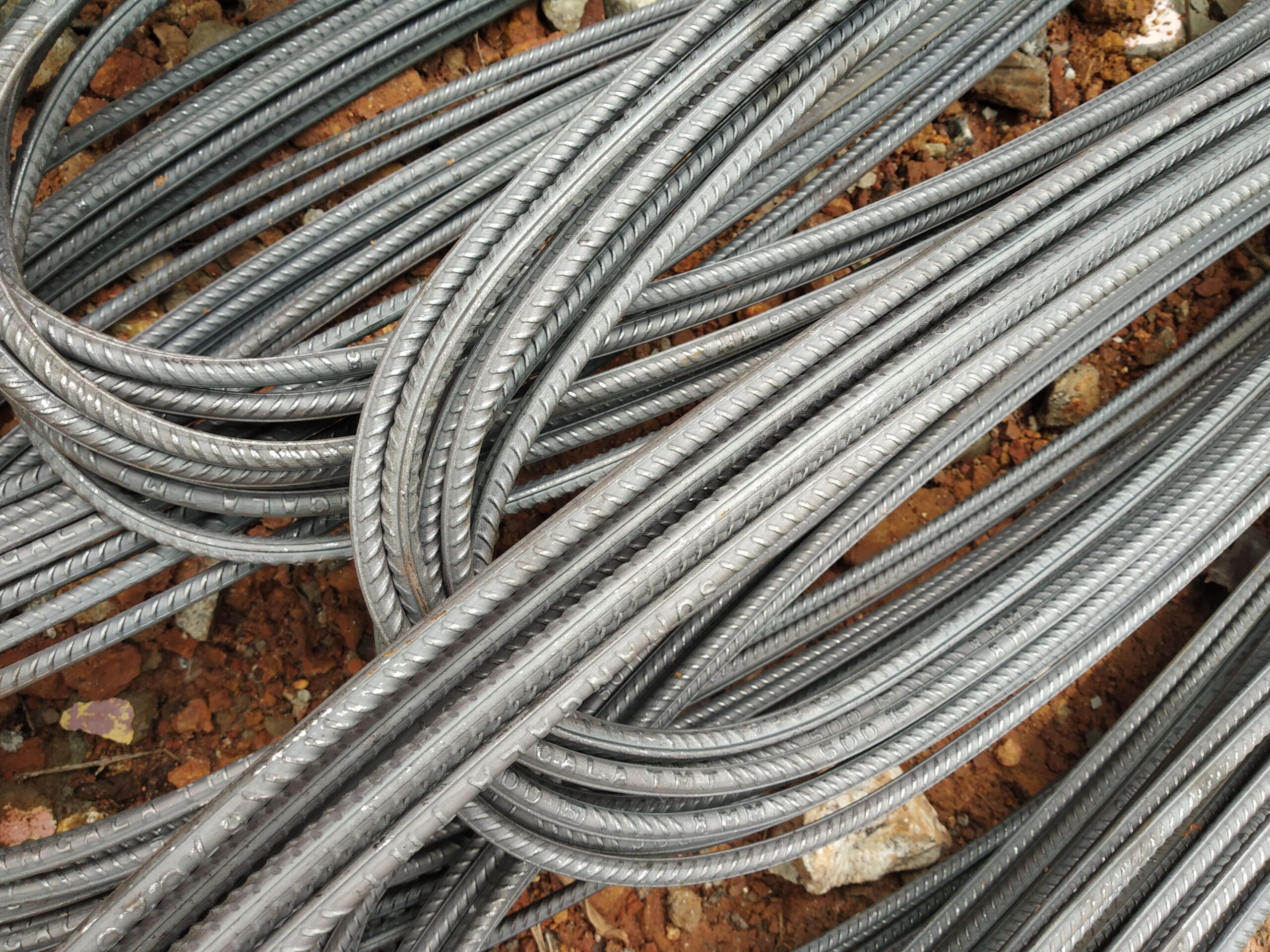
Stainless Steel Rebar: When and Why to Specify It
Stainless steel rebar delivers exceptional corrosion resistance in aggressive environments — marine structures, de-icing salt exposure, chemical plants, and coastal infrastructure — where standard carbon steel reinforcing bar would corrode and cause premature structural failure. This guide explains the grades, applications, and procurement considerations.
Why Standard Carbon Rebar Corrodes — and When It Matters
Standard hot-rolled reinforcing steel (B500B, B500C) is a carbon steel product. When chloride ions — from seawater, marine spray, or de-icing salts — penetrate the concrete cover and reach the bar surface, they break down the passive oxide layer that normally protects steel in an alkaline concrete environment. Once passivity is destroyed, electrochemical corrosion begins: iron dissolves, forming rust products that are approximately four times the volume of the original steel. The resulting expansive pressure cracks the concrete cover, causing spalling, delamination, and ultimately structural failure.
In most inland structures with adequate cover and good-quality concrete, carbon steel rebar performs for the full design life without intervention. However, for structures in chloride-rich environments — bridges exposed to road de-icing salts, coastal and offshore structures, marine piling, tidal zones, harbours, and chemical plant flooring — the corrosion risk is fundamentally different. Here, specifying stainless steel rebar is often the most cost-effective solution over the full life-cycle, despite the higher initial cost.
Stainless Steel Grades for Reinforcing Bar
The two most widely specified stainless steel grades for reinforcing applications are austenitic types, differentiated primarily by molybdenum content:
| Grade | Composition | PREN* | Typical Application |
|---|---|---|---|
| 1.4301 (304) | 18% Cr, 8% Ni, no Mo | ~18 | Low-chloride environments, architectural concrete |
| 1.4401 (316) | 17% Cr, 11% Ni, 2.2% Mo | ~25 | Marine splash zones, de-icing salt exposure |
| 1.4436 (316) | 17% Cr, 12% Ni, 2.5% Mo | ~27 | Offshore, tidal, high-chloride zones |
| 1.4462 (2205 Duplex) | 22% Cr, 5% Ni, 3% Mo | ~35 | Highly aggressive marine, chemical environments |
*PREN = Pitting Resistance Equivalent Number: higher values indicate greater resistance to localised pitting corrosion in chloride environments.
For most bridge decks, coastal retaining walls, and harbour structures in northern European climates subject to de-icing salts, grade 1.4401 (316) is typically the baseline specification. Duplex grade 1.4462 is reserved for the most aggressive applications where even 316 may not provide adequate service life.
Mechanical Properties: Compatibility with Design Codes
Stainless steel rebar must still meet the yield strength and ductility requirements of EN 1992-1-1 (Eurocode 2). The relevant product standard is EN 10088-1 (stainless steel general) in conjunction with EN 10080, and project-specific approvals (European Technical Assessments or national product approvals) are commonly required. Key mechanical properties for structural stainless rebar:
- Minimum yield strength: 500 MPa (equivalent to carbon steel B500 grades) — available in both standard and high-strength versions.
- Tensile strength: typically 700–850 MPa depending on grade and processing.
- Elongation: austenitic grades have excellent ductility (A5 ≥ 40% in annealed condition); cold-worked versions for structural use have lower elongation but typically meet ductility class B requirements.
- Bond behaviour: ribbed stainless steel bars are available with rib geometry compliant with EN 10080 bond requirements.
Hybrid Designs: Selective Use of Stainless Rebar
Full replacement of all reinforcing steel with stainless grades is rarely necessary or economical. Most engineers adopt hybrid designs where stainless rebar is specified only in the critical zones most susceptible to chloride ingress — the outer layer of reinforcement nearest the exposed face, or the full cross-section of elements in the splash and tidal zones. Interior reinforcement, where chlorides are unlikely to penetrate within the design life, remains standard carbon steel B500B.
When mixing stainless and carbon steel in the same element, galvanic coupling must be assessed: the large cathode area of stainless steel relative to a small carbon steel anode can accelerate corrosion of the carbon steel. Proper detailing — insulating spacers or design separation — mitigates this risk.
For guidance on standard carbon rebar grades and the full product range, see our B500B rebar page and the steel grades comparison.
Cost-Benefit Analysis: Life-Cycle vs. First Cost
Stainless steel rebar typically costs 5–8 times the equivalent weight of carbon steel rebar. However, the correct comparison is life-cycle cost: the cost of concrete repair, lane closure, structural rehabilitation, or replacement of a corroded element far exceeds the initial material premium of stainless rebar. Infrastructure owners and public procurement bodies increasingly require life-cycle cost assessments for critical structures, and stainless rebar commonly demonstrates the lowest whole-life cost for bridges, coastal retaining walls, and maritime infrastructure with 100+ year design lives.
Related Resources
B500B Reinforcing Bar
Standard carbon steel rebar: specifications, weight table, and export documentation.
View B500B →Steel Grades Overview
Compare B500A, B500B, and B500C ductility classes and applications.
Compare grades →Standards & Certification
EN 10080, DIN 488, CE marking, and MTC 3.1 documentation explained.
View standards →Frequently Asked Questions: Stainless Steel Rebar
Common questions from structural engineers and procurement teams specifying corrosion-resistant reinforcing steel.
When should I specify stainless steel rebar instead of epoxy-coated or galvanised rebar?
What is the difference between 316 and 304 stainless rebar for construction?
Can stainless steel rebar be welded?
Does stainless steel rebar require special concrete cover requirements?
Is stainless steel rebar available in standard DIN 488 diameters?
Source German-standard rebar with full export documentation
Tell us your specification and destination port — we’ll respond with a detailed quotation.