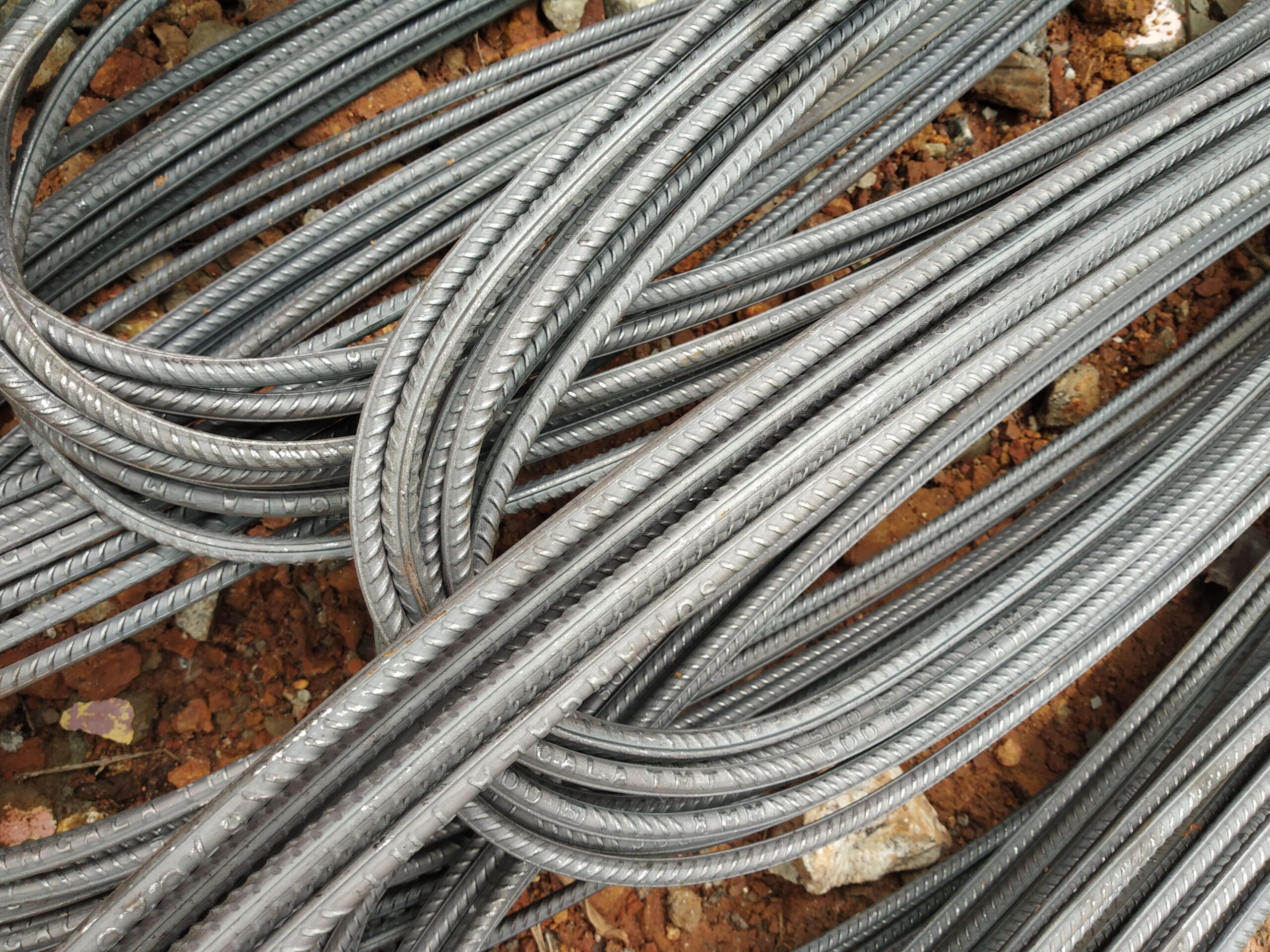
Rebar Couplers Explained for Buyers
Mechanical rebar couplers are the B2B buyer’s answer to long lap splices, congested reinforcement cages, and structural continuity challenges at construction joints. This guide covers types, thread standards, sizing, and procurement considerations for German-quality couplers.
What Are Rebar Couplers?
Rebar couplers — also called mechanical splices or bar couplers — are steel sleeves that connect two reinforcing bars end-to-end, transferring tensile and compressive forces directly through the connection rather than relying on bond length through overlapping concrete. They are governed by design codes including EN 1992-1-1 (Eurocode 2) and national application documents, and by product standards such as ISO 15835 for reinforcing steel mechanical splices.
Where conventional lap splices require an overlap length of 40–60 bar diameters (e.g. 800–1200 mm for a 20 mm bar), a mechanical coupler achieves the same structural function in a threaded connection typically 80–160 mm long. This matters enormously in congested pile caps, columns, and walls where bar clearance is tight.
Types of Rebar Couplers: A Comparison
Three coupler families cover the vast majority of construction applications:
| Type | Thread Form | Diameter Range | Key Advantage |
|---|---|---|---|
| Parallel-thread (cold-forged) | Fine parallel thread machined after cold-forging the bar end | 12–40 mm (B500B) | Full bar tensile capacity; no bar area loss; preferred for seismic zones |
| Taper-thread | Tapered thread cut directly on bar end | 12–32 mm | Self-locking; faster site fitting; modest bar cross-section reduction |
| Grout-filled sleeve | No threading required | 16–40 mm | Tolerates bar misalignment; suits precast-to-precast and precast-to-in-situ connections |
For export projects procured to German/EU standards, parallel-thread couplers machined from bar stock conforming to DIN 488 B500B are the most common specification. They achieve performance class “A” per ISO 15835-1, meaning the assembly develops at least 110% of the bar’s specified yield, with slip under cyclic loading within 0.1 mm.
Sizing Rebar Couplers: What Buyers Need to Specify
When requesting a coupler quotation, provide the following information to avoid mismatches:
- Bar diameter (mm): nominal diameter per DIN 488 or EN 10080 — e.g. 16, 20, 25, 32, 40 mm
- Steel grade: B500B (most common for high-ductility structural work) or B500C (seismic)
- Coupler type: parallel-thread, taper, transition (dissimilar diameters), or positional (bars cannot rotate)
- Performance class required: ISO 15835-1 Class A or Class B
- Design code governing the structure: EN 1992-1-1 (Eurocode 2), national annex, or project-specific specification
- Quantity and delivery schedule: couplers are typically supplied pre-installed on one bar end at the fabrication yard
Transition couplers, which join bars of different diameters (e.g. a 25 mm column starter to a 20 mm wall bar), are available but must be explicitly ordered — they are not interchangeable with standard same-diameter sleeves.
Structural Behaviour: Why Couplers Matter for B500B
The workhorse grade B500B carries a minimum yield strength of 500 MPa, an actual-to-nominal yield ratio k ≥ 1.08, and total elongation at maximum force Agt ≥ 5.0%. A coupler assembly must preserve these ductility characteristics through the connection — not merely transfer force statically. ISO 15835-1 Class A mandates that residual slip after 20 load cycles between 5% and 95% of yield is ≤ 0.1 mm, and that the assembly ruptures in the bar, not the coupler body or thread, under monotonic tension to failure.
For seismic structures designed to EN 1998 (Eurocode 8), grade B500C couplers with k in the range 1.15–1.35 and Agt ≥ 7.5% are specified. Procurement without verified coupler qualification testing is non-compliant — always request the coupler supplier’s test reports alongside the rebar Mill Test Certificate (EN 10204 3.1).
Installation and Site Handling
Parallel-thread couplers require a calibrated torque wrench set to the manufacturer’s specified make-up torque (typically 200–600 N·m depending on diameter) and a thread-engagement depth mark on the bar. Correct installation check: the bar end must be flush with or protruding past the mid-point of the coupler body. Taper-thread couplers tighten to a defined number of turns from hand-tight, verified by a witness mark.
Storage: couplers should be stored dry, with plastic end caps in place, to protect thread form. On site, plastic protectors remain in place until just before bar installation to prevent corrosion and damage to thread flanks. Galvanised or epoxy-coated coupler variants are available for aggressive or marine exposure conditions.
Procurement Considerations for International Projects
Buyers sourcing couplers for export projects should confirm compatibility between the coupler thread and the bar thread before dispatch. German-produced bars compliant with DIN 488 carry a specific rib geometry and dimensional tolerance that determines which thread form the rolling or cutting operation produces. Mismatching a coupler threaded for one bar production line with bars from a different mill can result in binding or under-engagement.
Steel Rebar Germany supplies couplers matched to the specific rebar batches in your order, eliminating thread compatibility uncertainty. Export documentation includes the coupler manufacturer’s declaration of performance alongside the rebar Mill Test Certificates, providing a complete compliance package for site engineer review.
Frequently Asked Questions: Rebar Couplers
What is the difference between a parallel-thread and a taper-thread coupler?
Do rebar couplers comply with Eurocode 2?
Can couplers be used with B500C seismic rebar?
What documentation comes with coupler supply from Steel Rebar Germany?
What diameter range is available for mechanical rebar couplers?
Source German-standard rebar with full export documentation
Tell us your specification and destination port — we’ll respond with a detailed quotation.