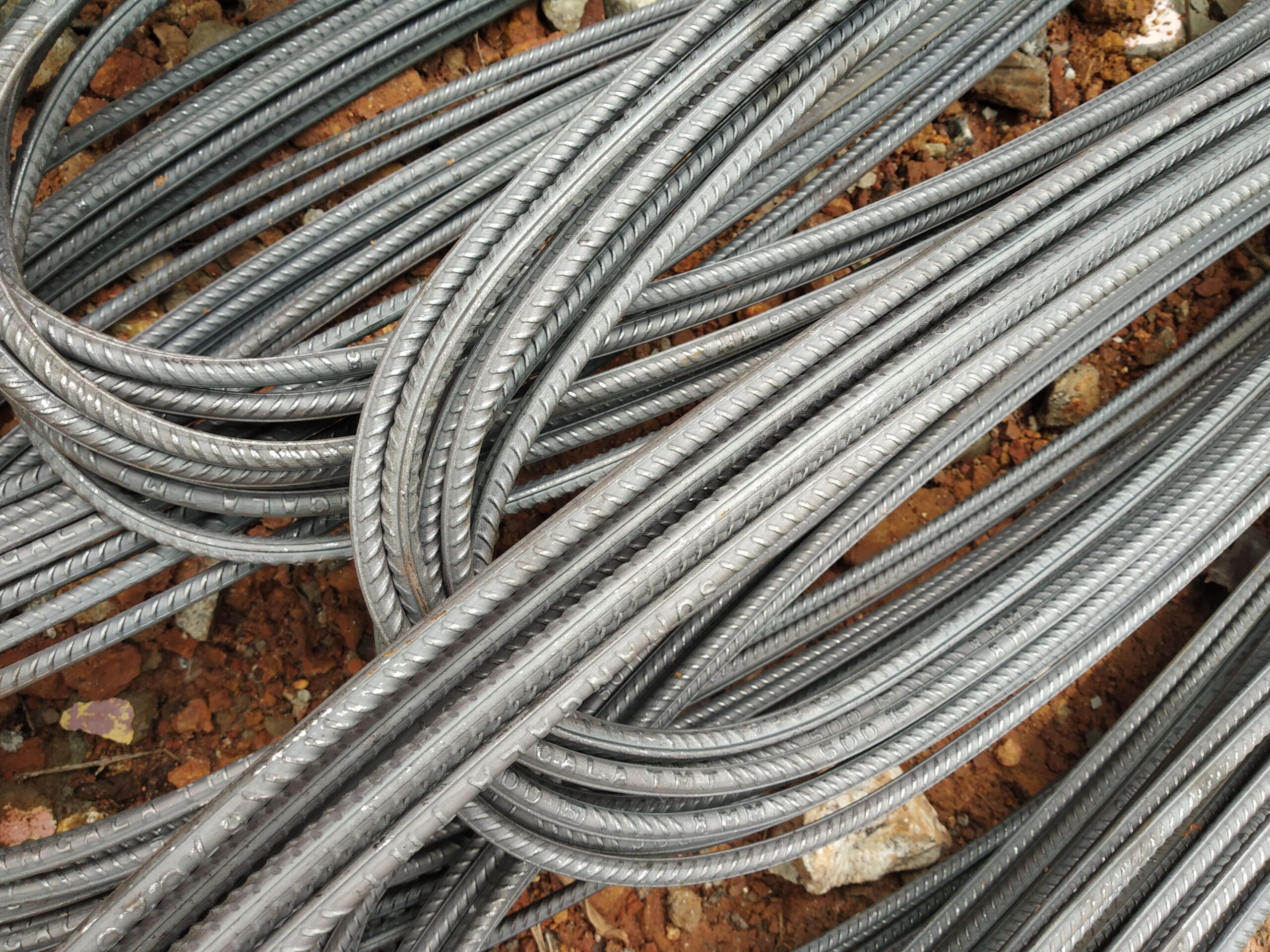
What Size Rebar for Strip and Pad Footings?
Bar-diameter, spacing, and layout guidance for reinforced concrete strip and pad footings — DIN 488 / EN 10080 B500B supplied with Mill Test Certificates for international projects.
Why Footings Need Correctly Sized Rebar
Strip and pad footings are the primary load-transfer elements between a structure’s columns or walls and the bearing soil. They must distribute concentrated loads across a wider area without bending failure, punching shear, or excessive settlement. Rebar in footings resists the tensile stresses that arise from the upward bearing pressure of the soil acting against the downward structural load.
Getting the bar diameter right is critical: too small and the footing cracks under service loads; too large and the design becomes uneconomical. The values below are typical for B500B hot-rolled deformed bar per DIN 488 / EN 10080 — the high-ductility, 500 MPa yield-strength grade standard across European structural concrete.
Typical Rebar Sizes for Strip and Pad Footings
Common bar diameters and configurations used in European and international footing construction.
| Footing Type | Typical Load | Main Bar Dia | Spacing c/c | Distribution Bar | Cover (min) |
|---|---|---|---|---|---|
| Residential strip footing | Light walls | 12 mm | 200 mm | 10 mm | 50 mm |
| Commercial strip footing | Medium walls/columns | 16 mm | 150–200 mm | 12 mm | 50 mm |
| Isolated pad footing (small) | Single column ≤ 500 kN | 16 mm | 150 mm | 16 mm | 50 mm |
| Isolated pad footing (medium) | Single column 500–2000 kN | 20 mm | 150 mm | 20 mm | 50 mm |
| Large pad / combined footing | Heavy columns / transfer | 25–32 mm | 125–150 mm | 20–25 mm | 75 mm |
All values indicative. Actual design governed by Eurocode 2, soil bearing capacity, and column/wall loads.
Strip Footings: Bar Layout and Minimum Steel
A reinforced concrete strip footing typically contains:
- Bottom longitudinal bars: resist tensile bending stress from upward bearing pressure. Typically 3–5 bars of 12–16 mm B500B running the full length of the strip.
- Transverse distribution bars: prevent cracking perpendicular to the strip axis. Typically 10–12 mm bars at 200–300 mm c/c.
- Starter bars / dowels: project above the footing to lap with the wall or column reinforcement above. Length = maximum lap length per Eurocode 2 (typically ≥ 50d from the top of the footing).
Minimum concrete cover to the bottom of a footing cast against prepared ground is 40–75 mm depending on whether a blinding layer is used. DIN 488 / EN 10080 B500B bar from Steel Rebar Germany is available in 12 m stock lengths or cut to your starter-bar dimensions via our cut-and-bend service.
Pad Footings: Two-Way Reinforcement
An isolated pad footing is reinforced in both plan directions (X and Y) with a uniform mat of bars. For a square pad, the same bar size and spacing applies in both directions. For a rectangular pad, the engineer may specify different bar counts per direction.
The key design check is punching shear around the column perimeter. Larger, more heavily loaded columns may require shear links or stud rails in addition to the main flexural mat. For these applications, mechanical couplers (dia 16–40 mm, parallel-thread or taper-thread) are often used to splice column bars through the footing without long laps.
Typical bar weights for pad footing design:
| Dia (mm) | kg/m | Section mm² |
|---|---|---|
| 12 | 0.888 | 113 |
| 16 | 1.58 | 201 |
| 20 | 2.47 | 314 |
| 25 | 3.85 | 491 |
| 32 | 6.31 | 804 |
Rebar for Footings: Ordering and Export
Steel Rebar Germany supplies B500B bar in diameters 8–40 mm, stock lengths 6–18 m. For footing cages and starter bars, factory cut-and-bend to DIN 488 shape codes eliminates site cutting waste and reduces labour. Mechanical couplers for dia 12–40 mm are available as part of a complete reinforcement package.
All material ships with EN 10204 3.1 Mill Test Certificates, Certificate of Origin, and CE/DoP for international procurement. Seaworthy bundles of approximately 2 tonnes each are standard for container and break-bulk shipments. For full export logistics information, see our export and delivery page.
Frequently Asked Questions
What size rebar is used in strip footings?
What size rebar is standard for a pad footing?
How much concrete cover is needed in a footing?
What is the difference between a strip footing and a pad footing?
Can Steel Rebar Germany supply pre-bent footing cages?
Source German-standard rebar with full export documentation
Tell us your footing schedule, bar sizes, and destination port — we’ll respond with a detailed quotation.