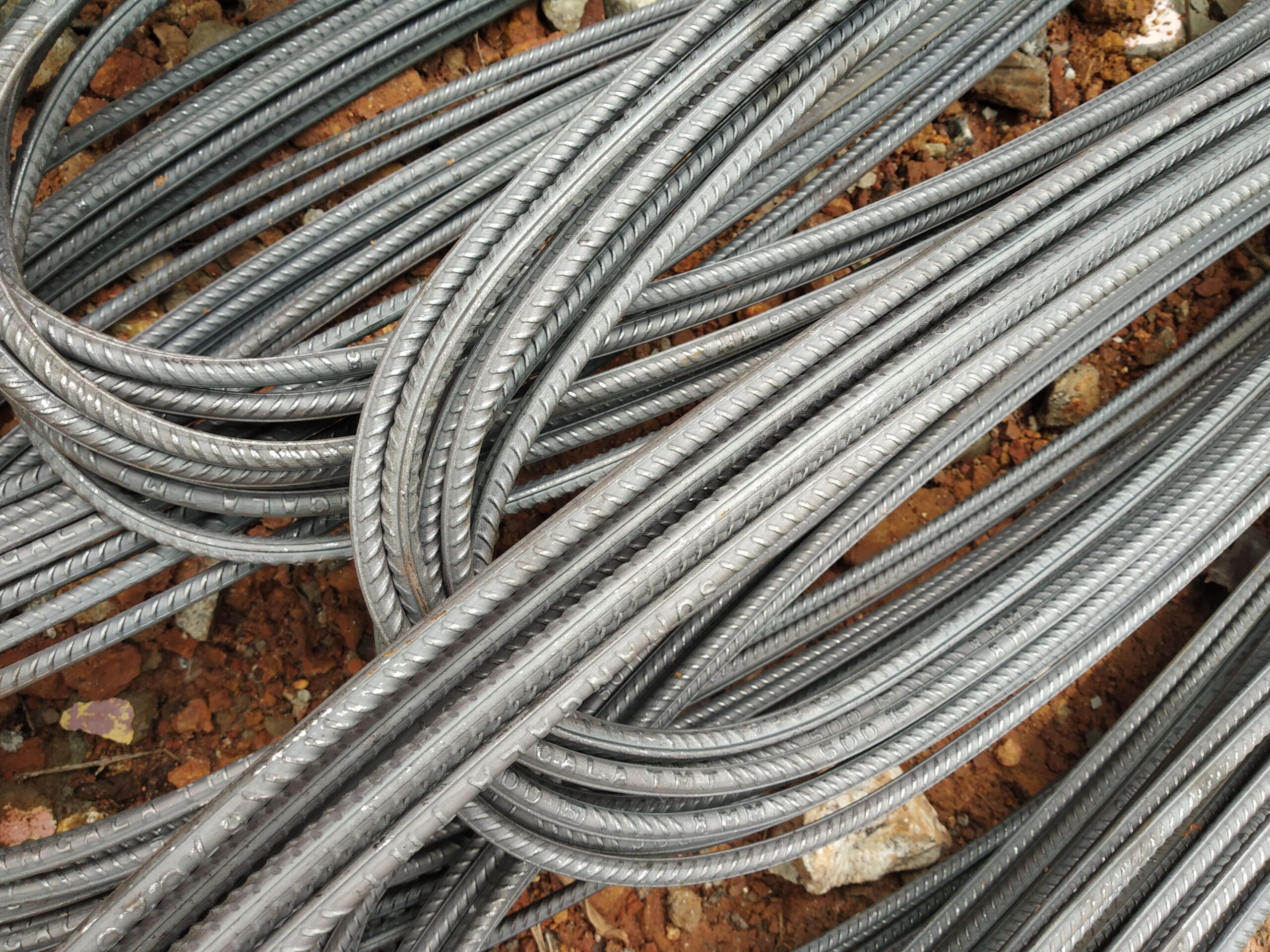
Yield Strength of Rebar: What the “500” in B500B Actually Means
A clear technical explanation of yield strength in reinforcing steel — how 500 MPa is defined under DIN 488 and EN 10080, how it is measured, how Eurocode 2 uses it, and what to check on a Mill Test Certificate.
Yield Strength of Rebar: The Core Concept
The yield strength of reinforcing steel is the stress at which the bar begins to deform plastically — the point beyond which deformation is permanent and the steel no longer returns to its original shape on unloading. In structural engineering, yield strength is the primary design parameter: Eurocode 2 bases all reinforced concrete design on the characteristic yield strength fyk. The “500” in B500B refers directly to this: a minimum characteristic yield strength of 500 MPa (N/mm²).
Understanding this value matters for procurement because yield strength determines the cross-sectional area of steel required to resist a given load. Higher yield strength means less steel by weight for the same structural capacity — which is why the shift from older 400 MPa grades to 500 MPa grades reduced rebar consumption across Europe significantly.
Re vs Rp0.2: Two Ways to Measure Yield
Steel with a well-defined yield plateau exhibits a clear upper and lower yield point — labelled ReH (upper yield strength) and ReL (lower yield strength) in EN ISO 6892-1 tensile testing. Hot-rolled rebar in grades B500B and B500C typically shows this behaviour, and the relevant value reported on a Mill Test Certificate is Re (yield strength, MPa).
Cold-worked products (B500A coil, some mesh) may lack a distinct yield point. For these, the proof strength Rp0.2 is used — the stress at which 0.2% permanent strain occurs. Both Re and Rp0.2 serve as the measured yield strength; the standard and MTC will indicate which applies.
DIN 488 / EN 10080 Requirements
| Grade | Min. Yield Strength Re / Rp0.2 (MPa) | Max. Yield Strength (MPa) | Min. Tensile Strength Rm (MPa) |
|---|---|---|---|
| B500A | 500 | 650 | 525 (k ≥ 1.05) |
| B500B | 500 | 650 | 540 (k ≥ 1.08) |
| B500C | 500 | 650 | 575–877 (1.15 ≤ k < 1.35) |
Note that DIN 488 also sets an upper bound of 650 MPa on yield strength. This cap prevents bars from being excessively strong, which is important in capacity-designed seismic structures and ensures consistency with Eurocode 2 design tables.
Characteristic vs Actual Yield Strength
The characteristic yield strength fyk = 500 MPa is a statistical lower bound — defined in EN 10080 as the value below which no more than 5% of test results fall (5th percentile). The actual yield strength of any individual bar will typically be higher, often in the range 530–600 MPa for quality-produced B500B. This “overstrength” is a safety benefit in normal design but must be accounted for in seismic capacity design — which is why B500C has the additional upper cap on k.
When reviewing a Mill Test Certificate, you will see the actual measured Re for the specific heat or delivery batch — not the characteristic value. Both values are important: the characteristic underpins design; the actual confirms the specific product meets the standard.
How Eurocode 2 Uses Yield Strength
In Eurocode 2 (EN 1992-1-1), the design yield strength of reinforcement is:
fyd = fyk / γs
Where γs = 1.15 is the partial factor for reinforcing steel (persistent/transient design situations). For B500B: fyd = 500 / 1.15 = 434.8 MPa. This is the value used in all section design calculations — cross-sectional areas, beam bending, column interaction diagrams, and shear links. A higher fyk means a lower area of steel required, but European practice has standardised on 500 MPa as the optimum balance of strength, ductility, weldability, and cost.
What to Check on a Mill Test Certificate
- Re or Rp0.2: Must be ≥ 500 MPa and ≤ 650 MPa
- Rm: Must satisfy the k ratio for the declared grade (k ≥ 1.08 for B500B)
- Agt: Must be ≥ 5.0% for B500B, ≥ 2.5% for B500A
- Standard reference: DIN 488 and/or EN 10080 should be cited
- Certificate type: EN 10204 3.1 — inspection by an independent third-party or mill inspector; 2.2 is mill’s own declaration (less rigorous)
All B500B rebar and related products supplied by Steel Rebar Germany are accompanied by EN 10204 3.1 Mill Test Certificates with full mechanical property reporting.
Related Resources
Standards & Certification
DIN 488, EN 10080, EN 10204 3.1 — what each document confirms.
Learn more →Rebar Ductility Explained
Class A, B, C — the Agt and k parameters that define ductility class.
Learn more →Tensile Strength & Rm/Re Ratio
The relationship between yield strength and tensile strength in rebar.
Learn more →Frequently Asked Questions
What does 500 MPa yield strength mean in practical terms?
Why is there an upper limit of 650 MPa on yield strength?
Is B500B yield strength the same as grade 500 rebar elsewhere in the world?
Can I use the actual Re value from the MTC for design?
Source German-standard rebar with full export documentation
Tell us your specification and destination port — we’ll respond with a detailed quotation.