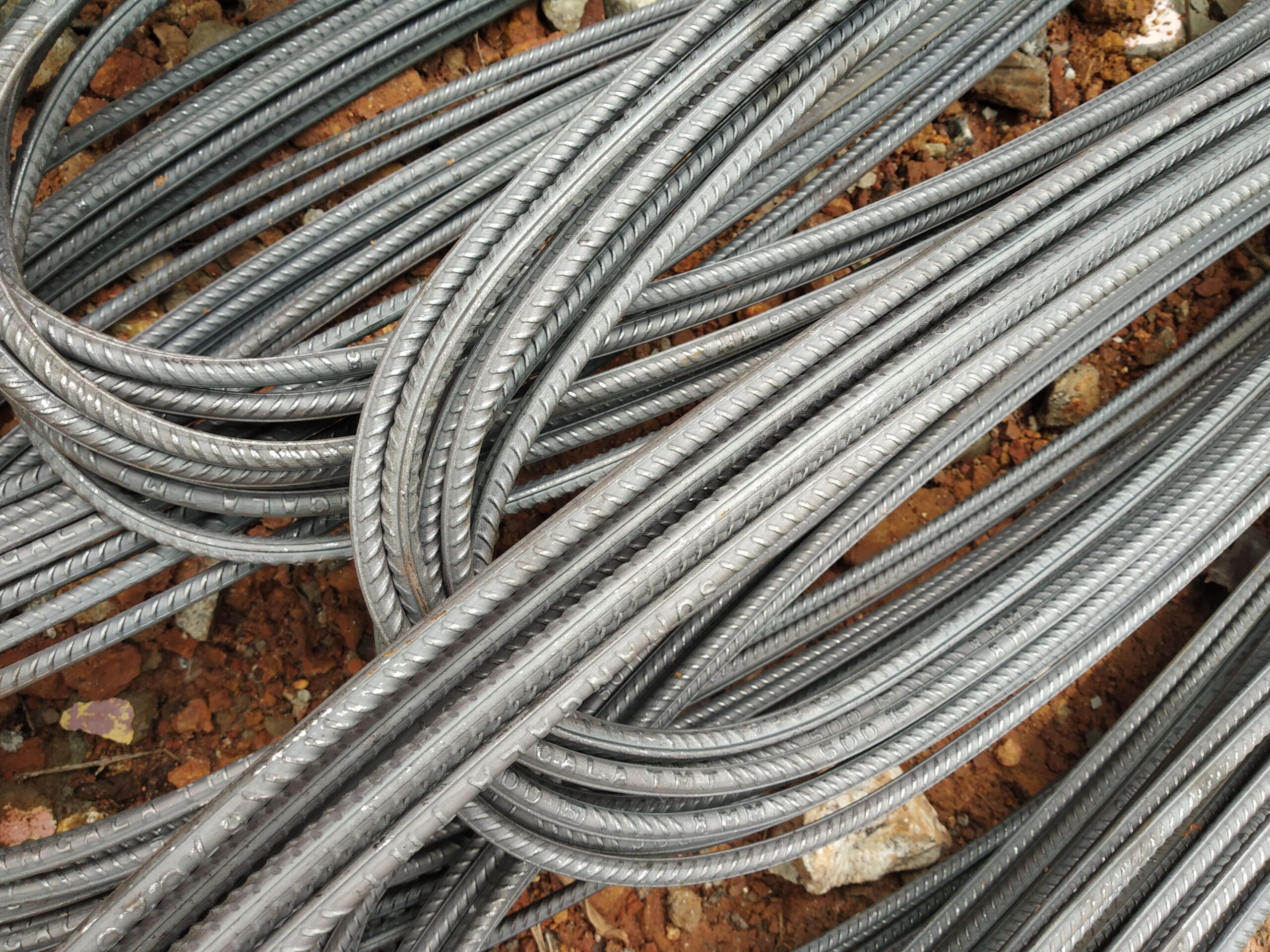
28mm Rebar: Typical Uses & Where It Is Specified
28 mm B500B rebar is a heavy-structural diameter — at 4.837 kg/m and 615.8 mm² cross-section, it delivers high individual bar capacity for the most demanding structural members in civil and building engineering. This guide explains where 28 mm bars are specified under DIN 488 / EN 10080 design practice and what makes this diameter the right choice over 25 mm or 32 mm.
Why Engineers Specify 28 mm B500B
The 28 mm diameter sits between the widely-used 25 mm bar (490.9 mm²) and the heavy 32 mm bar (804.2 mm²). Its 615.8 mm² cross-section represents a 25 % increase over 25 mm — a meaningful step-up that allows the structural designer to reduce bar count in congested reinforcement zones while staying below the handling threshold that makes 32 mm bars difficult to cut and bend economically on most fabrication setups.
Under Eurocode 2 design (EN 1992-1-1), the design yield force of a single 28 mm B500B bar is:
F_yd = A_s × f_yd = 615.8 mm² × (500/1.15) MPa ≈ 267.7 kN
This capacity per bar — approximately 27 tonnes — is why 28 mm appears in the principal tensile reinforcement of major structural members where providing an equivalent force with 20 mm or 25 mm bars would require too many bars to fit within the section geometry and cover constraints.
Primary Structural Applications for 28 mm Rebar
- Heavily loaded columns in high-rise and multi-storey construction — where axial loads from 10 or more storeys accumulate, 28 mm longitudinal bars in the column cage combine high area with a manageable bar count, simplifying cage fabrication and concrete placement.
- Deep transfer beams and belt beams — transfer structures carrying multiple column loads over open floors frequently specify 28 mm or 32 mm in the bottom tension chord. The 28 mm option is preferred where cover and anchorage geometry allows, as lap lengths and bend radii remain more manageable than at 32 mm.
- Bridge girder and box-girder soffits — civil bridge structures governed by EN 1992-2 regularly specify 28 mm in the principal bending reinforcement of girders, where long spans generate high design forces across multiple bar layers.
- Diaphragm walls and secant pile walls — large-diameter diaphragm panels used in deep basements and cut-and-cover tunnels carry 28 mm horizontal and vertical reinforcement to resist lateral earth and water pressures. See our foundations and piling applications page for related context.
- Nuclear, industrial, and infrastructure structures — heavily shielded concrete structures (reactor buildings, tunnel linings, dam monoliths) frequently specify large diameters including 28 mm and 32 mm to concentrate reinforcement area while limiting bar count and maintaining adequate aggregate pass-through gaps.
- Precast beam elements — long-span prestressed or reinforced precast beams with high moment demands use 28 mm bars in the tension zone, often combined with mechanical couplers for continuity connections at supports.
28mm Rebar: Key Properties at a Glance
| Property | Value |
|---|---|
| Nominal diameter | 28 mm |
| Cross-sectional area | 615.8 mm² |
| Weight per metre | 4.837 kg/m |
| Weight per 12 m bar | ≈ 58.0 kg |
| Bars per tonne (12 m) | ≈ 17 |
| Design yield force (B500B) | ≈ 267.7 kN per bar |
| Grade | B500B (DIN 488 / EN 10080) |
| Min. yield strength | 500 MPa |
| Ductility class | High (k ≥ 1.08, Agt ≥ 5.0 %) |
Detailing Considerations: Bending, Lapping, and Couplers
At 28 mm, detailing in compliance with Eurocode 2 requires attention to several constraints:
- Minimum bend diameter: 7× bar diameter = 196 mm internal radius — large corners and hooks require generous section dimensions or the use of mechanical couplers in lieu of standard hooks.
- Lap lengths: for B500B in C30/37 concrete with good bond conditions and ≤ 33 % bars lapped at a section, lap lengths are typically 850–1,100 mm depending on the design lap class. In congested sections, threaded mechanical couplers eliminate the lap entirely and reduce bar congestion significantly.
- Minimum bar spacing: Eurocode 2 requires clear spacing ≥ max(bar diameter, 20 mm, 1.2× dg) where dg is the aggregate maximum size. For 28 mm bars, this typically governs at 28 mm clear spacing, limiting how densely bars can be arranged.
For cut-and-bend service, shape codes under DIN 488 or BS 8666 apply. Shape fabrication of 28 mm bars requires heavy-duty bending equipment; confirm fabricator capability when procuring bent 28 mm bars.
Sourcing 28 mm B500B from Steel Rebar Germany
Steel Rebar Germany supplies 28 mm B500B in standard straight lengths (6 m, 9 m, 12 m, 18 m) and cut-to-length. Export orders are seaworthy-bundled at approximately 2 tonnes per bundle, suitable for 20 ft and 40 ft container shipment. Complete documentation — Mill Test Certificate (EN 10204 3.1), CE/DoP, Certificate of Origin, packing list — is provided. Submit your bar schedule or specification via request-a-quote for a prompt response.
Frequently Asked Questions — 28 mm Rebar Uses
Where is 28 mm rebar typically used?
What grade is 28 mm rebar supplied as?
How does 28 mm compare to 25 mm and 32 mm in structural performance?
Can 28 mm bars be mechanically coupled?
What documentation comes with 28 mm rebar orders?
Source German-standard rebar with full export documentation
Tell us your specification and destination port — we’ll respond with a detailed quotation.