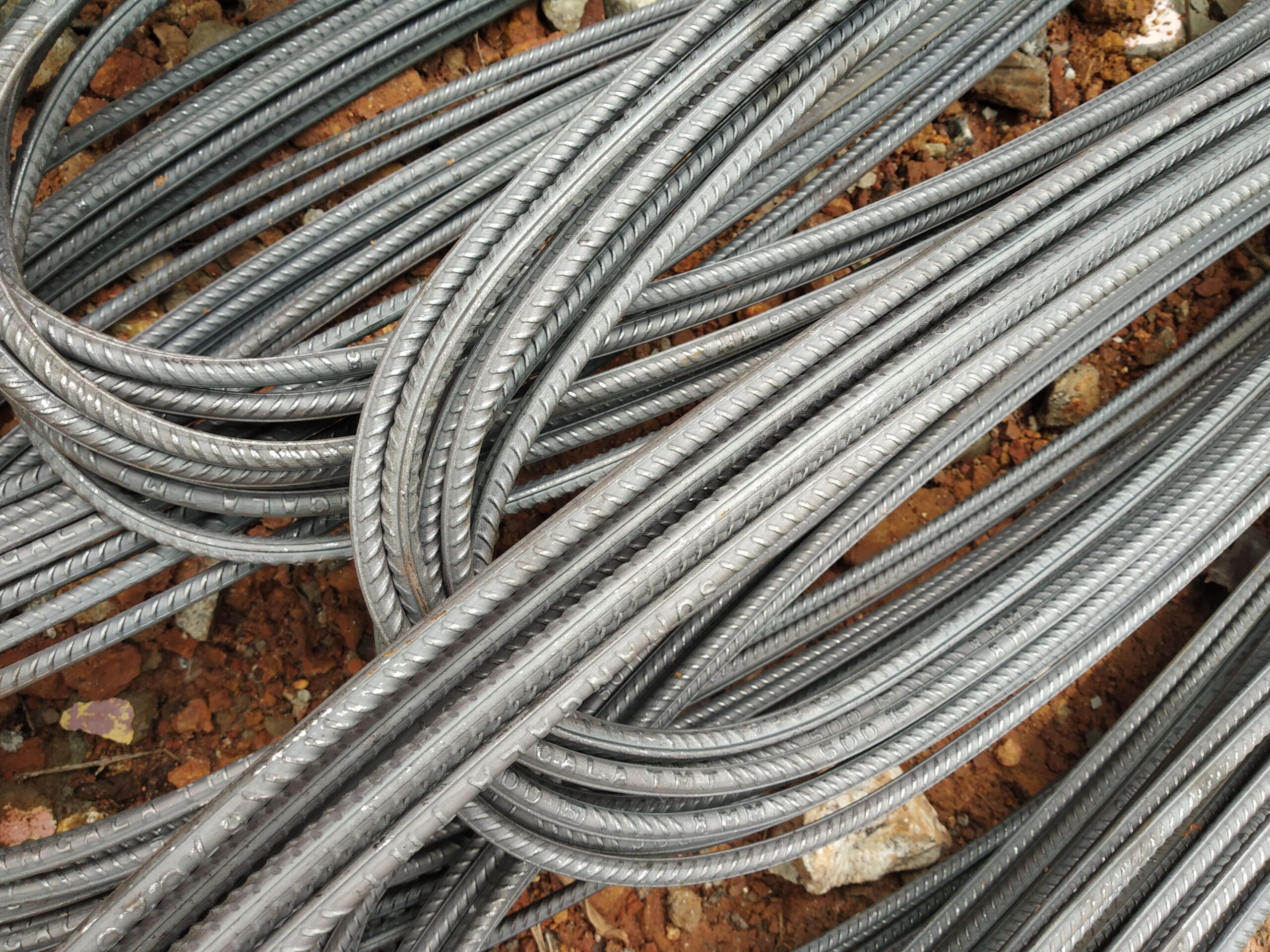
10mm Rebar: Typical Uses & Where It Is Specified
10 mm B500B reinforcing bar occupies a precise engineering niche — light enough for slabs and secondary reinforcement, strong enough for walls, columns and smaller structural elements. This guide covers where 10 mm rebar is specified, why engineers choose it, and how to source it to DIN 488 / EN 10080 standards with full export documentation.
Why 10 mm Rebar Occupies Its Own Structural Niche
In the DIN 488 / EN 10080 diameter range, 10 mm bar sits between the light-distribution sizes (6–8 mm) and the structural workhorses (12–16 mm). Its cross-sectional area of 78.5 mm² and unit weight of 0.617 kg/m give structural engineers a cost-effective choice for elements where moderate reinforcement ratios are required without the mass of larger diameters.
For a standard 12 m stock length, one bar weighs approximately 7.4 kg. That translates to roughly 135 bars per tonne — a useful figure when estimating delivery volumes. The ribbed surface profile (transverse ribs to DIN 488-1 / EN 10080 geometry requirements) ensures reliable mechanical bond with concrete at the fy = 500 MPa yield level of grade B500B.
Primary Structural Applications of 10 mm B500B
Design codes (Eurocode 2, DIN EN 1992-1-1) leave diameter selection to the structural engineer, but 10 mm appears repeatedly in certain application families:
- Reinforced concrete slabs (one-way and two-way): 10 mm at 150–200 mm centres is a common specification for domestic floor slabs and lightweight industrial decks where loading is moderate. The bar spacing remains constructable without excessive bar density.
- Wall reinforcement: Shear walls and retaining walls of moderate height typically specify 10 mm vertical and horizontal bars, often at 200 mm centres, delivering an adequate reinforcement ratio without impeding concrete placement.
- Secondary/distribution reinforcement: As transverse distribution bars in one-way slabs or as temperature and shrinkage steel in large flat elements, 10 mm complements primary bars of 16–25 mm efficiently.
- Columns with smaller cross-sections: Lightly loaded columns — up to 300 × 300 mm — may specify 10 mm longitudinal bars where the design load allows, reducing cage weight and simplifying fabrication.
- Precast concrete elements: Precast panel producers often use 10 mm for face reinforcement in sandwich panels, facade units, and staircase flights, where handling stresses govern rather than service loads.
- Pile caps and ground beams: As stirrup/link bar in pile caps, 10 mm closed links are common for piles up to 600 mm diameter, providing adequate confinement without excessive labour in bending.
10 mm Rebar Physical Properties at a Glance
| Property | Value | Standard |
|---|---|---|
| Nominal diameter | 10 mm | DIN 488-1 |
| Cross-sectional area | 78.5 mm² | EN 10080 |
| Unit weight | 0.617 kg/m | DIN 488-1 |
| Weight per 12 m bar | ≈ 7.4 kg | Calculated |
| Bars per tonne (12 m) | ≈ 135 | Calculated |
| Min. yield strength (Re) | 500 MPa | B500B / DIN 488 |
| Min. tensile/yield ratio (k) | ≥ 1.08 | B500B |
| Min. total elongation (Agt) | ≥ 5.0 % | B500B |
Comparison with Adjacent Diameters
Understanding 10 mm in context of its neighbours helps specifiers make the right call. Moving from 8 mm to 10 mm increases cross-section by 56 % (50.3 → 78.5 mm²) — a substantial gain in capacity per bar. Moving from 10 mm to 12 mm adds a further 44 % section (78.5 → 113.1 mm²). When reinforcement ratio or minimum area of steel (As,min) requirements push beyond what 8 mm can deliver at a practical spacing, 10 mm is the natural step before committing to the larger 12 mm diameter.
For stirrups and links, 10 mm is particularly popular: it is robust enough to hold position during concrete placement (unlike 6–8 mm links in deeper beams), yet still bends cleanly on automated stirrup machines and hand benders using standard mandrel sizes per EN 1992-1-1 Table NA.8.
Cut-and-Bend and Coil Supply Options
10 mm B500B is available both as straight stock bars (standard 12 m, cut lengths on request) and as rebar coil for automated processing. Coil supply is particularly suited to stirrup-bending lines that run 10 mm continuously. Where project specifications call for prefabricated shapes, bars can be supplied cut-and-bent to BS 8666 or DIN 488 shape codes with dimensional tolerances held to ±5 mm.
For export projects, 10 mm bars are bundled into seaworthy packages of approximately 2 tonnes, strapped and tagged with heat number, grade, diameter and standard — meeting the Mill Test Certificate (MTC) requirements of EN 10204 type 3.1. Learn more about export documentation and logistics.
Specifying 10 mm Rebar: Key Checklist
- Confirm grade: B500B (high ductility, hot-rolled) is required for seismic zones and most structural applications; B500A is acceptable for mesh and lightly-stressed secondary steel.
- State the applicable standard: DIN 488 or EN 10080 (both are acceptable in EU projects; specify which MTC format is required).
- Define lengths: stock 12 m or cut lengths; include cutting tolerances (typically +0/−25 mm for straight bars).
- Specify surface: ribbed (deformed) for structural bond — smooth bar is not permitted as main reinforcement under Eurocode 2.
- Declare required documentation: EN 10204 3.1 MTC, Certificate of Origin, CE/DoP where applicable.
- Confirm quantity in tonnes and bars (use 135 bars/tonne at 12 m as planning figure).
Frequently Asked Questions: 10 mm Rebar Uses
Common questions from international project buyers and engineers
Where is 10 mm rebar most commonly specified?
What is the weight of a 10 mm rebar bar per metre and per 12 m length?
Can 10 mm rebar be used for stirrups and links?
What is the difference between 10 mm B500A and B500B?
Is 10 mm rebar available in coil form for automated processing?
Source German-standard rebar with full export documentation
Tell us your specification and destination port — we’ll respond with a detailed quotation.