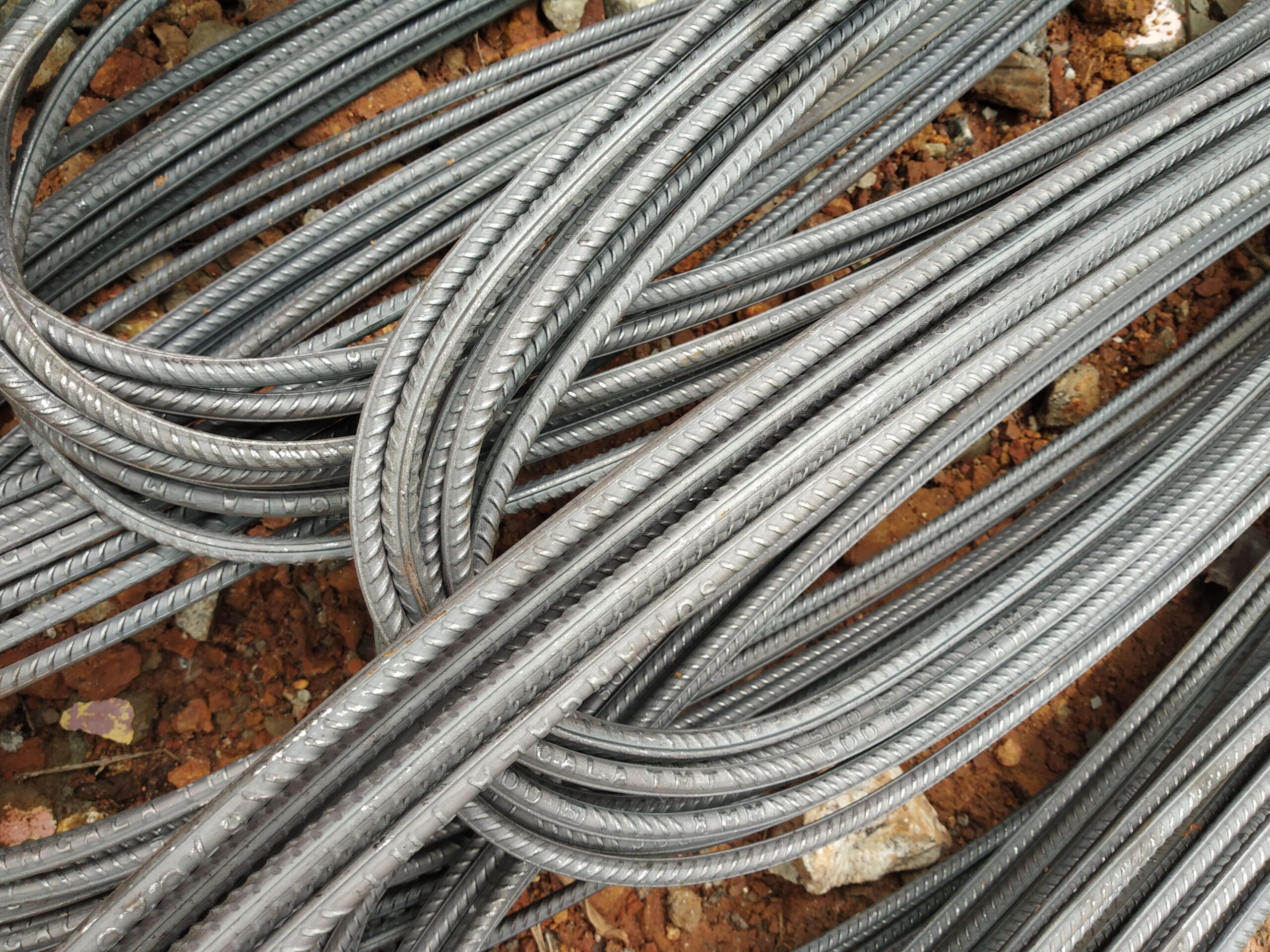
25mm Rebar: Typical Uses & Where It Is Specified
25 mm diameter B500B rebar sits at the boundary between medium and heavy reinforcement — strong enough for major structural members, still practical to handle and lap-splice on site. This guide explains exactly where 25 mm bars appear in DIN 488 / EN 10080 designs and why engineers reach for this diameter.
Why 25 mm Is a Pivotal Rebar Diameter
In the diameter range commonly specified under DIN 488, the jump from 20 mm to 25 mm represents a significant step up in load-carrying capacity. A single 25 mm B500B bar has a cross-sectional area of 490.9 mm² and weighs 3.854 kg/m — roughly 56 % more steel per metre than a 20 mm bar (314 mm², 2.47 kg/m). That extra capacity is precisely what structural engineers need when member geometry constrains the number of bars that can physically fit while maintaining the cover and spacing requirements of Eurocode 2 (EN 1992-1-1).
The weight formula confirms the figure: kg/m = d² × 0.00617 = 625 × 0.00617 = 3.854 kg/m. A standard 12 m export bar therefore weighs approximately 46.2 kg, placing it comfortably within one-person lift guidance where mechanical assistance is available on a reinforcement cage.
Primary Structural Applications for 25 mm Rebar
25 mm bars appear most frequently in the following structural contexts under German / EU design practice:
- Heavy ground-floor columns and core walls — where high axial loads from multi-storey buildings concentrate, 25 mm B500B provides the required area with manageable bar count, simplifying fabrication of tight cage assemblies.
- Transfer beams and post-tensioned beam tension zones — large longitudinal bars resist the high tensile forces in deep beams spanning over open-plan floors. 25 mm bars in two or three layers are a standard solution before stepping up to 28 mm or 32 mm.
- Bridge pier reinforcement — infrastructure designers frequently specify 25 mm for piers and abutment stems where bending moments from traffic loading and seismic checks (using B500C where required) demand high individual bar capacity.
- Raft and pile-cap tension zones — heavily loaded raft foundations carry 25 mm bottom mats to resist punching and flexure at column positions, complementing the pile foundation systems we cover in detail.
- Retaining walls and basement slabs — lateral earth pressure and hydrostatic loads in below-grade construction are often best resisted by spacing 25 mm bars at 150–200 mm centres rather than tighter arrays of 16 mm or 20 mm bars.
- Precast column and beam elements — the 25 mm diameter is compatible with most standard mechanical coupler sizes (parallel-thread systems per manufacturer specification), making it a practical choice for precast-to-in-situ connections. See our rebar couplers page for coupler compatibility.
25 mm Rebar Section & Weight at a Glance
| Property | Value |
|---|---|
| Nominal diameter | 25 mm |
| Cross-sectional area | 490.9 mm² |
| Weight per metre | 3.854 kg/m |
| Weight per 12 m bar | ≈ 46.2 kg |
| Bars per tonne (12 m) | ≈ 21.6 bars |
| Standard grade | B500B (DIN 488 / EN 10080) |
| Min. yield strength | 500 MPa |
| Characteristic ductility (k) | ≥ 1.08 |
| Uniform elongation Agt | ≥ 5.0 % |
Specification Norms and Standards
When 25 mm rebar is called out on a German or EU project, the specification almost always references one or more of the following:
- DIN 488-1: defines the reinforcing steel grades, rib geometry, and mechanical properties. B500B is the dominant weldable hot-rolled grade.
- EN 10080: the harmonised European standard for reinforcing steels, underpinning CE marking and the Declaration of Performance (DoP).
- EN 1992-1-1 (Eurocode 2): governs the structural design side — minimum cover, lap length, anchorage, and detailing rules that determine how 25 mm bars are positioned in the section.
- DIN EN ISO 17660: welding of reinforcing steel — relevant when 25 mm bars are welded (e.g., headed anchors, connection plates).
Mill Test Certificates (EN 10204 3.1) accompany every shipment we supply, confirming that the yield strength, tensile strength, elongation, and rib geometry of the specific heat comply with the declared standard. For export orders, a Certificate of Origin and CE / DoP documentation are included as standard.
Handling, Lapping, and Anchorage of 25 mm Bars
At 3.854 kg/m, a 12 m bar of 25 mm rebar weighs around 46 kg — manageable with a two-person lift or mobile crane on large sites. For fabrication purposes, 25 mm bars are cut and bent to BS 8666 or DIN 488 shape codes; minimum bend diameter is typically 7× the bar diameter (175 mm), so space for stirrup corners and hooks must be allocated carefully in the structural drawings.
Lap lengths under Eurocode 2 for 25 mm B500B in good bond conditions (C25/30 concrete, no more than 33 % lapped at a section) are typically in the range of 650–900 mm, depending on cover, bar spacing, and the design lap class. Where lap lengths become impractical — particularly in heavily reinforced sections — mechanical couplers offer a compact threaded alternative that eliminates the congestion penalty.
Sourcing 25 mm B500B from Germany
Steel Rebar Germany supplies 25 mm B500B in standard lengths of 6 m, 9 m, 12 m, and 18 m, as well as cut-to-length and cut-and-bend service. Bars are bundled in seaworthy packages of approximately 2 tonnes, suitable for container (20 ft / 40 ft) or break-bulk shipment. Full export documentation — Mill Test Certificate EN 10204 3.1, packing list, Certificate of Origin, CE/DoP — accompanies every order.
For project quantities, submit your bar schedule or specification sheet via our quote request form and we will respond with pricing and lead-time details.
Frequently Asked Questions — 25 mm Rebar Uses
Answers to the most common questions buyers and engineers ask about 25 mm diameter reinforcing bar.
What is the weight per metre of 25 mm rebar?
Where is 25 mm rebar typically specified?
What grade is 25 mm rebar normally supplied as?
How many 25 mm bars are there in a tonne?
Can 25 mm rebar be used with mechanical couplers?
Source German-standard rebar with full export documentation
Tell us your specification and destination port — we’ll respond with a detailed quotation.