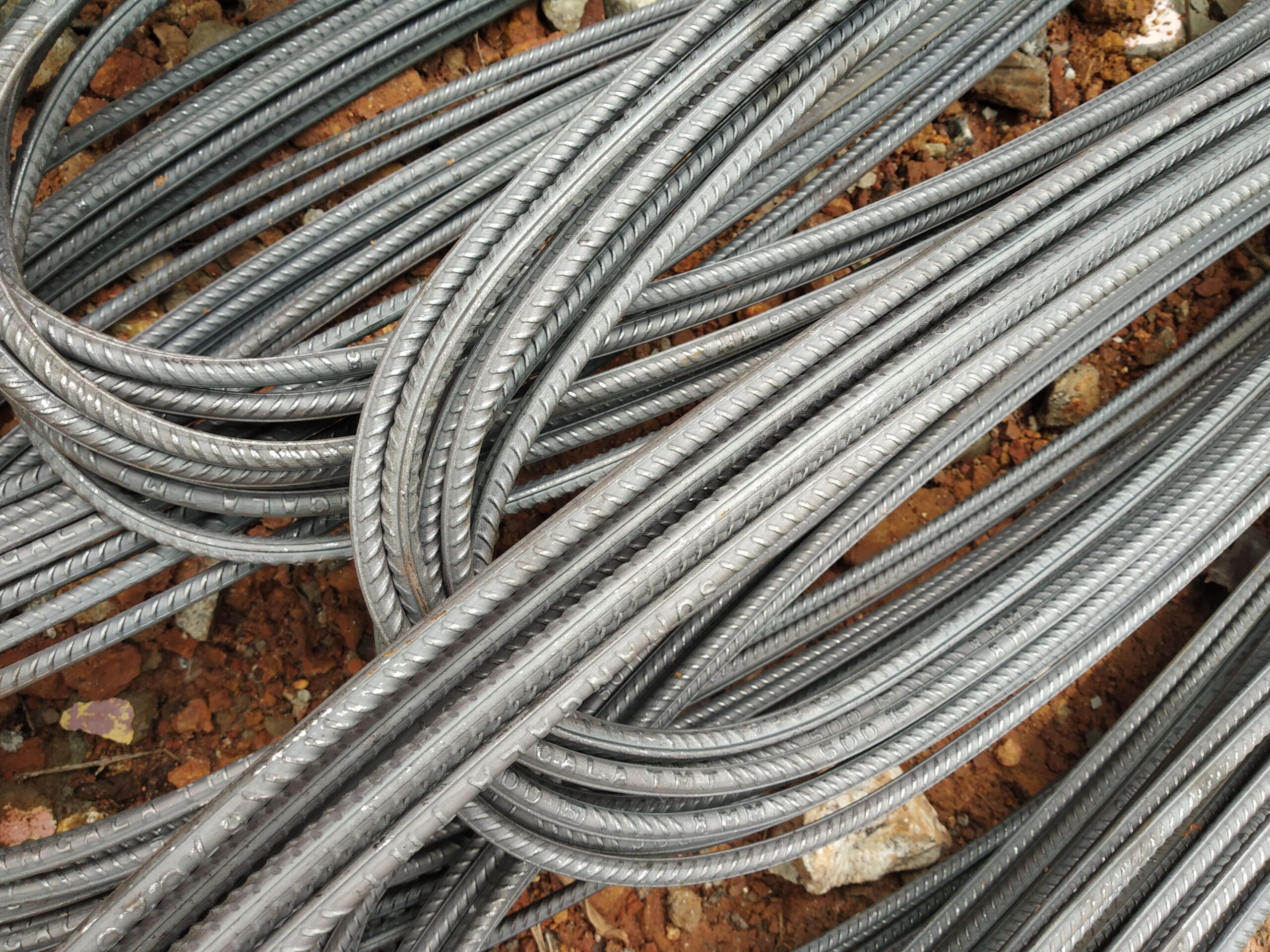
Rebar for Suspended & Ground Slabs: Sizes, Detailing & Quantities
Practical reinforcement guidance for flat slabs and ground-bearing slabs — typical bar sizes, spacing, concrete cover, and quantity estimating using DIN 488 / EN 10080 compliant B500B rebar.
Why Slab Reinforcement Specification Matters
Slabs are among the most material-intensive reinforced concrete elements on any project. Whether you are designing a ground-bearing industrial floor or a multi-storey suspended flat slab, choosing the right bar diameter, spacing and grade is central to both structural performance and procurement cost. This guide provides general, reference-level detailing information for international B2B buyers sourcing DIN 488-compliant rebar. It is not a substitute for project-specific structural engineering.
The dominant grade for slab reinforcement in German and EU practice is B500B — hot-rolled, high-ductility (k ≥ 1.08, Agt ≥ 5.0 %), 500 MPa minimum yield, conforming to DIN 488 and EN 10080. For lightly loaded secondary mesh or crack-control zones, B500A (cold-rolled, normal ductility, Agt ≥ 2.5 %) is also widely used, often supplied as ready-made mesh panels.
Typical Bar Sizes for Slab Applications
Slab main reinforcement typically runs from 10 mm to 20 mm diameter, with 12 mm and 16 mm being the most common choices across residential, commercial and infrastructure projects. Secondary (distribution / anti-crack) bars are frequently 8 mm or 10 mm. The table below gives unit weights and cross-sections for the most relevant diameters:
| Diameter (mm) | Weight (kg/m) | Cross-section (mm²) | Typical slab use |
|---|---|---|---|
| 8 | 0.395 | 50.3 | Distribution / anti-crack bars |
| 10 | 0.617 | 78.5 | Light slabs, mesh secondary layer |
| 12 | 0.888 | 113 | Residential flat slabs, ground slabs |
| 16 | 1.58 | 201 | Commercial suspended slabs, heavy ground floors |
| 20 | 2.47 | 314 | Transfer slabs, heavily loaded podium decks |
| 25 | 3.85 | 491 | Thick transfer plates, pile caps with slab action |
Spacing and Cover Requirements
Eurocode 2 (EN 1992-1-1) governs design in Germany and across the EU. Key detailing principles for slabs include:
- Main bar spacing: Typically 100 mm–200 mm centre-to-centre in each direction for two-way spanning slabs; up to 300 mm for one-way slabs under modest load.
- Minimum concrete cover: 20 mm for internal elements (XC1 exposure class), 30–40 mm for external or aggressive environments (XC2–XC4, XD classes). Cover is measured to the outermost bar.
- Minimum bar spacing: Not less than the maximum aggregate size + 5 mm, and not less than the bar diameter.
- Maximum bar spacing: Eurocode 2 §9.3 limits main bar spacing to 3h or 400 mm (whichever is smaller) for slabs where h is the slab depth.
- Two-layer arrangement: Suspended slabs carry bottom steel in the span and top steel over supports; ground slabs often use a single central layer or top-and-bottom mesh.
For ground-bearing slabs on prepared sub-base, a damp-proof membrane (DPM) beneath the concrete reduces the moisture exposure class; minimum cover can sometimes be reduced accordingly, but local ground conditions and engineer’s specification govern.
Estimating Rebar Quantities for Slabs
A reliable starting point for quantity take-off uses the unit weight formula from DIN 488: kg/m = d²(mm) × 0.00617. For a practical order estimate, multiply bar weight per metre by total bar length and add a waste allowance (typically 5–8 % for standard cut-and-bend, less if pre-cut mesh panels are used).
Example: A 200 m² ground slab, 200 mm thick, with T12 @ 150 mm both ways top and bottom. Each direction: 200 m / 0.15 = 1,334 bars × 10 m average length = 13,340 m. Four layers × 13,340 m = 53,360 m of 12 mm bar. At 0.888 kg/m that is approximately 47,400 kg (47.4 t) before waste. Real projects require a full bar bending schedule per DIN 488 or BS 8666.
For large slab orders, standard reinforcing mesh panels (e.g. 6.0 × 2.3 m, Q-type) can significantly reduce on-site labour. We supply both loose B500B bars and mesh to DIN 488-4.
Sourcing DIN 488-Compliant Slab Rebar for Export
International projects targeting German or EU-standard documentation require a Mill Test Certificate (MTC) to EN 10204 3.1, which certifies the heat/cast-specific mechanical and chemical properties of each bar batch. This is a mandatory document for EU-standard projects and increasingly demanded by international project lenders and insurance underwriters.
We supply B500B rebar in straight bars (8–40 mm, 6–18 m length) and coil form (6–16 mm) for automated processing. All export shipments include the MTC, Certificate of Origin, CE Declaration of Performance, packing list, and seaworthy bundle packaging typically in 2-tonne lifts — ready for container or break-bulk loading. Lead times and minimum order quantities depend on specification; use the quote form to share your bar schedule and destination port.
See also: Rebar for Pad & Strip Footings and Rebar for Beams & Lintels for complementary structural element guides.
Frequently Asked Questions — Slab Rebar
Common questions from international buyers and project engineers about reinforcing slabs with DIN 488-compliant rebar.
What rebar grade should I specify for a suspended flat slab to EN 1992-1-1?
How does concrete cover differ between ground slabs and suspended slabs?
Can I use reinforcing mesh instead of loose bars for slab construction?
What is the typical rebar density (kg/m³) for a reinforced concrete slab?
Do you supply rebar pre-cut and bent to my bar schedule?
Source German-Standard Rebar with Full Export Documentation
Tell us your slab specification, bar schedule and destination port — we’ll respond with a detailed quotation including MTC and logistics options.