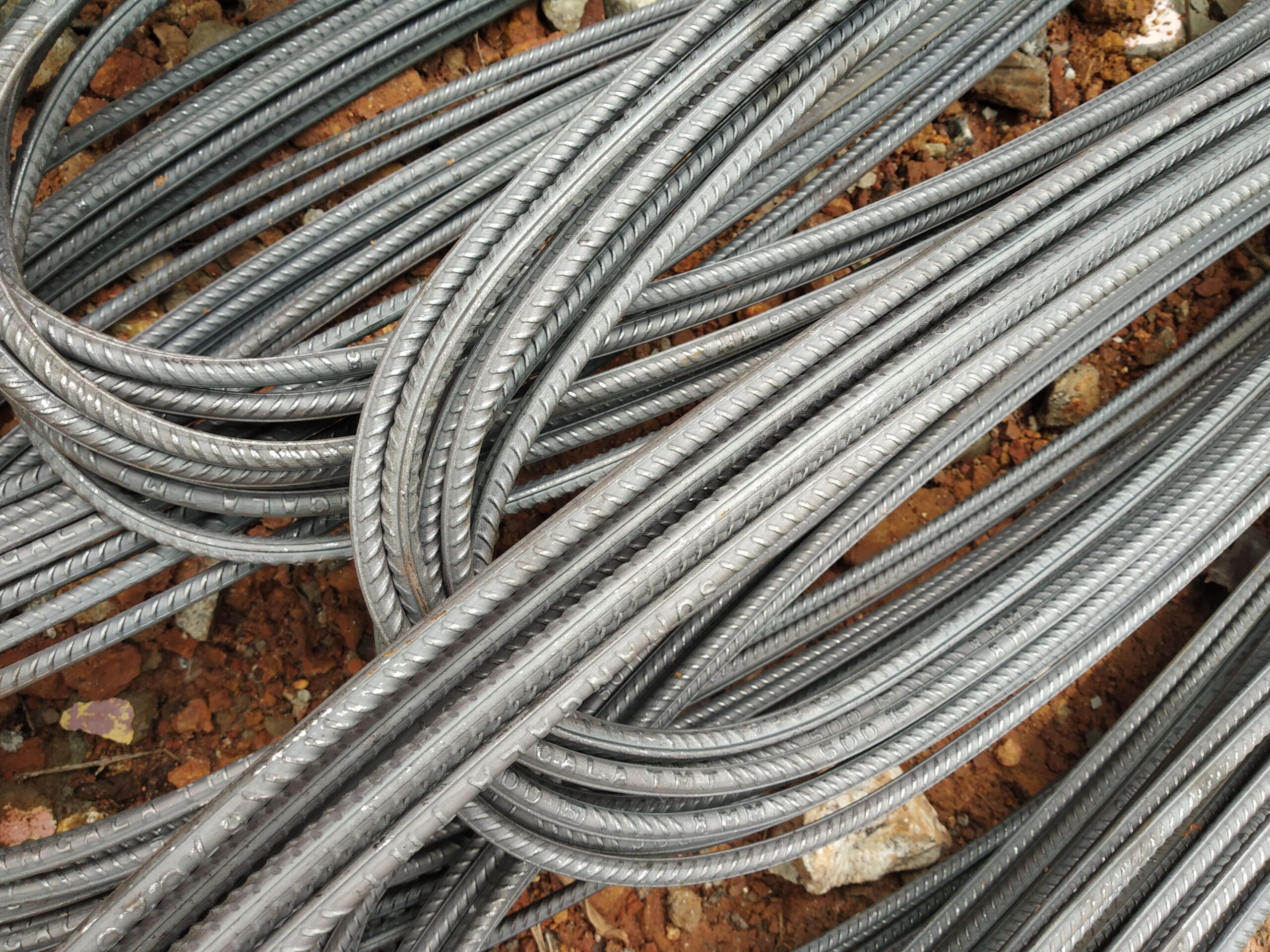
How Many 14mm Rebar Bars in a Tonne?
14mm B500B rebar weighs 1.209 kg per metre — meaning a standard 12 m bar tips the scales at approximately 14.5 kg, yielding around 69 bars per tonne and roughly 827 metres of steel. Use this guide to plan procurement, estimate bundle quantities and verify supplier quotations.
The 14mm Rebar Weight Formula
The mass per unit length of any round steel bar follows a simple relationship derived from the material density of carbon steel (approximately 7,850 kg/m³) and the bar’s cross-sectional area:
kg/m = d² (mm) × 0.00617
For a 14 mm nominal diameter bar: 14² × 0.00617 = 196 × 0.00617 = 1.209 kg/m. The cross-sectional area is π/4 × 14² = 153.9 mm² (commonly rounded to 154 mm² in structural schedules).
This figure is consistent across DIN 488 and EN 10080, the governing standards for reinforcing steel supplied from Germany and the broader EU. Every Mill Test Certificate (EN 10204 3.1) issued by German steel mills will reference this nominal weight and section.
14mm Rebar: Weight and Quantity Reference Table
| Bar length | Weight per bar (kg) | Bars per tonne | Metres per tonne |
|---|---|---|---|
| 6 m | 7.25 | 138 | 828 |
| 9 m | 10.88 | 92 | 828 |
| 12 m (standard) | 14.51 | ≈ 69 | ≈ 827 |
| 15 m | 18.14 | 55 | 825 |
| 18 m | 21.76 | 46 | 828 |
Note that metres per tonne remains essentially constant regardless of cut length because you are dividing the same total steel mass by the same unit weight — a useful cross-check when converting between tonnes and bar counts in procurement documents.
Practical Bar-Count Calculations for 14mm Rebar
Buyers sourcing in full tonnes of 14mm rebar can use the following working rules:
- 1 tonne = 69 bars × 12 m (standard stock length; minor rounding applies).
- 1 tonne = 827 metres of 14mm bar — apply this when scheduling reinforcement by linear metre of structure.
- Bundle weight: Mills typically bundle 14mm bars at 2–3 tonnes per seaworthy bundle for export. At 14.51 kg per 12 m bar, a 2-tonne bundle contains approximately 138 bars.
- Container load: A 20-ft container accommodates bars up to 6 m; a 40-ft flat-rack or open-top handles 12–18 m bars. Volume and weight limits govern — 14mm bars at 12 m typically allow up to approximately 18 tonnes per flat-rack depending on routing.
Why 14mm Rebar Is Commonly Specified
The 14mm diameter sits between the lighter 12mm and the heavier 16mm in typical structural schedules. It is frequently specified for:
- Secondary beams and lintels where 12mm lacks bending capacity.
- Column ties and links alongside 20–25mm main bars.
- Slab reinforcement in mid-range span designs (4–6 m slabs at moderate live loads).
- Retaining wall vertical bars where deflection control governs over pure strength.
In Germany and across the EU, 14mm bars are supplied in grade B500B (high ductility, 500 MPa minimum yield, characteristic elongation Agt ≥ 5.0%, strength ratio k ≥ 1.08) per DIN 488 / EN 10080. For seismic zones, B500C (Agt ≥ 7.5%) is available on request. See our steel grades guide for a full comparison.
Ordering 14mm Rebar: What to Specify
When requesting a quotation for 14mm rebar, include the following in your enquiry to ensure an accurate offer:
- Grade: B500B (standard) or B500C (seismic).
- Length: Stock 12 m, or custom cut-and-bend lengths per DIN 488 shape codes / BS 8666.
- Quantity: State in tonnes or bar count — we convert either way.
- Surface: Ribbed (deformed) as standard for structural use; plain bar on request.
- Documents required: Mill Test Certificate EN 10204 3.1, Certificate of Origin, CE Declaration of Performance.
- Destination port and Incoterms: We supply on FOB, CFR and CIF terms worldwide.
For cut-to-length or bent assemblies, visit our cut-and-bend service page.
Frequently Asked Questions — 14mm Rebar Bar Count
Quick answers to the most common questions buyers ask when ordering by tonne.
Exactly how many 14mm rebar bars are in one tonne?
How many metres of 14mm rebar are in a tonne?
Does bar length affect the number of bars per tonne?
What is the cross-sectional area of a 14mm rebar bar?
Can Steel Rebar Germany supply 14mm rebar with full export documentation?
Source German-standard rebar with full export documentation
Tell us your specification and destination port — we’ll respond with a detailed quotation.