How Is Steel Rebar Made?
Steel rebar begins as scrap metal or virgin billet and ends as a precisely deformed reinforcing bar verified to DIN 488 and EN 10080. Understanding the manufacturing route — electric arc furnace, continuous casting, hot-rolling, and quenching — explains why grade, ductility, and traceability matter in procurement.
Step 1 — Raw Material: Scrap Steel and the Electric Arc Furnace
The dominant production route for reinforcing steel in Germany and across Europe is the Electric Arc Furnace (EAF) route, also called the mini-mill or scrap-based route. The primary raw material is ferrous scrap — recycled steel from demolished structures, end-of-life vehicles, industrial offcuts, and post-consumer steel products. This makes EAF-produced rebar one of the most recycled construction materials in the world, with typical recycled content exceeding 90 %.
In the EAF, a powerful electric arc (typically 100–300 MVA) melts the scrap charge at temperatures above 1,600°C. Once melted, the liquid steel is transferred to a ladle furnace (secondary metallurgy) where the chemical composition is precisely adjusted — carbon, manganese, silicon, phosphorus, and sulfur are brought within the tight limits specified by DIN 488. This is the stage where the alloy chemistry that determines yield strength, ductility class, and weldability is locked in.
Step 2 — Continuous Casting: Billet Formation
The ladle of refined liquid steel is transferred to a continuous casting machine, where it is poured through a water-cooled copper mould and withdrawn as a solidifying strand. For rebar production, the cross-section produced is a square billet, typically 120×120 mm to 160×160 mm, cut into lengths of 6–12 m. Each billet carries a heat number traceable back to the EAF charge, the scrap mix, and the ladle chemistry — this traceability chain is the foundation of the EN 10204 3.1 Mill Test Certificate issued with the finished bars.
Step 3 — Reheating and Hot Rolling
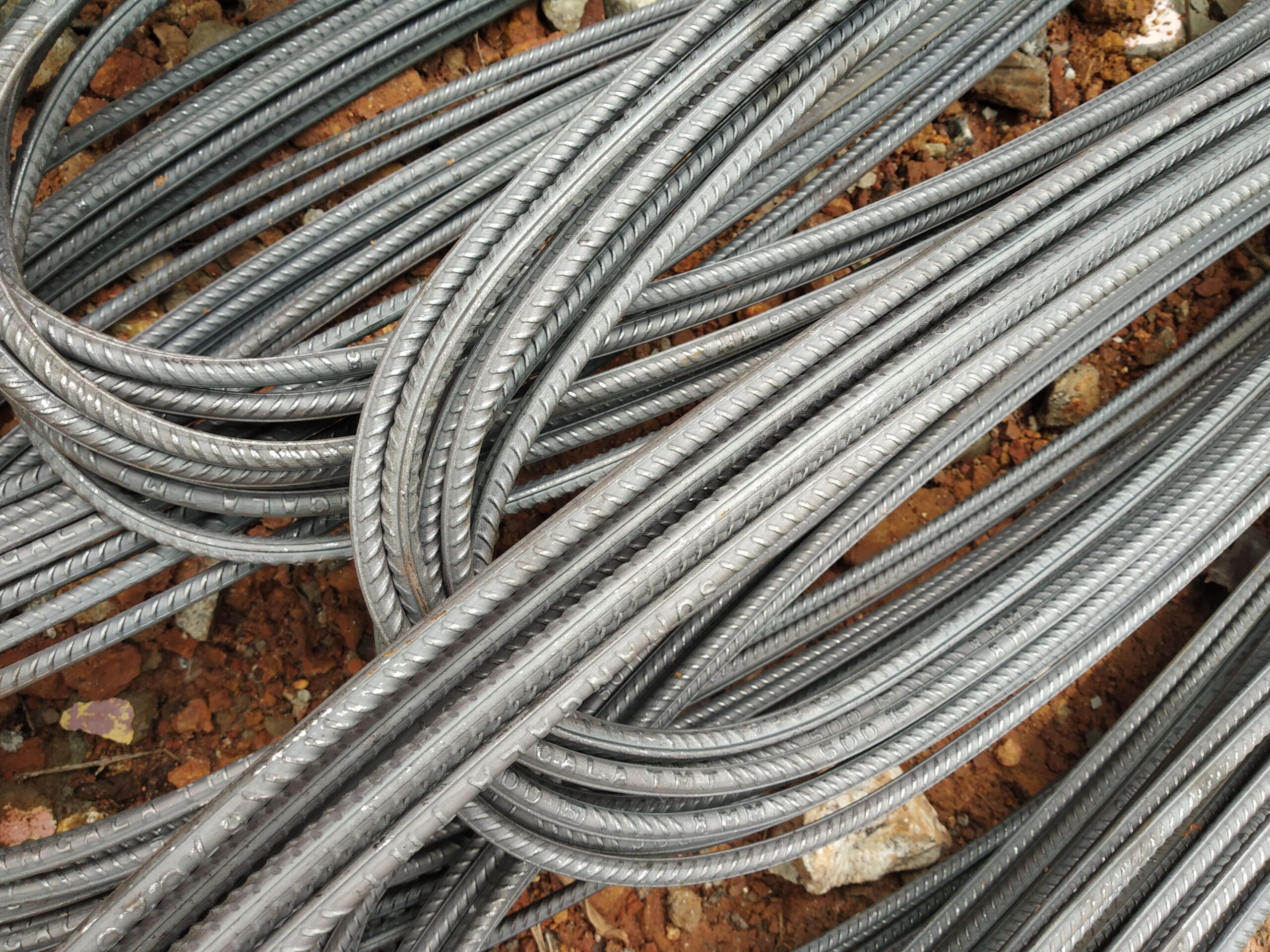
Cold billets are reheated in a walking-beam or pusher furnace to approximately 1,050–1,200°C — the temperature range at which the steel is in a single-phase austenite condition, plastically workable with low rolling forces. The heated billet passes through a series of rolling mill stands (typically 16–20 passes) where it is progressively reduced in cross-section and elongated. Final stands shape the circular cross-section and, critically, impress the transverse ribs and longitudinal fins directly into the bar surface using profiled grooves machined into the work rolls.
This is the stage that creates the deformed surface. There is no secondary operation to add ribs — they are formed during the same rolling pass that reduces the bar to its final diameter. The rib geometry is therefore controlled by the roll profile and verified against EN 10080 relative rib area (fR) requirements during periodic roll inspection and qualification.
Step 4 — Quenching and Self-Tempering (TMT / QST Process)
To achieve the high ductility required by B500B (Agt ≥ 5.0 %, k ≥ 1.08) without adding expensive alloying elements, German mills typically apply the Quenching and Self-Tempering (QST) process — marketed under trade names such as Tempcore or similar. Immediately after the final rolling pass, the bar surface is rapidly quenched by water jets, forming a hard martensitic outer case. The residual heat from the bar core then re-tempers this outer case as the bar cools in air, converting it to a tough tempered martensite. The core remains as a fine-grained ferrite-pearlite structure with high ductility.
The result is a composite cross-section: a tough outer ring providing the yield strength, and a ductile core providing the elongation at maximum force (Agt) needed for ductility Class B. This two-zone microstructure can be observed in a cross-section etch of the bar.
Step 5 — Cooling, Cutting, Bundling and Testing
After quenching, bars travel along a cooling bed where they are air-cooled to ambient temperature. They are then cut to length (typically 6, 12, or 18 m), bundled in standard weights, and tagged with heat and lot numbers. Before release, samples are taken per DIN 488 / EN 10080 requirements for tensile testing (yield strength Re, tensile strength Rm, elongation Agt), bend testing, rib geometry measurement, and chemical analysis. All results are recorded on the EN 10204 3.1 Mill Test Certificate, which accompanies every shipment.
Rebar Manufacturing Summary
| Stage | Process | What it Controls |
|---|---|---|
| 1 — Melting | Electric Arc Furnace (EAF) | Chemical composition (C, Mn, P, S, Si) |
| 2 — Casting | Continuous casting → billet | Internal soundness, heat traceability |
| 3 — Rolling | Hot rolling, profiled rolls | Diameter, rib geometry (fR), tolerances |
| 4 — QST | Quenching & Self-Tempering | Yield strength, ductility class (k, Agt) |
| 5 — Testing | Mechanical & chemical per DIN 488 | EN 10204 3.1 MTC, CE marking |
For a detailed breakdown of the mechanical properties produced by this route, see the B500B rebar product page and the standards and certification overview.
Related Reading
Frequently Asked Questions
Common questions about how reinforcing steel is manufactured.
What is the difference between EAF rebar and blast furnace rebar?
What is the QST / Tempcore process and how does it affect ductility?
Can rebar be welded, and does the manufacturing process affect weldability?
Why does heat number traceability matter for export shipments?
What is the standard length for rebar bars, and can custom lengths be supplied?
Source German-standard rebar with full export documentation
Tell us your specification and destination port — we’ll respond with a detailed quotation.