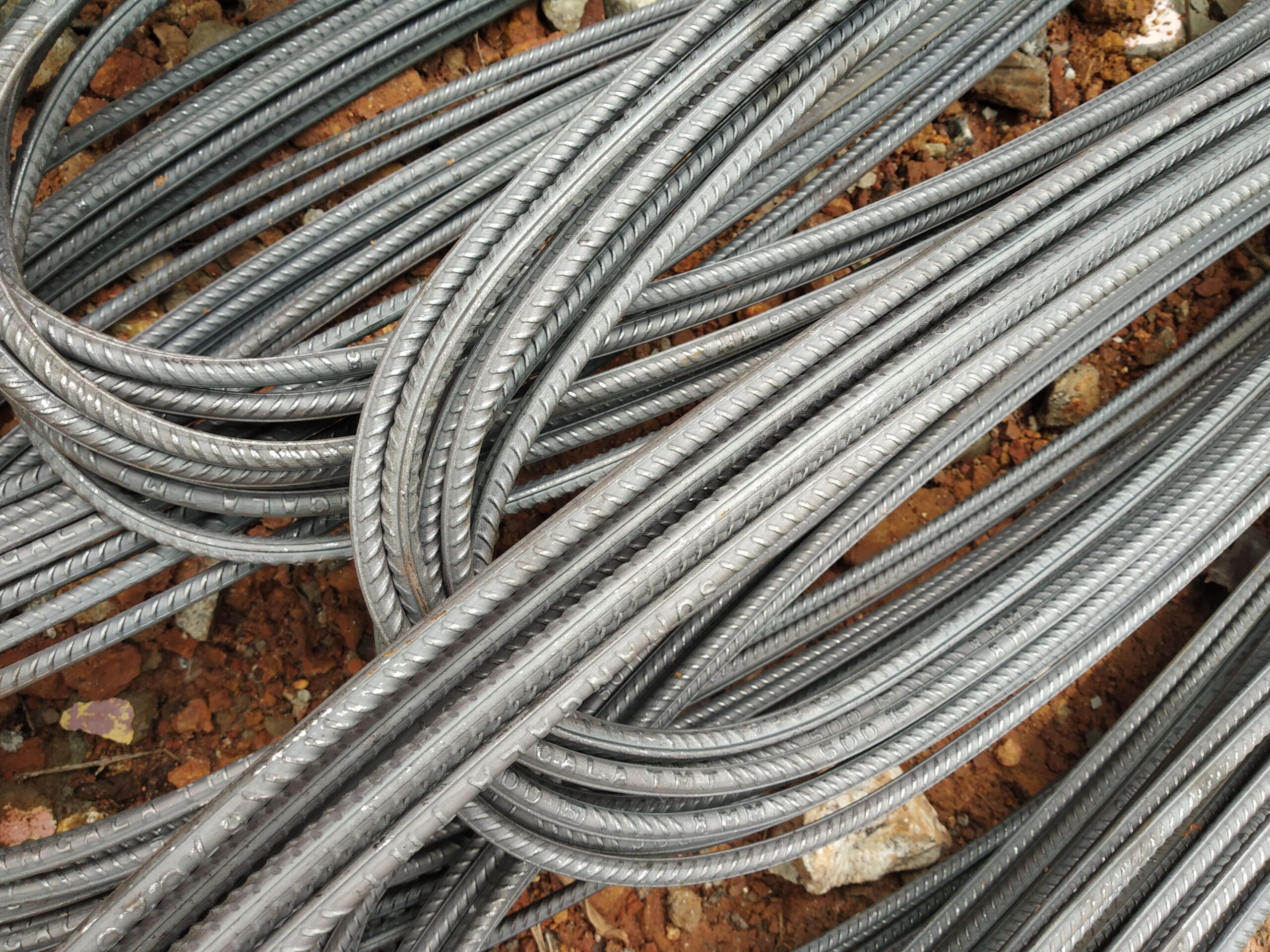
How to Identify Rebar Grade from Markings
Every compliant B500B bar carries a rolled-in marking system that encodes the producer, diameter, ductility class, and country of origin directly on the bar surface. Knowing how to read these marks lets site teams and procurement officers verify grade compliance before a single bar is placed.
Why Rolled-In Markings Exist
EN 10080 and DIN 488 require that every reinforcing bar carry permanent identification marks rolled directly into the bar surface during the final pass of the hot-rolling mill. These marks serve two purposes: they allow the ductility class and country of production to be verified visually without reference to a Mill Test Certificate, and they provide a non-removable link between the physical bar and its production documentation. Paint, stickers, and bundle tags can be lost in transit or swapped; rolled-in marks cannot.
For international procurement, the ability to cross-check bar markings against the accompanying MTC is an important quality-assurance step that site engineers and third-party inspectors routinely perform on delivery.
The Four Elements of an EN 10080 Bar Marking
EN 10080 defines four compulsory marking elements, each rolled into the longitudinal or transverse rib pattern of the bar. They appear in the following order along the bar length:
- Producer mark: One or more letters or symbols identifying the rolling mill. Each mill registers a unique producer mark with the national standardisation body. German mills typically use a 1–3 character code.
- Nominal diameter: The bar diameter in millimetres, encoded as a number of consecutive transverse ribs or as a rolled figure, depending on the mill’s chosen marking system. Both the “gap” system (a missing rib gap counts the diameter in units of 2 mm) and direct numerical impression are used.
- Ductility class indicator: The critical identification for grade. Under EN 10080:
- Class A (B500A): no extra mark (absence of dots)
- Class B (B500B): one continuous longitudinal rib (in addition to the standard ribs), or a single raised dot or dash between rib rows on one side of the bar
- Class C (B500C): two continuous longitudinal ribs, or two raised dots/dashes
- Country of production code: A country identifier encoded as a number of dots or a registered symbol — for example, Germany uses the code consistent with its national registration.
Reading the Marks: A Practical Field Guide
On a typical German B500B bar, the sequence of marks visible on the bar surface will be:
| Mark element | Appearance on bar | What it confirms |
|---|---|---|
| Producer symbol | Rolled letters or logo between rib rows | Which mill produced the bar |
| Diameter code | Rib gap count or rolled numeral | Nominal diameter (e.g. 16 mm) |
| Ductility class | Single raised dot or extra longitudinal rib | Class B = B500B |
| Country code | Dot pattern or registered symbol | Country of production (DE = Germany) |
To read diameter from the rib-gap system: count the number of ribs between the two blank gap zones. Each gap unit corresponds to 2 mm of nominal diameter — so a gap sequence indicating 8 units means a 16 mm bar. Direct numerical impressions (where the number “16” is visibly pressed into the bar surface) are increasingly common on modern rolling mills and are easier to read in the field.
Ductility Class Dots: The Most Important Mark for Procurement
For procurement and site verification purposes, the ductility class indicator is the most critical marking to check. Specifying “500 MPa rebar” without confirming Class B can result in Class A material (B500A) being delivered — which, as discussed in the related post on B500B vs Grade 500, has different ductility requirements and is not suitable for all structural applications.
The field check is straightforward:
- No ductility mark between the producer symbol and diameter indicator = Class A (B500A)
- One mark (dot, dash, or extra longitudinal line) = Class B (B500B)
- Two marks = Class C (B500C)
If the ductility mark is absent or ambiguous, cross-reference with the EN 10204 3.1 Mill Test Certificate, which must state the grade designation explicitly as “B500B” (not merely “500 N/mm²”).
Bundle Tags and Heat Number Labels
In addition to rolled bar markings, every bundle of German rebar is accompanied by a bundle tag or steel strap label stating the heat number, grade, diameter, length, and quantity. The heat number on the tag must match the heat number on the EN 10204 3.1 MTC. On import projects, customs documentation, Certificate of Origin, and the CE Declaration of Performance carry the same heat and lot information, creating a complete traceability chain from the original EAF melt to the delivered bundle.
For guidance on the full documentation package that accompanies export shipments, see the export and delivery page. For a detailed comparison of grade designations, visit the steel grades overview.
Related Reading
Frequently Asked Questions
Common questions about reading and verifying rebar grade markings.
Can I identify rebar grade from bar markings alone, without a Mill Test Certificate?
What does a single raised dot on a rebar mean?
Do different countries use the same bar marking system?
Can bar markings be forged or faked?
What happens if bars arrive without readable markings?
Source German-standard rebar with full export documentation
Tell us your specification and destination port — we’ll respond with a detailed quotation.