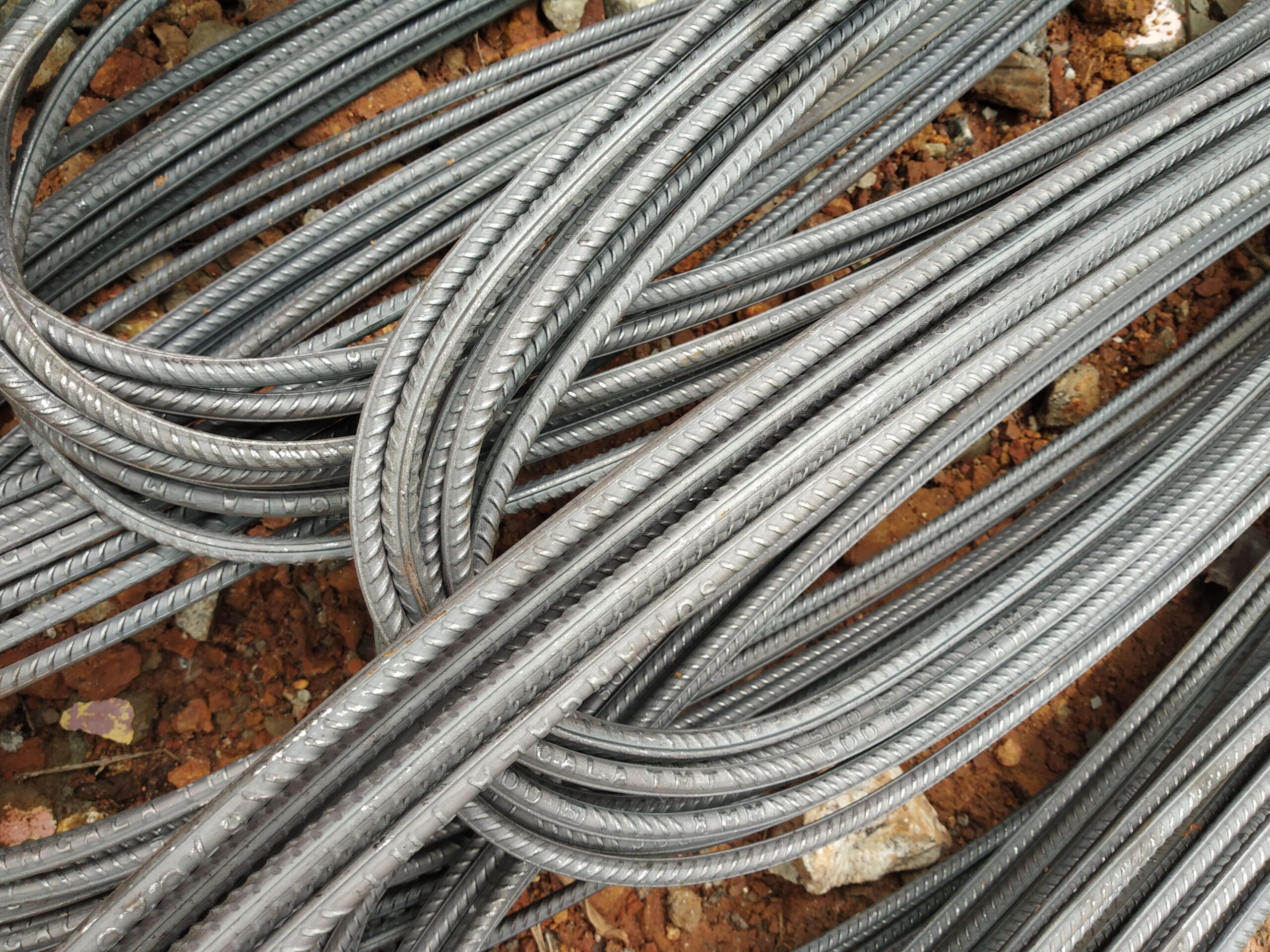
Ribbed vs Plain Round Bar: Which Reinforcing Steel Do You Need?
An authoritative comparison of deformed (ribbed) and plain round reinforcing bar — covering bond behaviour, applicable standards, typical applications, and how to specify the right product for your project.
Ribbed vs Plain Rebar: The Core Distinction
The most fundamental distinction in reinforcing steel is between deformed (ribbed) bar and plain round bar. The surface geometry determines how the bar bonds to concrete, which directly governs structural performance, lap length requirements, and code compliance. For the vast majority of structural reinforced concrete applications under European and German standards, deformed ribbed bar is the required product.
Deformed (Ribbed) Reinforcing Bar
Ribbed rebar — the dominant product in German and EU structural construction — features transverse ribs and longitudinal fins rolled directly into the bar surface during hot rolling. These surface deformations create mechanical interlock with the surrounding concrete matrix, dramatically improving the bond between steel and concrete compared to a smooth surface.
Under DIN 488 and EN 10080, deformed bars must meet defined rib geometry parameters (relative rib area fR ≥ 0.056) to be classified as high-bond (HB) reinforcement. The standard grades — B500A, B500B, and B500C — are all produced as deformed bar. B500B is the workhorse grade for general structural work: 500 MPa minimum yield strength, high-bond surface, high ductility (k ≥ 1.08, Agt ≥ 5.0%).
Because of the enhanced bond, ribbed bars require shorter development and lap lengths than plain bars — a major design advantage that reduces material usage and simplifies detailing under Eurocode 2.
Plain Round Bar
Plain round bar has a smooth, undeformed surface. Without mechanical interlock, bond with concrete relies entirely on friction and end anchorage (hooks or bends), requiring significantly longer lap and anchorage lengths. Plain bar is also designated as normal-ductility class (Class A under EN 1992-1-1).
Plain round bar is rarely specified for primary structural reinforcement in modern European practice. Its principal uses today include:
- Dowel bars in pavement/slab joints (where some slip is intentional)
- Starter bars and holding-down bolts in specific connection details
- Legacy repair work on older structures originally built with plain bar
- Wire products (tying wire, light mesh) in some manufacturing contexts
Side-by-Side Comparison
| Property | Ribbed (Deformed) Bar | Plain Round Bar |
|---|---|---|
| Surface | Transverse ribs + longitudinal fins | Smooth, undeformed |
| Bond to concrete | Mechanical interlock (high bond) | Friction only (low bond) |
| Standard grades | B500A, B500B, B500C (DIN 488 / EN 10080) | Not assigned a B500 grade under EN 10080 |
| Ductility class | A, B, or C depending on grade | Class A (normal ductility) |
| Development length | Short (standard Eurocode 2 tables) | Long (hooks/bends required) |
| Typical structural use | Beams, columns, slabs, walls, foundations | Dowels, joints, legacy/repair |
| Welding | DIN EN ISO 17660 (weldable grades) | Generally weldable |
Which Should You Specify?
If your project is governed by Eurocode 2 (EN 1992-1-1), the German national annex, or any equivalent European national code, the answer is almost always ribbed deformed bar, grade B500B (or B500C for seismic applications). Plain bar may only be used for primary reinforcement in Eurocode 2 with explicit detailing provisions to compensate for the reduced bond — provisions that increase material quantities and are rarely cost-effective.
For procurement purposes, always confirm the surface type and standard on the Mill Test Certificate. All B500B rebar supplied by Steel Rebar Germany is produced as high-bond deformed bar to DIN 488 / EN 10080, with EN 10204 3.1 Mill Test Certificates included as standard.
Related Resources
Standards & Certification
DIN 488, EN 10080 and full export documentation for every shipment.
Learn more →Rebar Ductility Explained
Class A / B / C ductility — what the parameters mean for your design.
Learn more →Frequently Asked Questions
Is ribbed bar always required for structural concrete?
What does “high bond” mean on a Mill Test Certificate?
Can plain round bar be used to replace ribbed bar in repairs?
Does Steel Rebar Germany supply plain round bar?
Source German-standard rebar with full export documentation
Tell us your specification and destination port — we’ll respond with a detailed quotation.