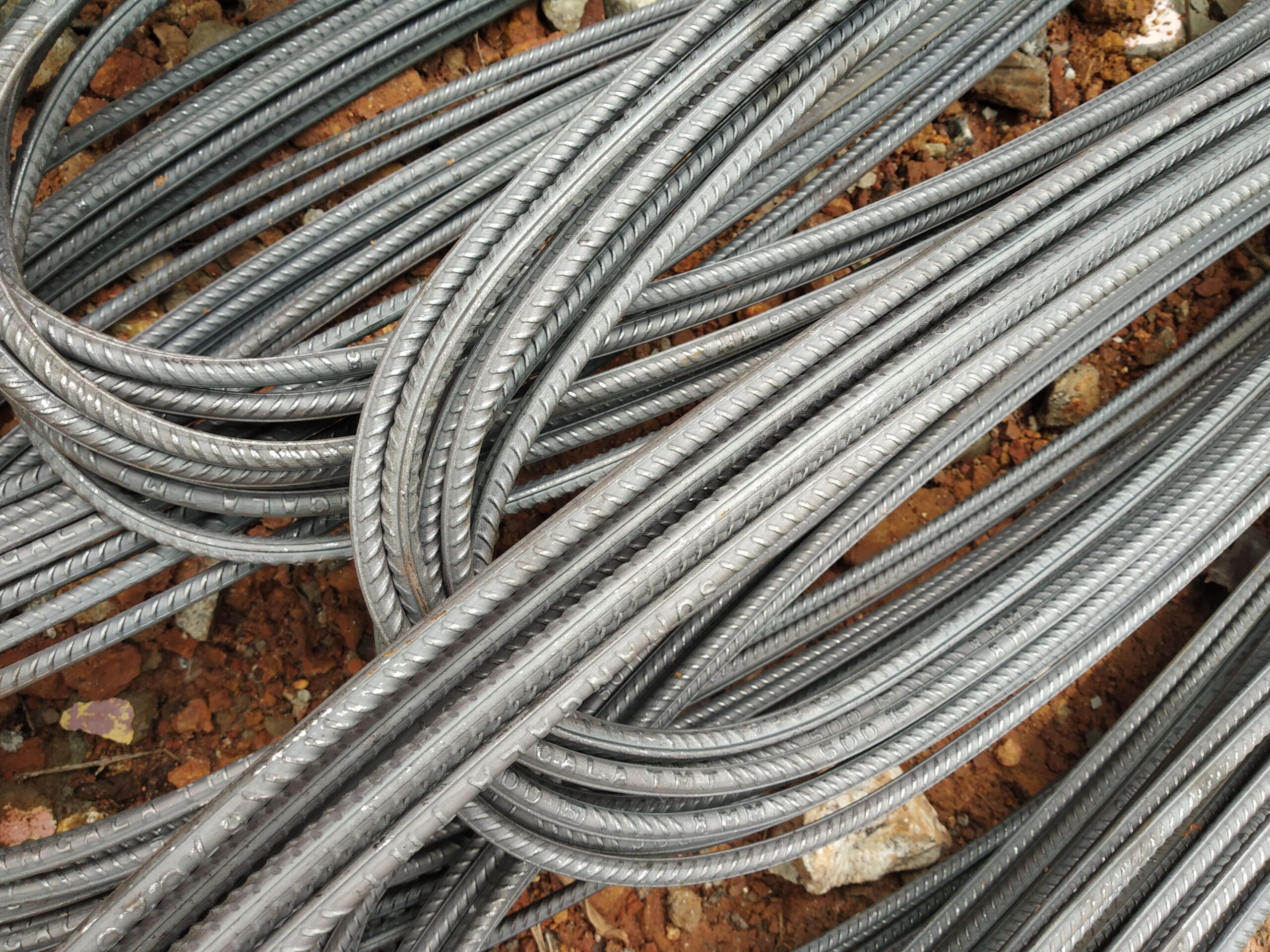
What Do the Numbers on Rebar Mean? Diameter, Grade, and the B500 Marking System
Every piece of European reinforcing steel carries a mandatory rolled-on marking. Understanding what the numbers on rebar mean — diameter, yield grade, ductility class, and manufacturer code — is essential for correct procurement, inspection, and placement.
Pick up a length of German rebar and look closely at the surface: between the transverse ribs you will see a series of indented or raised marks rolling along the length of the bar. These are not decorative — they are mandatory identifiers required by EN 10080 and DIN 488, carrying three key pieces of information: the nominal diameter, the steel grade designation, and the manufacturer’s country or mill mark. Knowing how to read them is a basic procurement and site quality skill.
The Diameter Mark: Reading Bar Size from the Rib Pattern
The nominal diameter of a rebar is encoded in the number of longitudinal rib lines visible on the bar’s surface. Under EN 10080, manufacturers use either a single longitudinal rib (one line) or double longitudinal rib (two lines) combined with a number of transverse rib gaps to indicate diameter. In practice, for German supply to DIN 488, the diameter is typically also stamped as a number (e.g., “12” for 12 mm) in the rolled-on marking sequence.
This matters operationally: a 12 mm bar weighs 0.888 kg/m and has a cross-section of 113 mm². A 16 mm bar — visually similar at a glance — weighs 1.58 kg/m with 201 mm² cross-section. Placing the wrong diameter in a structural element is a serious engineering non-conformance.
| Nominal Dia (mm) | Weight (kg/m) | Cross-section (mm²) | Common uses |
|---|---|---|---|
| 8 | 0.395 | 50.3 | Stirrups, ties, light slabs |
| 10 | 0.617 | 78.5 | Slabs, walls, secondary reinforcement |
| 12 | 0.888 | 113 | Beams, columns, slabs |
| 16 | 1.58 | 201 | Columns, beams, foundations |
| 20 | 2.47 | 314 | Heavy columns, large foundations |
| 25 | 3.85 | 491 | Infrastructure, bridges, piling |
| 32 | 6.31 | 804 | Heavy civil, large-diameter piles |
| 40 | 9.86 | 1257 | Mass concrete, special structures |
The Grade Number: What “B500” Means
The “B” in B500 stands for Betonstahl (reinforcing steel in German), and the “500” designates the minimum characteristic yield strength: 500 MPa. This is the fundamental mechanical performance level required by EN 10080 and Eurocode 2 (EN 1992-1-1) for structural reinforcement in Europe. All three German grades — B500A, B500B, and B500C — share the same 500 MPa yield floor; they differ in their ductility classification, which is the letter suffix.
The Letter Suffix: Ductility Class A, B, or C
The letter after B500 is the single most important differentiator on a rebar marking, yet it is also the most commonly overlooked by buyers unfamiliar with the German/European system:
- B500A — Normal ductility. Minimum tensile-to-yield ratio k ≥ 1.05, minimum uniform elongation at maximum force Agt ≥ 2.5%. Most commonly produced as cold-rolled coil; used in mesh and stirrups where high deformability is not required.
- B500B — High ductility. k ≥ 1.08, Agt ≥ 5.0%. Hot-rolled straight bar — the dominant grade in German and European structural construction. Required by Eurocode 2 for the main reinforcement in most ductility design classes.
- B500C — Seismic/enhanced ductility. 1.15 ≤ k < 1.35, Agt ≥ 7.5%. Required in seismic design categories (DCM and DCH under EN 1998 / Eurocode 8). Specified for high-seismicity regions in Southern Europe and the Middle East.
Substituting B500A for B500B in a structural design that calls for Class B or C ductility is a non-conformance — the numbers on the bar surface are the verification point for inspectors and testing laboratories.
The Manufacturer Mark and Country Code
Every EN 10080-compliant bar also carries a manufacturer identification mark — typically one or two letters or a symbol unique to the steel mill — and a country code in the form of additional transverse ribs or a stamped letter. For German-origin rebar (DIN 488 certified), the country mark is “D”. This lets an inspector on site confirm, from the bar itself, that the material matches the Mill Test Certificate presented at delivery.
Our steel grades page gives a full breakdown of B500A, B500B, and B500C mechanical properties, and our standards and certification page explains how DIN 488 and EN 10080 interlock to govern the marking system.
How to Cross-Check Markings Against the Mill Test Certificate
The rolled-on bar marking is a first-pass identity check. For full conformity verification, the marking must match the heat/cast number on the bundle tag, which in turn must correspond to an EN 10204 3.1 Mill Test Certificate (MTC) issued by the producing mill. The MTC records the actual mechanical test results — yield strength, tensile strength, elongation, and bend test outcomes — for that specific production heat.
When receiving a delivery of B500B bar, the check sequence is: (1) confirm the bar marking shows “B500B” and the mill mark; (2) match the bundle tag heat number to the MTC heat number; (3) confirm the MTC values meet or exceed DIN 488 minimums. This three-step check is standard practice in German construction and is expected by engineers carrying out structural inspections.
Legacy Designation: BSt 500 S
Older German drawings and specifications may refer to BSt 500 S — the legacy DIN 488 designation superseded when the unified European B500 system was adopted. BSt 500 S corresponds broadly to today’s B500B (high ductility, 500 MPa yield). If you encounter this designation in project documents, confirm with the structural engineer that B500B is the accepted equivalent before ordering.
Related Reading
Explore grades, standards, and product specifications in depth.
Steel Grades: B500A, B500B, B500C
Full mechanical property tables, ductility class comparison, and application guidance for all three European grades.
Learn more →Standards & Certification
DIN 488, EN 10080, and EN 10204 3.1 Mill Test Certificate — how the standards interlock for export supply.
Learn more →B500B Rebar — Product Page
Diameters, stock lengths, weight tables, and export documentation for Germany’s standard structural bar.
Learn more →Frequently Asked Questions: Numbers on Rebar
What does “B500B” mean on a rebar marking?
How do I find the diameter from the bar marking?
What is the difference between B500A and B500B?
What is BSt 500 S and is it the same as B500B?
Why does the bar marking matter for procurement?
Source German-standard rebar with full export documentation
Tell us your specification and destination port — we’ll respond with a detailed quotation.