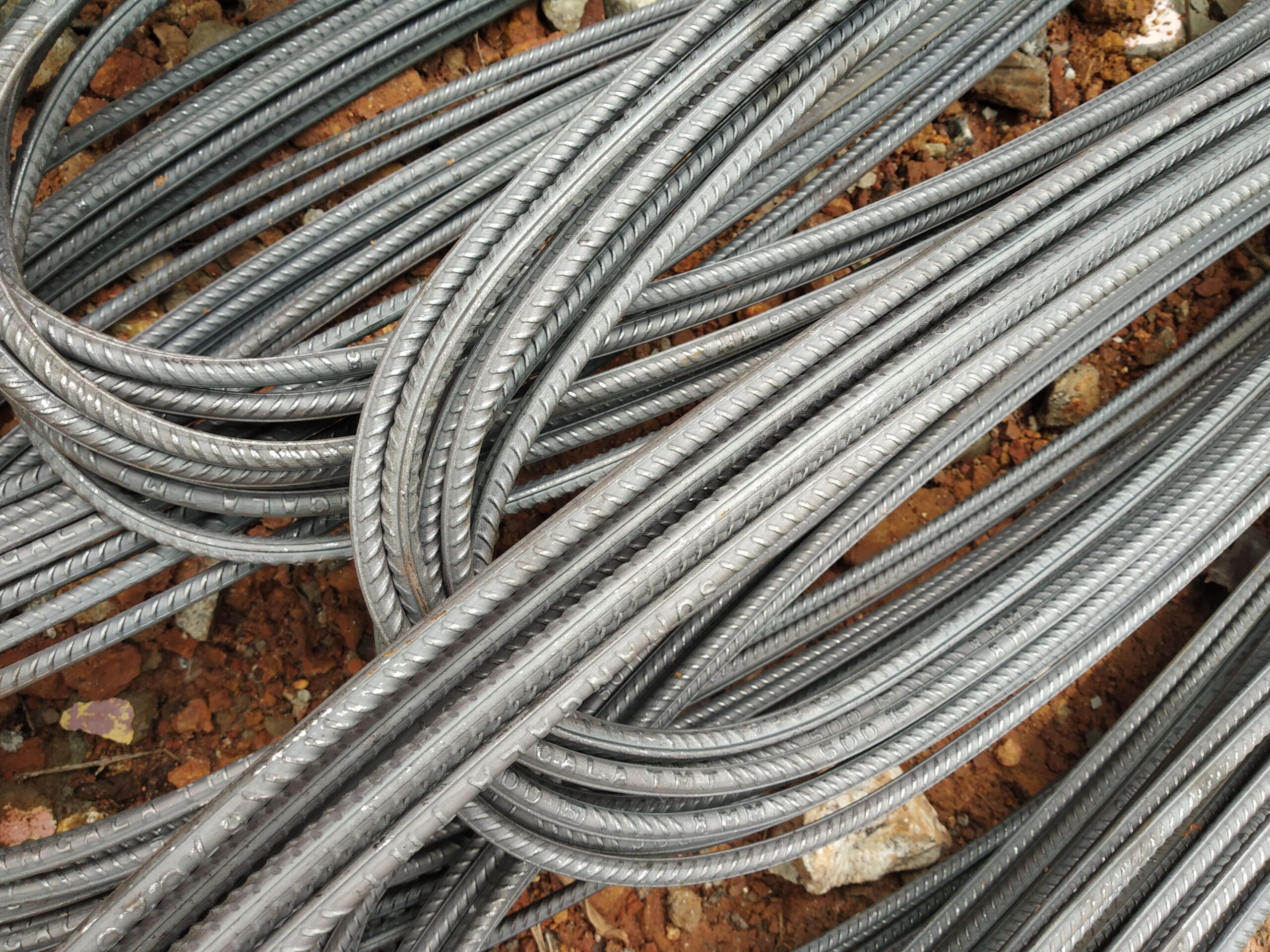
12mm Rebar: Typical Uses & Where It Is Specified
12 mm B500B is the most versatile structural diameter in the DIN 488 range — present in slabs, beams, columns, walls, foundations and precast elements across almost every construction sector. This guide details where 12 mm rebar is specified, the engineering rationale for its selection, and how to procure it to German / EU standards with full export documentation.
Why 12 mm Is the Structural Workhorse Diameter
At a cross-section of 113.1 mm² and unit weight of 0.888 kg/m, 12 mm B500B delivers a favourable ratio of tensile capacity to mass. A single 12 mm bar provides a characteristic tensile resistance of 113.1 mm² × 500 MPa = 56.6 kN — enough to carry meaningful structural load while remaining easy to handle, bend and splice on site. This combination of capacity, workability and economy explains why 12 mm appears in more project specifications than any other single diameter.
Grade B500B is required for virtually all structural uses: its minimum yield of 500 MPa, k ≥ 1.08 and Agt ≥ 5.0 % satisfy both the strength and ductility requirements of Eurocode 2 (EN 1992-1-1) and DIN EN 1992-1-1/NA for ordinary and ductility class B elements.
Primary Structural Applications
The following application families represent the most common specification contexts for 12 mm B500B:
- Reinforced concrete slabs: 12 mm at 150–200 mm centres is a standard specification for intermediate floors, ground-bearing slabs and transfer decks in commercial buildings. It provides adequate bending capacity while keeping reinforcement ratios within practical ranges (typically 0.5–1.2 %).
- Beams and lintels: As longitudinal tension reinforcement in beams with spans up to approximately 5 m (depending on loading), 12 mm bars form efficient, fabricable cages. They pair naturally with 8–10 mm closed stirrups to form complete beam assemblies.
- Columns: Rectangular and circular columns with cross-sections from 250 × 250 mm upward typically specify 12 mm longitudinal bars (4–8 bars) for gravity-dominated loading. The 113 mm² section contributes meaningfully to the combined axial + bending capacity.
- Retaining and shear walls: Both vertical and horizontal reinforcement in walls of moderate height commonly use 12 mm at 200 mm centres (As = 565 mm²/m), meeting minimum reinforcement requirements of EC2 clause 9.6.
- Pile caps and ground beams: As the primary bottom mesh reinforcement in pile caps, 12 mm is a common choice — heavy enough to span between piles under punching shear, light enough to fabricate as flat mats on site.
- Precast concrete: Staircase flights, landing slabs, hollowcore topping reinforcement and precast facade panels frequently specify 12 mm as the primary structural bar, complemented by 6–8 mm distribution steel.
- Infrastructure: Box culverts, manhole frames, concrete drainage channels and bridge deck soffit reinforcement commonly call for 12 mm as a practical mid-range choice balancing cover requirements and structural performance.
12 mm B500B Properties at a Glance
| Property | Value | Standard |
|---|---|---|
| Nominal diameter | 12 mm | DIN 488-1 |
| Cross-sectional area | 113.1 mm² | EN 10080 |
| Unit weight | 0.888 kg/m | DIN 488-1 |
| Weight per 12 m bar | ≈ 10.66 kg | Calculated |
| Bars per tonne (12 m) | ≈ 94 | Calculated |
| Characteristic tensile capacity | 56.6 kN/bar | As × fyk |
| Min. yield strength (fyk) | 500 MPa | B500B / DIN 488 |
| Min. tensile/yield ratio (k) | ≥ 1.08 | B500B |
| Total elongation at max load | ≥ 5.0 % | B500B |
| Ductility class (EC2) | Class B | EN 1992-1-1 |
Specifying 12 mm Rebar for Export Projects
When procuring 12 mm B500B for international projects, the specification document should state:
- Grade: B500B (or BSt 500 S under older German designation)
- Standard: DIN 488-1 / EN 10080
- Diameter: 12 mm (nominal), deformed (ribbed profile)
- Length: 12 m stock (or cut lengths with ± tolerances)
- MTC type: EN 10204 type 3.1 (specific inspection certificate)
- Additional docs: Certificate of Origin, CE Declaration of Performance / DoP where required by destination country
Supply is available as straight bars bundled into approximately 2-tonne seaworthy packages. For large projects, cut-and-bend to BS 8666 or DIN 488 shape codes is also available, reducing on-site labour and waste. See how many 12 mm bars are in a tonne and weight data for 12 mm rebar for procurement planning.
Frequently Asked Questions: 12 mm Rebar Uses
Common specification and procurement questions for international buyers
What is 12 mm rebar most commonly used for?
Is 12 mm rebar suitable as stirrup/link reinforcement in beams?
What is the difference between using 12 mm B500B and 12 mm B500A?
Can 12 mm B500B be used in seismic design?
How is 12 mm rebar packaged for export shipment?
Source German-standard rebar with full export documentation
Tell us your specification and destination port — we’ll respond with a detailed quotation.