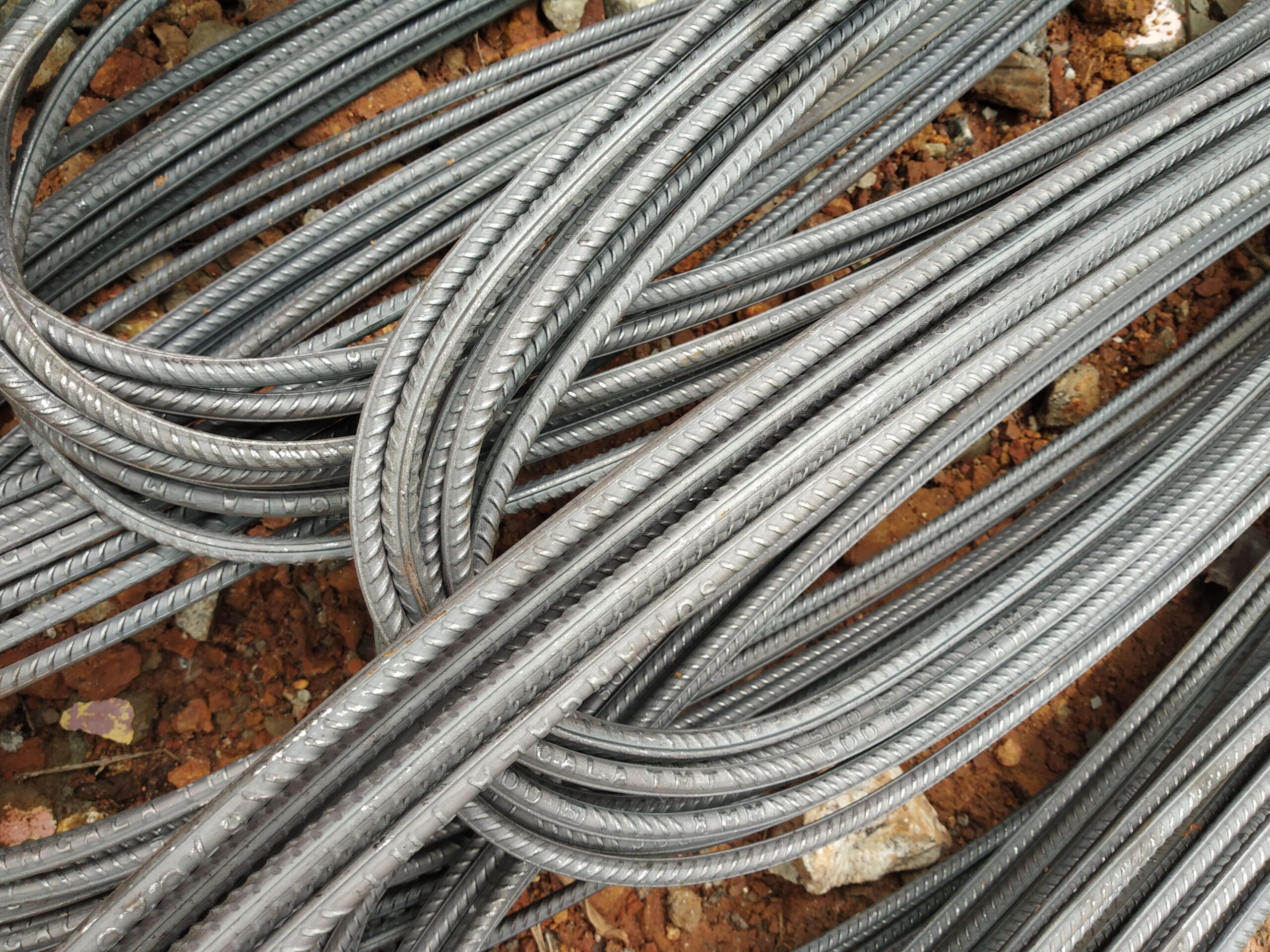
16mm Rebar: Typical Uses & Where It Is Specified
16mm B500B rebar — 201 mm² cross-section, 1.58 kg/m — is the structural workhorse of primary beams, heavily loaded slabs, columns and infrastructure elements. This guide explains where designers choose 16mm over adjacent diameters, how it is detailed under DIN 488 and Eurocode 2, and how to source it with full German export documentation.
Why 16mm Is the First Bar to Exceed 200 mm²
The 16mm diameter is a structural threshold in the DIN 488 / EN 10080 range because its cross-sectional area — π/4 × 16² = 201.1 mm² — crosses the 200 mm² mark. This matters because many Eurocode 2 design aids, reinforcement tables and software defaults use 200 mm² as a reference band boundary. Moving from 14mm (154 mm²) to 16mm gains 31% more steel area with only a moderate increase in bar weight (from 1.209 kg/m to 1.58 kg/m).
This combination makes 16mm B500B the natural choice when:
- A 14mm bar requires congested spacing (below 125 mm centres) to meet the required steel area per metre.
- Bending moments in a primary beam exceed what a 14mm main bar arrangement can efficiently handle.
- Deflection control under Eurocode 2 serviceability limits (EN 1992-1-1 Clause 7.4) benefits from a larger, stiffer bar at wider spacing.
- High-cycle fatigue loading (bridges, crane beams) favours fewer, larger bars at lower stress range.
Structural Applications Where 16mm Rebar Is Commonly Specified
Primary Beams in Building Frames
In reinforced concrete frames, primary beams spanning 5–8 m with floor loads of 5–10 kN/m² regularly require main bottom steel in the range of 400–800 mm²per beam. Two to four 16mm bars (402–804 mm²) is the standard solution, providing both adequate bending capacity and straightforward lapping and anchorage detailing. The 201 mm² section means that two bars in a 250 mm wide beam can be arranged with clear spacing well above the DIN 488 / EN 1992-1-1 minimum (bar diameter or maximum aggregate size + 5 mm, whichever is greater).
Heavily Loaded Floor Slabs (Spans 5–8 m)
For post-tensioned or conventionally reinforced flat slabs with imposed loads above 5 kN/m², or for transfer slabs, 16mm bars at 150–200 mm centres provide steel areas of 1,005–1,340 mm²/m — covering a wide band of design requirements. At 150 mm centres, 16mm yields 1,340 mm²/m; at 200 mm centres, 1,005 mm²/m. This range maps directly to mid-to-heavy slab design without needing to step up to the significantly heavier 20mm bar.
Columns: Vertical Main Reinforcement
Eurocode 2 Clause 9.5.2 sets minimum column reinforcement at 0.002 × Ac. For a 300 × 300 mm column (Ac = 90,000 mm²), the minimum is 180 mm² — a single 16mm bar exceeds this minimum. In practice, four to eight 16mm bars (804–1,608 mm²) are common in medium-sized columns of 300–400 mm section, with lateral ties in 8–10mm diameter per Clause 9.5.3. For larger columns or higher axial loads, designers step up to 20mm or 25mm.
Retaining and Basement Walls (Vertical Face Steel)
Earth-retaining walls of 3–5 m retained height generate bending moments that frequently require vertical reinforcement in the range of 600–1,200 mm²/m. At 175 mm centres, 16mm bars provide 1,149 mm²/m; at 200 mm centres, 1,005 mm²/m — both common design solutions. The relatively stiff 16mm bar also maintains alignment during concrete placing in wall forms more reliably than 12mm or 14mm alternatives, reducing chair and spacer requirements.
Bridge Decks and Infrastructure
Bridge deck slabs, culvert walls and box-section drainage structures routinely specify 16mm bars at 150–200 mm in both faces (top and bottom, transverse and longitudinal). The combination of high strength (500 MPa yield), adequate ductility (Agt ≥ 5.0% for B500B), and efficient cross-section makes 16mm the standard across German highway bridge design practice under DIN 1045 and Eurocode 2.
Precast Concrete Elements
Precast beams, columns, wall panels and stair flights frequently incorporate 16mm as the main longitudinal reinforcement. In lattice girder slabs (Filigrandecken), 16mm chord bars are common in heavier panel configurations where loads or spans exceed the capacity of 12mm chord variants. See our lattice girder page for more on precast reinforcement systems.
16mm Rebar: Properties at a Glance
| Property | Value | Standard |
|---|---|---|
| Nominal diameter | 16 mm | DIN 488 / EN 10080 |
| Cross-sectional area | 201.1 mm² | Calculated |
| Weight per metre | 1.58 kg/m | DIN 488 |
| Weight per 12 m bar | ≈ 19.0 kg | Calculated |
| Min. yield strength (B500B) | 500 MPa | EN 10080 |
| Strength ratio k (B500B) | ≥ 1.08 | EN 10080 |
| Elongation Agt (B500B) | ≥ 5.0% | EN 10080 |
| Available lengths | 6–18 m (12 m standard) | Mill schedule |
| Surface | Ribbed (deformed) | DIN 488 |
Comparing 16mm to Adjacent Diameters
Choosing between 14mm, 16mm and 20mm bars involves balancing required steel area, bar spacing, cover requirements and lapping length. The table below shows key differences:
| Diameter | Area (mm²) | Weight (kg/m) | At 150 mm c/c (mm²/m) | Typical use |
|---|---|---|---|---|
| 14 mm | 154 | 1.209 | 1,027 | Mid-span slabs, secondary beams |
| 16 mm | 201 | 1.580 | 1,340 | Primary beams, heavy slabs, columns |
| 20 mm | 314 | 2.470 | 2,094 | Heavy beams, transfer structures, columns |
The step from 14mm to 16mm is relatively modest in weight (+31% area, +31% kg/m) while providing a meaningful increase in steel area per bar. The step from 16mm to 20mm is much larger (+56% area) and is typically reserved for elements with substantially higher moment demand. For procurement guidance on the 16mm bar count and weight, see our companion article on 16mm rebar weight per metre and the 16mm bars per tonne guide.
Sourcing 16mm B500B Rebar from Germany
We supply 16mm B500B rebar in stock lengths of 6, 9, 12 and 18 m, as well as cut-to-length and bent assemblies to DIN 488 shape codes or BS 8666 bending schedules. B500C (seismic grade, Agt ≥ 7.5%) is available on request. All material ships with Mill Test Certificate EN 10204 3.1, Certificate of Origin, and CE Declaration of Performance. Export packaging uses seaworthy steel-banded bundles of approximately 2 tonnes — at 19.0 kg per 12 m bar, a 2 t bundle contains approximately 105 bars. Visit our B500B product page or export and delivery page for full logistics details, or request a quotation with your tonnage, lengths and destination port.
Frequently Asked Questions — 16mm Rebar Uses
Common questions from structural engineers and procurement teams about 16mm B500B rebar.
Where is 16mm rebar most commonly used in building construction?
What steel area does 16mm rebar provide at 150 mm and 200 mm centres?
Can 16mm rebar be welded?
Is 16mm rebar available in B500C seismic grade?
What is the minimum lap length for 16mm B500B rebar in normal-weight concrete?
Source German-standard rebar with full export documentation
Tell us your specification and destination port — we’ll respond with a detailed quotation.