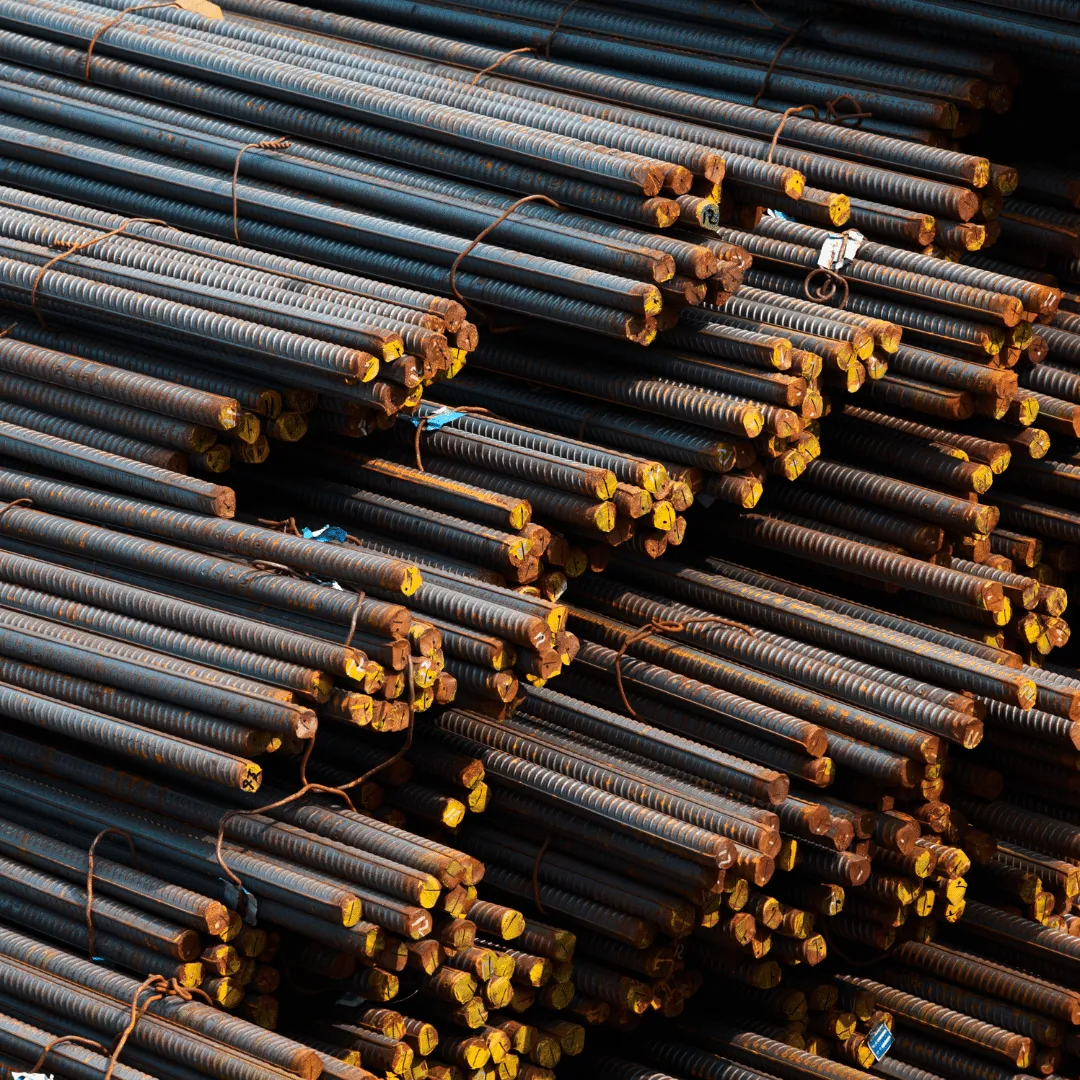
Cut & Bend Rebar to BS 8666
Off-site reinforcement fabrication done right: we schedule, cut, bend, tag and deliver Ø8–40mm bar to your bar bending schedule — mill-certified, sequenced for the fixing gang, and shipped just-in-time to site.
Fabrication Capability
From schedule to site in five controlled steps
Our cut and bend rebar service replaces ad-hoc on-site cutting with a disciplined, factory-controlled workflow. Each bar is processed, checked and traced before it ever reaches your hoarding line.
Schedule
We take your bar bending schedule (or build one from drawings), validate shape codes and dimensions against BS 8666, and lock bar marks for traceability.
Cut
Straight stock and coil is shear-cut to the scheduled cutting length on automatic lines, optimised for minimum offcut and verified to ±25mm.
Bend
Bars are formed to the correct shape code on the right mandrel radius — stirrup benders for links, heavy hydraulic benders for Ø32–40mm.
Tag
Each bundle is tagged with bar mark, shape code, diameter, length, quantity and project reference, cross-referenced to the schedule and MTC heat number.
Deliver
Bundles are loaded in fixing sequence and delivered just-in-time by container or flatbed, so steel-fixers install straight from the truck.
Less waste, faster fixing, certified every bundle
Pre-fabricated reinforcement removes cutting and bending from the critical path, cuts site scrap, and gives QA a paper trail from heat number to fixed bar.
Common BS 8666 shape codes we fabricate
BS 8666:2020 defines the standard library of bending shapes used in bar bending schedules. We routinely produce the full range — from straight cut bar to multi-bend links and helical forms. A selection is shown below.
Cutting, bending & capacity reference
Our fabrication tolerances follow BS 8666:2020. Minimum scheduling radii and former diameters vary with bar size; a representative range is shown below.
| Bar size (Ø) | Grade | Min. former dia. | Min. bend radius | Cutting tol. |
|---|---|---|---|---|
| 8 mm | B500B | 32 mm | 16 mm | ±25 mm |
| 10 mm | B500B | 40 mm | 20 mm | ±25 mm |
| 12 mm | B500B / Gr60 | 48 mm | 24 mm | ±25 mm |
| 16 mm | Gr60 | 64 mm | 32 mm | ±25 mm |
| 20 mm | Gr60 / Gr75 | 140 mm | 70 mm | ±25 mm |
| 25 mm | Gr75 | 175 mm | 87 mm | ±40 mm |
| 32 mm | Gr75 | 224 mm | 112 mm | ±40 mm |
| 40 mm | Gr75 | 280 mm | 140 mm | ±40 mm |
*Indicative values. Final scheduling dimensions, radii and tolerances are confirmed per project to BS 8666:2020 and your engineer’s specification.
Fabrication delivered, sequenced and certified
Representative cut and bend programmes across infrastructure, high-rise and marine works. Project names are illustrative pending client release.
Reininghaus Tower
Pre-bent links and column cages to BS 8666 Shape 51, sequenced floor-by-floor for a 42-storey core. Just-in-time delivery kept the slip-form on programme.
A2 Süd Interchange
Cranked and U-bars (Shapes 21/41) for deck and pier reinforcement, cut to schedule with full MTC traceability to BS 4449 heat numbers.
Deepwater Port Berth
Heavy Ø32–40mm Gr75 bar bent on hydraulic benders for quay-wall pile caps, delivered break-bulk with corrosion-rated tagging.
What a cut and bend rebar service actually delivers
A cut and bend rebar service takes the labour-intensive work of cutting and shaping reinforcement steel off the construction site and into a controlled fabrication facility. Instead of receiving straight stock bar and processing it under a hoarding in dust, heat and tight programme pressure, the contractor receives finished bars — already cut to the scheduled length, bent to the correct shape code, bundled by mark and labelled for the fixing gang. For any project with significant reinforcement tonnage, this is the difference between a predictable, certified supply chain and a daily scramble.
Built around the bar bending schedule
Everything begins with the bar bending schedule (BBS). The structural engineer’s drawings are translated into a tabulated schedule listing each bar mark, its diameter, grade, shape code, cutting length, bending dimensions (A, B, C, D…) and quantity. Steel Rebar Germany can work directly from a client-issued schedule or prepare one from your drawings and have it checked against BS 8666:2020 — the British Standard that governs the scheduling, dimensioning, bending and cutting of steel reinforcement. Catching a scheduling error at this stage, before a single bar is cut, is far cheaper than discovering it when a cage will not fit on site.
BS 8666 shape codes — a shared language
BS 8666 assigns a numeric shape code to every standard bend configuration, from a plain straight bar (Shape 00) through single and double bends, U-bars, cranked bars, closed links and stirrups (Shape 51), helical spirals (Shape 67) and fully bespoke detailing (Shape 99). Because the codes are standardised, your detailer, our fabrication floor and your steel-fixer all read the same instruction the same way. The standard also specifies minimum former diameters and bending radii for each bar size, ensuring bends do not crack or over-stress the steel — values we apply on the correct mandrel for every diameter from Ø8mm to Ø40mm.
Grades, diameters and certification
We fabricate deformed reinforcing bar in Grade B500B (to BS 4449), Grade 60 and Grade 75 (to ASTM A615), with ISO 6935 also available for export markets. Every cut and bend shipment carries a mill test certificate (MTC) traceable to the heat number, confirming chemical composition and mechanical properties. Bend and re-bend test results are provided on request. This unbroken traceability — from molten heat, to certified bar, to tagged bundle, to fixed reinforcement — is exactly what auditors, consultants and clients expect on certified works.
Why contractors move fabrication off-site
- Programme certainty: cutting and bending leaves the critical path; steel-fixers install pre-formed bar straight from the delivery.
- Less waste: automated cutting lines optimise stock to minimise offcut, reducing scrap and skip charges versus manual on-site cutting.
- Quality control: bends are formed on calibrated machines to the correct radius, not bent by hand against a former on a slab.
- Site logistics: no bar-bending compound, fewer plant movements, less stored stock, and a safer, tidier working area.
- Traceability: every bundle is tagged and tied back to the schedule and MTC, so QA documentation assembles itself.
Tagging, sequencing and just-in-time delivery
Finished bars are bundled by bar mark and tagged with the shape code, diameter, length, quantity and project reference. Bundles are loaded in fixing sequence — the order the gang needs them — and delivered just-in-time by container or flatbed. For export, fabricated reinforcement ships container or break-bulk to over 40 ports across the GCC, Africa, Europe and Asia, with packing and tagging specified to survive the journey. The result: your steel-fixers spend their time fixing certified, correctly-shaped bar, not cutting and bending it.
Cut & bend rebar FAQ
What is a cut and bend rebar service?
A cut and bend rebar service fabricates reinforcement steel off-site to your engineer’s bar bending schedule. Straight stock bar is cut to length and bent to BS 8666 shape codes, tagged by mark and bundle, and delivered to site ready to fix — removing the need for on-site cutting and bending.
Which standard governs cut and bend rebar shapes?
BS 8666 governs the scheduling, dimensioning, bending and cutting of steel reinforcement in the UK and many export markets. It defines standard shape codes, minimum bending radii and cutting/bending tolerances. Steel Rebar Germany fabricates to BS 8666 using bar certified to BS 4449, with ASTM A615 and ISO 6935 also available.
What bar sizes can you cut and bend?
Steel Rebar Germany cuts and bends deformed reinforcing bar from Ø8mm to Ø40mm in Grade B500B, Grade 60 and Grade 75. Links, stirrups and small shapes are produced on automatic stirrup benders; large-diameter bars are formed on heavy hydraulic bending machines to the correct mandrel radius.
How is cut and bend rebar tagged and delivered?
Every fabricated bundle carries a durable tag showing the bar mark, shape code, diameter, length, quantity and project reference, cross-referenced to the bar bending schedule. Bundles are loaded in fixing sequence and delivered just-in-time by container or flatbed so your steel-fixers can install straight from the truck.
Do you provide a mill test certificate with cut and bend orders?
Yes. Every cut and bend shipment ships with a mill test certificate (MTC) traceable to the heat number, confirming chemical composition and mechanical properties against BS 4449, ASTM A615 or ISO 6935. Bend test and re-bend test results are available on request.
Send your schedule. Get a fabrication quote.
Upload a bar bending schedule or drawings and our dedicated export desk will price your cut and bend programme — with lead time, certification and delivery to your port or site.
