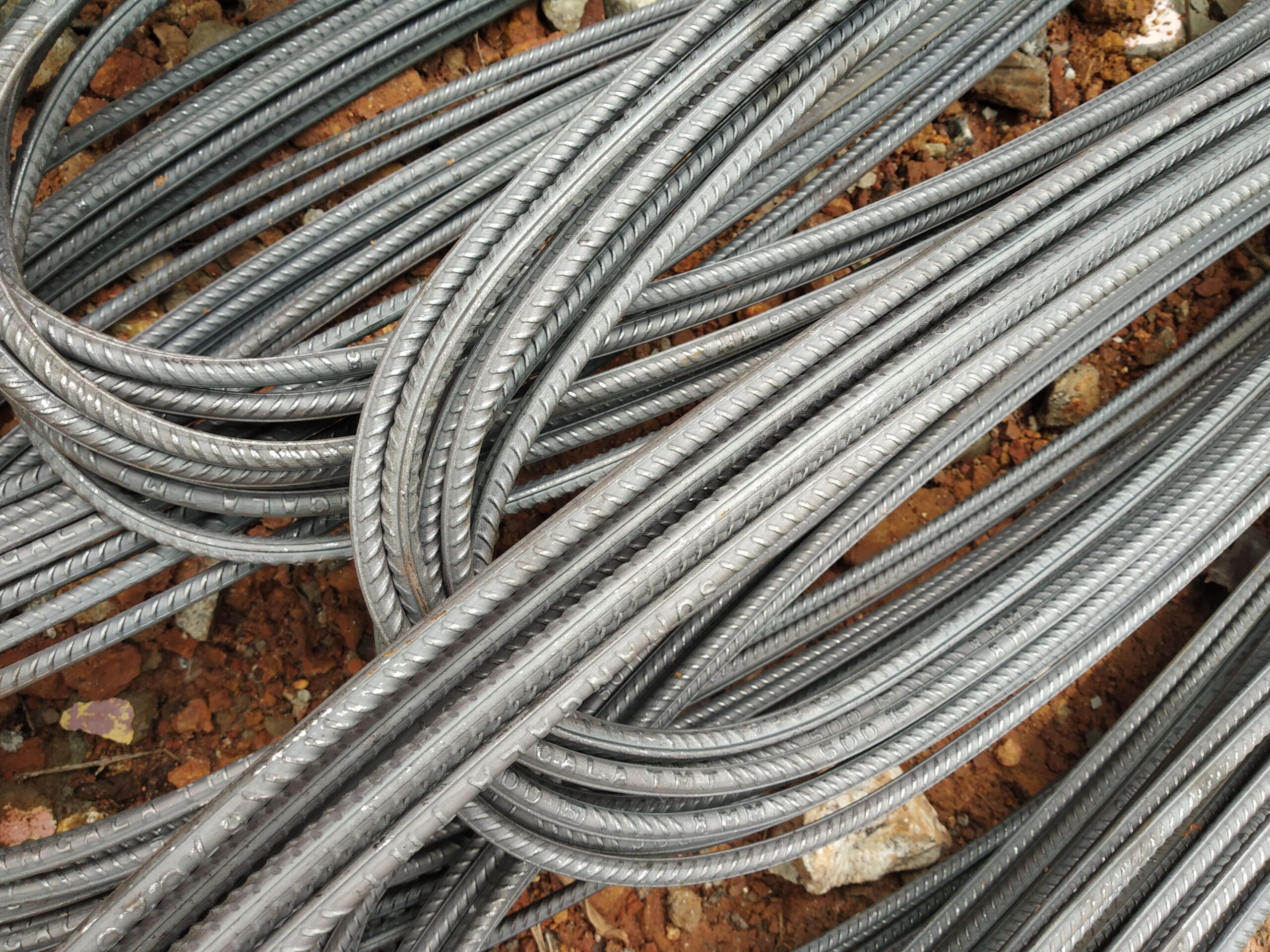
14mm Rebar Weight per Metre (and per Bar)
14 mm reinforcing bar weighs 1.209 kg/m with a cross-sectional area of 153.9 mm². A standard 12 m stock bar comes in at approximately 14.5 kg, putting roughly 69 bars per tonne. This complete reference covers the derivation, per-length weight tables, procurement data and export guidance for 14 mm B500B rebar to DIN 488 / EN 10080.
The Definitive 14 mm Rebar Weight Figure
The unit weight of any reinforcing bar follows directly from steel density and bar geometry. The standard formula used throughout DIN 488 and EN 10080 is:
weight (kg/m) = d²(mm) × 0.00617
14² × 0.00617 = 196 × 0.00617 = 1.209 kg/m
The cross-sectional area is derived from the circle formula A = π/4 × d²:
A = π/4 × 14² = 0.7854 × 196 = 153.9 mm²
Both figures are fixed by geometry and the density of reinforcing steel (7,850 kg/m³). They are standardised in DIN 488-1 and do not vary between manufacturers — weight is a property of the bar, not of the mill producing it.
Weight per Bar at Standard Stock Lengths
14 mm rebar is available in stock lengths of 6 m, 12 m (the procurement standard) and up to 18 m for special orders. The table below gives per-bar weights and bars-per-tonne at each common length:
| Bar length (m) | Weight per bar (kg) | Bars per tonne | Linear m/tonne |
|---|---|---|---|
| 6 m | ≈ 7.25 kg | ≈ 138 | ≈ 827 |
| 9 m | ≈ 10.88 kg | ≈ 92 | ≈ 827 |
| 12 m (standard) | ≈ 14.51 kg | ≈ 69 | ≈ 827 |
| 15 m | ≈ 18.14 kg | ≈ 55 | ≈ 827 |
| 18 m | ≈ 21.76 kg | ≈ 46 | ≈ 827 |
The linear metres per tonne (≈ 827 m) is constant regardless of bar length — it is 1,000 ÷ 1.209. The bar count per tonne changes with length because each longer bar is heavier. For procurement planning, always use the linear-metres figure as the primary scheduling quantity, then divide by actual bar length to derive count.
Full Property Table for 14 mm B500B
| Property | Value | Reference |
|---|---|---|
| Nominal diameter | 14 mm | DIN 488-1 |
| Cross-sectional area (A) | 153.9 mm² | A = π/4 × d² |
| Unit weight | 1.209 kg/m | DIN 488-1 / EN 10080 |
| Weight per 12 m bar | ≈ 14.51 kg | Calculated |
| Bars per tonne (12 m bars) | ≈ 69 | Calculated |
| Linear metres per tonne | ≈ 827 m | Calculated |
| Characteristic tensile capacity | 76.95 kN/bar | As × fyk = 153.9 × 500 |
| Min. yield strength (fyk) | 500 MPa | B500B / DIN 488 |
| Tensile/yield ratio (k) | ≥ 1.08 | B500B |
| Total elongation at max load (Agt) | ≥ 5.0 % | B500B |
| Ductility class (EC2) | Class B | EN 1992-1-1 |
Weight Comparison with Adjacent Diameters
Structural engineers and quantity surveyors routinely compare 14 mm with the diameters above and below it. Moving from 12 mm to 14 mm increases cross-section by 36 % (113.1 → 153.9 mm²) and unit weight by 36 % (0.888 → 1.209 kg/m). Moving from 14 mm to 16 mm adds a further 31 % in section (153.9 → 201.1 mm²). The table below spans the most commonly specified range:
| Diameter (mm) | Weight (kg/m) | Section (mm²) | Per 12 m bar (kg) | Bars/tonne (12 m) |
|---|---|---|---|---|
| 10 | 0.617 | 78.5 | 7.40 | ≈ 135 |
| 12 | 0.888 | 113.1 | 10.66 | ≈ 94 |
| 14 | 1.209 | 153.9 | 14.51 | ≈ 69 |
| 16 | 1.578 | 201.1 | 18.94 | ≈ 53 |
| 20 | 2.466 | 314.2 | 29.59 | ≈ 34 |
| 25 | 3.854 | 490.9 | 46.25 | ≈ 22 |
| 32 | 6.313 | 804.2 | 75.76 | ≈ 13 |
Applying 14 mm Weight Data in Reinforcement Scheduling
The 69 bars/tonne figure is the foundation of quantity take-offs for 14 mm at the 12 m stock length. A practical scheduling workflow:
- Extract total linear metres of 14 mm from the bar bending schedule.
- Divide by 827 m/tonne to obtain net tonnes required.
- Add lapping and wastage allowance. For 14 mm B500B in C25/30 concrete (bond condition good), the lap length per EC2 is approximately 560 mm (40d); add 10–15 % for overall site waste.
- Round up to the next whole tonne for the purchase order — mills export in full-tonne increments.
- Verify bar count on delivery: 69 bars/tonne × number of tonnes, ±5 % for weight tolerance.
Weight tolerance under DIN 488-1 / EN 10080 for 14 mm bars is ±4.5 % on nominal unit weight. This means a bar nominally weighing 1.209 kg/m could run between approximately 1.155 and 1.263 kg/m within conforming limits — shifting bars per tonne between approximately 66 and 72 at the extremes. For export contracts, the EN 10204 type 3.1 Mill Test Certificate documents the actual measured unit weight of each production heat, providing the contractual basis for weight.
14 mm Rebar for Export: Packaging and Documentation
14 mm B500B bars are bundled into seaworthy packages of approximately 2 tonnes — roughly 138 bars per bundle at 12 m — strapped, tagged and documented with:
- EN 10204 type 3.1 Mill Test Certificate: heat number, chemical composition, mechanical test results, dimensional checks.
- Certificate of Origin: confirming German / EU origin for customs and preferential tariff purposes.
- CE Declaration of Performance (DoP): where required by destination country regulations.
- Packing list and weight certificate: bundle-by-bundle breakdown for port and customs clearance.
Shipping is available as full container load (FCL) or break-bulk for larger consignments. See our export delivery and documentation page for full logistics detail. Related guides: 12 mm rebar weight per metre · 12 mm rebar typical uses · B500B rebar product page.
Frequently Asked Questions: 14 mm Rebar Weight
Precise answers for quantity surveyors, procurement managers and site engineers
What is the weight of 14 mm rebar per metre?
How much does a 12 m bar of 14 mm rebar weigh?
How many 14 mm rebar bars are in one tonne?
What is the cross-sectional area of 14 mm rebar?
What weight tolerance applies to 14 mm rebar under DIN 488 / EN 10080?
Source German-standard rebar with full export documentation
Tell us your specification and destination port — we’ll respond with a detailed quotation.