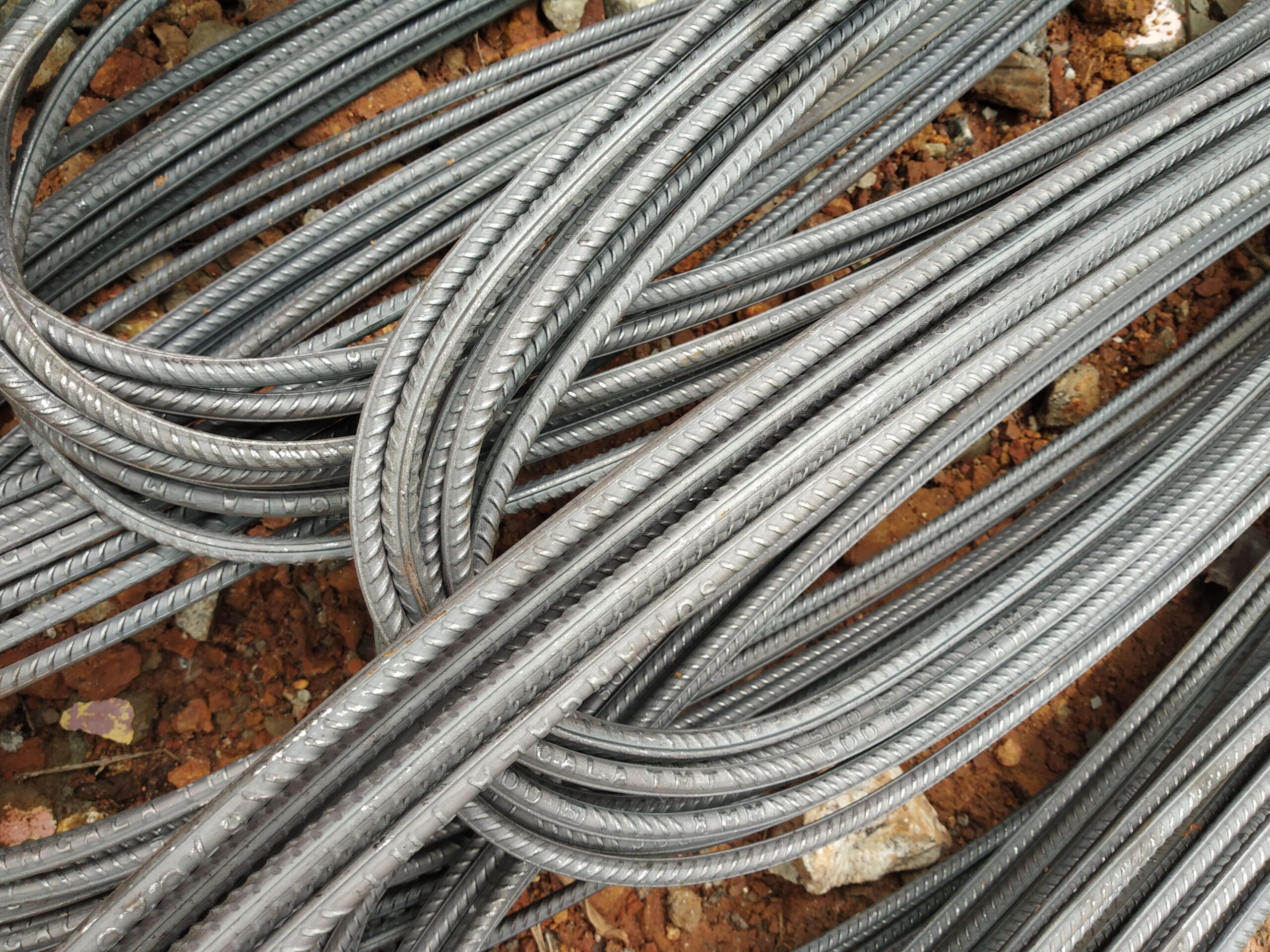
Steel Rebar Export to Canada
B500B reinforcing steel to EN 10080 — supplied from Germany with full Mill Test Certificate 3.1, Certificate of Origin, and seaworthy bundles for Canadian infrastructure and construction projects. Technically comparable to CSA G30.18 weldable grades.
Rebar Canada: Market Context and Infrastructure Demand
Canada is one of North America’s largest construction markets, with sustained public and private investment in infrastructure, residential housing, commercial development, and resource-sector civil works. Federal and provincial programmes continue to fund highway upgrades, bridge rehabilitation, transit corridors, port expansions, and energy infrastructure — all of which are heavy consumers of reinforcing steel.
Canadian structural design is governed by the National Building Code of Canada (NBC) and provincial equivalents, with reinforcing steel specified to CSA G30.18, the Canadian standard for carbon steel bars for concrete reinforcement. The dominant grades are 400W and 500W — the “W” suffix denoting weldability. Our German B500B rebar to EN 10080 is produced to a minimum yield of 500 MPa with k ≥ 1.08 and Agt ≥ 5.0%, and carries full weldability documentation per DIN EN ISO 17660. The mechanical properties are technically comparable to CSA G30.18 Grade 500W. This is a comparability note only — we do not claim formal CSA certification or Canadian national approval. Project owners and structural engineers must confirm suitability for their specific application.
Key demand drivers include the Trans-Canada highway network, urban transit (LRT, metro), residential high-rise construction in Toronto, Vancouver, Calgary, and Montreal, and mining infrastructure in northern Ontario, British Columbia, and Quebec.
Products Available for Canadian Export
- B500B deformed bars — 8–40 mm diameter, 6–18 m lengths, ribbed surface per EN 10080. Min. yield 500 MPa, k ≥ 1.08, Agt ≥ 5.0%. B500B product page →
- B500A/B500B coils — 6–16 mm for automated stirrup-bending lines and mesh fabrication. Rebar coils →
- Welded reinforcing mesh — Q-type and R-type standard panels; bespoke sizes to DIN 488-4. Mesh panels →
- Mechanical couplers — parallel-thread and taper-thread systems, 12–40 mm, eliminating lap-splice congestion in high-rise cores and bridge piers. Couplers →
- Cut-and-bend rebar — fabricated to project bending schedules, shape codes per DIN 488 or equivalent. Cut & Bend →
- Lattice girders — Gitterträger for precast and filigree slab systems in modular construction. Lattice girders →
Canadian Entry Ports: Vancouver, Montreal & Halifax
Three major gateway ports serve different regions of Canada, supporting both container and break-bulk steel shipments.
Port of Vancouver
Canada’s largest port by tonnage and the primary Pacific gateway. Serves British Columbia, Alberta, and the western prairies. Container handling and break-bulk facilities accommodate heavy steel cargo. Transit from Northern European ports via Panama Canal or Suez routing.
Port of Montreal
The principal inland port on the St. Lawrence Seaway. Direct deep-water access for vessels up to approximately 235 m LOA. Serves Ontario and Quebec, Canada’s two most populous provinces, with strong rail connections to Chicago and the US Midwest.
Port of Halifax
Canada’s premier Atlantic gateway with the shortest transatlantic crossing from Northern Europe. Handles container, break-bulk, and project cargo. Serves the Maritime provinces and, via CN Rail, provides intermodal connections to central Canada and the US Northeast.
B500B Weight & Cross-Section Reference Table
Standard data for procurement planning. Formula: kg/m = d²(mm) × 0.00617.
| Diameter (mm) | Weight (kg/m) | Cross-section (mm²) |
|---|---|---|
| 8 | 0.395 | 50.3 |
| 10 | 0.617 | 78.5 |
| 12 | 0.888 | 113 |
| 16 | 1.58 | 201 |
| 20 | 2.47 | 314 |
| 25 | 3.85 | 491 |
| 32 | 6.31 | 804 |
| 40 | 9.86 | 1257 |
Export Documentation for Canada
Importing steel rebar into Canada involves CBSA (Canada Border Services Agency) clearance. We provide a complete export documentation package to support customs and project requirements:
- EN 10204 3.1 Mill Test Certificate — full chemical composition and mechanical test data, heat/cast traceable, signed by an independent inspection body.
- Certificate of Origin — certifying German origin, supporting trade agreement eligibility (CETA: Canada–EU Comprehensive Economic and Trade Agreement reduces or eliminates tariffs on steel products meeting rules of origin).
- Commercial invoice & packing list — with HS code 7214 20 (deformed hot-rolled bars) or 7213 10 (coils), bundle markings, and cast numbers.
- Declaration of Performance (DoP) — CE marking per EU CPR 305/2011, available on request.
- Seaworthy packing — bundles approximately 2 t, strapped, marked, and suitable for container (20’/40′) or break-bulk ocean freight.
Frequently Asked Questions — Rebar Export to Canada
Is German B500B rebar comparable to CSA G30.18 Grade 500W?
Which Canadian port is best for rebar imports from Germany?
Does CETA reduce import duties on German rebar to Canada?
What container types are used for rebar shipments to Canada?
Can you supply rebar for Canadian cold-weather construction?
Source German-standard rebar with full export documentation
Tell us your specification and destination port — we’ll respond with a detailed quotation for your Canadian project.
