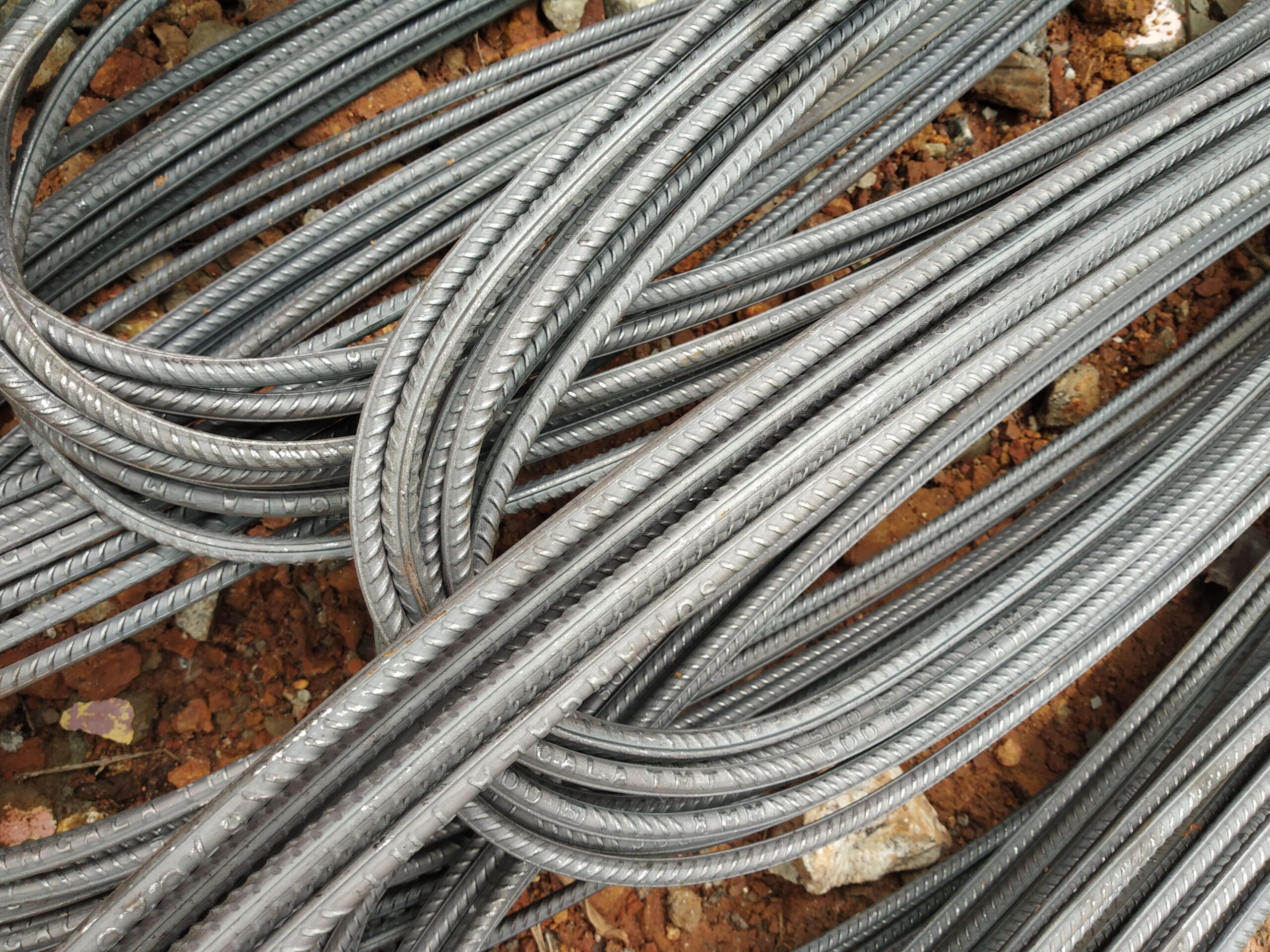
14mm Rebar: Typical Uses & Where It Is Specified
14mm B500B rebar is a structural workhorse specified across mid-range beams, slabs, columns and retaining walls. This guide explains where designers choose 14mm over adjacent diameters, how it is detailed under DIN 488 and Eurocode 2, and how to source it with full German export documentation.
Why 14mm Sits in the Middle of the Structural Diameter Range
The standard reinforcing bar diameter progression — 8, 10, 12, 14, 16, 20, 25, 32 mm — is not arbitrary. Each step up increases cross-sectional area and weight by a controlled ratio, allowing structural engineers to fine-tune reinforcement ratios without large jumps in bar spacing. At 154 mm² cross-section and 1.209 kg/m, the 14mm bar delivers roughly 36% more steel area than a 12mm bar (113 mm²) but weighs noticeably less than a 16mm bar (201 mm², 1.58 kg/m).
This intermediate position makes 14mm the preferred choice when:
- A 12mm bar is understressed and a 16mm bar would require uneconomically wide spacing.
- Rebar spacing targets 150–175 mm on centres and 12mm bars would require impractical density.
- Crack width control under Eurocode 2 serviceability criteria drives a larger bar at wider spacing over a smaller bar at tighter spacing.
Structural Applications Where 14mm Rebar Is Commonly Specified
One-Way and Two-Way Slabs (4–6 m Spans)
For medium-span floor slabs with imposed loads in the range of 3–7 kN/m², Eurocode 2 moment calculations frequently produce required steel areas between 130–175 mm²/m. A 14mm bar at 150 mm centres delivers 154/0.15 = 1,027 mm²/m — well within the typical design band. This avoids the awkward 12mm-at-120mm-centres solution that some engineers find congested for concrete placing.
Secondary Beams and Lintels
Secondary beams supporting slabs up to approximately 5–6 m span with moderate loading are commonly reinforced with 2–3 bottom bars at 14mm, providing bottom steel areas of 308–462 mm². For lintels above openings in masonry or concrete frame structures, two 14mm bars top and bottom is a standard detail across German residential and commercial construction.
Column Ties and Lateral Reinforcement
In columns with main vertical bars at 20–32mm, the lateral tie (stirrup) must satisfy minimum diameter requirements: DIN 488 and Eurocode 2 Clause 9.5.3 require ties of at least one-quarter of the main bar diameter, minimum 6mm. For 25mm and 32mm main bars, 14mm ties are occasionally specified where high shear demand or seismic detailing requires heavier confinement, though 8–12mm links are more usual in standard columns.
Retaining Walls and Basement Walls
Earth-retaining walls are governed by both bending moment and crack width control. The 14mm bar is frequently used for the vertical face reinforcement, with spacing selected to limit crack widths under EN 1992-1-1 Table 7.2N serviceability limits (typically wk = 0.2–0.3 mm for moisture-exposed conditions). A 14mm bar at 175 mm centres provides 880 mm²/m, common in walls retaining 2–4 m of soil.
Foundation Pad Bases and Pile Caps
Pad foundations for lightly loaded columns and pile caps for small diameter piles (250–300 mm bored piles) frequently use 14mm bars in both directions of the mat. The bar provides adequate stiffness to maintain position during concrete placing without requiring additional support chairs.
14mm Rebar: Properties at a Glance
| Property | Value | Standard |
|---|---|---|
| Nominal diameter | 14 mm | DIN 488 / EN 10080 |
| Cross-sectional area | 153.9 mm² (≈ 154 mm²) | Calculated |
| Weight per metre | 1.209 kg/m | DIN 488 |
| Min. yield strength (B500B) | 500 MPa | EN 10080 |
| Strength ratio k (B500B) | ≥ 1.08 | EN 10080 |
| Elongation Agt (B500B) | ≥ 5.0% | EN 10080 |
| Available lengths | 6–18 m (12 m standard) | Mill schedule |
| Surface | Ribbed (deformed) | DIN 488 |
Comparing 14mm to Adjacent Diameters
Choosing between 12mm, 14mm and 16mm bars is primarily a question of required steel area and bar spacing. The table below helps:
| Diameter | Area (mm²) | Weight (kg/m) | At 150 mm c/c (mm²/m) | Typical use |
|---|---|---|---|---|
| 12 mm | 113 | 0.888 | 753 | Light slabs, strip footings |
| 14 mm | 154 | 1.209 | 1,027 | Mid-span slabs, secondary beams |
| 16 mm | 201 | 1.580 | 1,340 | Primary beams, heavier slabs |
For procurement guidance on adjacent diameters, see our posts on 16mm rebar uses and the complete rebar weight chart.
Sourcing 14mm B500B Rebar from Germany
We supply 14mm B500B rebar in stock lengths of 6, 9, 12 and 18 m, as well as cut-to-length and bent assemblies per DIN 488 shape codes or BS 8666 bending schedules. All material is accompanied by Mill Test Certificate EN 10204 3.1, Certificate of Origin, and CE Declaration of Performance. Export packaging uses seaworthy steel-banded bundles of approximately 2 tonnes, suitable for container or break-bulk shipping worldwide. Visit our B500B product page or export and delivery page for logistics details.
Frequently Asked Questions — 14mm Rebar Uses
Where is 14mm rebar most commonly used in building construction?
What is the minimum cover required for 14mm rebar under Eurocode 2?
Can 14mm rebar be welded?
Is 14mm rebar available in B500C (seismic grade)?
What bar spacing gives 1,000 mm²/m with 14mm rebar?
Source German-standard rebar with full export documentation
Tell us your specification and destination port — we’ll respond with a detailed quotation.