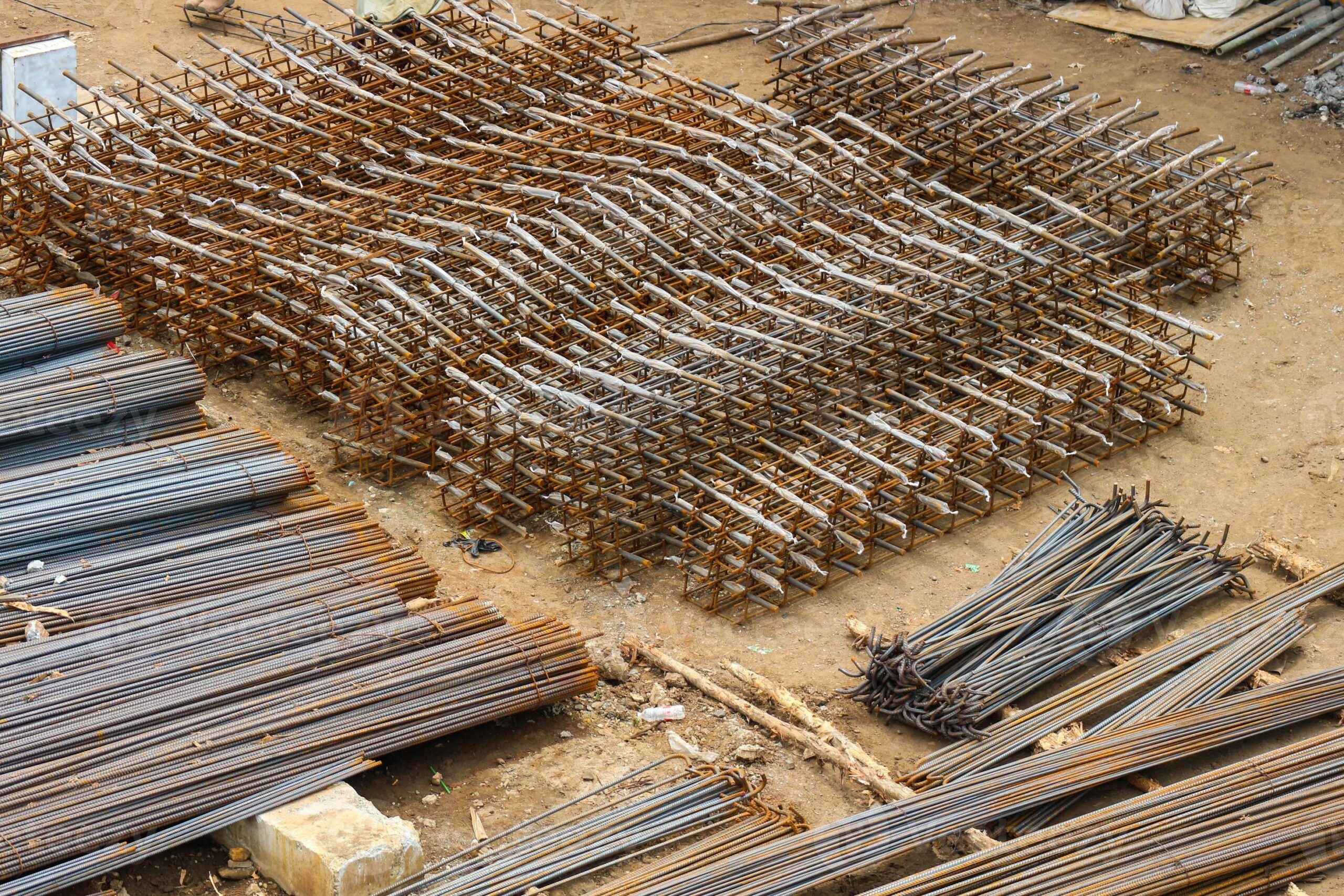
Rebar for Airport Infrastructure
Pavement, apron and terminal reinforcement — B500B bar, mesh, lattice girders and couplers to DIN 488 / EN 10080, designed to Eurocode 2 for the heaviest wheel-load and fatigue conditions.
The Reinforcement Demands of Airport Infrastructure
Airport construction encompasses some of the most technically demanding reinforced concrete applications in civil engineering. Runway pavements, taxiway slabs and aircraft aprons must resist extraordinarily high wheel loads — wide-body freighters such as the Boeing 747-8F impose maximum gross weights exceeding 440 tonnes distributed over a complex multi-wheel undercarriage — while simultaneously withstanding freeze-thaw cycling, fuel spill exposure and the fatigue effects of thousands of heavy load repetitions over a design life typically set at 40–60 years.
Terminal buildings, multi-storey car parks, fuel farm bunds, maintenance hangars and air traffic control towers each bring distinct structural challenges: long-span post-tensioned floors, heavily loaded column bases, retaining walls and deep pile foundations all requiring B500B reinforcing steel to DIN 488 / EN 10080 — with full traceability documentation as mandatory on every publicly tendered airport contract worldwide.
Key Structural Zones and Their Reinforcement Requirements
Airport infrastructure is not a single structure type but a campus of diverse concrete elements. The reinforcement specification varies significantly by zone:
- Airside pavements (runways, taxiways, aprons) — continuously reinforced concrete pavement (CRCP) or jointed reinforced concrete pavement (JRCP). CRCP uses longitudinal steel at 0.6–0.7% of cross-section, typically ø12–16 mm B500B at close centres, to prevent discrete crack formation. Transverse bars ø10–12 mm provide crack width control.
- Terminal foundations and column bases — large pad foundations and pile caps using ø20–32 mm main bars; dense mesh in base slabs against moisture ingress (Eurocode 2 exposure class XD1–XD2 for de-icing salt contact).
- Elevated walkways and baggage-handling floor slabs — composite decks or reinforced flat slabs, typically ø12–20 mm bars with welded mesh (B500A, Q-type DIN 488-4) for topping slabs.
- Fuel farm bunds and containment walls — watertight reinforced concrete to Eurocode 2 crack width limits (w ≤ 0.2 mm), ø12–20 mm bars at close spacing, designed to retain hydrocarbon spills.
- Hangars and maintenance facilities — wide-span portal frame bases and deep industrial floor slabs, ø16–32 mm bars, often with mechanical couplers at construction joints.
Rebar Diameter & Weight Reference for Airport Projects
Use this table to cross-check your bar schedule tonnage across the main diameters used in airport infrastructure.
| Diameter (mm) | Weight (kg/m) | Section (mm²) | Typical airport application |
|---|---|---|---|
| 10 | 0.617 | 78.5 | CRCP transverse bars, crack control reinforcement |
| 12 | 0.888 | 113 | CRCP longitudinal bars, taxiway pavement, links |
| 16 | 1.58 | 201 | Apron pavement longitudinal, terminal slab main bars |
| 20 | 2.47 | 314 | Pile cap and column base primary reinforcement |
| 25 | 3.85 | 491 | Heavy column bases, hangar portal foundations |
| 32 | 6.31 | 804 | Large pile caps, deep retaining walls, major column bases |
| 40 | 9.86 | 1257 | Very heavily loaded terminal tower foundations |
Weight formula: kg/m = d²(mm) × 0.00617. Cross-section: A = π/4 · d².
Products Supplied for Airport Construction
B500B Straight Bar
Diameters 8–40 mm, stock lengths 6–18 m (most commonly 12 m). Hot-rolled, ribbed to DIN 488 / EN 10080. The standard choice for pavement CRCP, foundations and structural frames across the airport campus.
Product details →Reinforcing Steel Mesh
B500A welded mesh panels to DIN 488-4, standard size 6.0 × 2.3 m (Q and R types). Used in terminal topping slabs, elevated walkways and crack-control layers in pavements.
Mesh range →Mechanical Couplers
Parallel-thread and taper-thread splices, diameters 12–40 mm. Eliminate lap-length congestion at construction joints in terminal columns, pile cap starters and hangar bases.
Coupler range →Certification and Traceability for Airport Contracts
Airport projects in most jurisdictions are publicly tendered under frameworks that impose strict material traceability requirements. Civil aviation authorities, national infrastructure ministries and international lenders (World Bank, AfDB, ADB) commonly specify that reinforcing steel must be accompanied by a Mill Test Certificate to EN 10204 type 3.1 — a third-party witnessed document confirming the chemical composition and mechanical properties of the specific heat numbers supplied.
Steel Rebar Germany provides the complete documentation package with every export shipment:
- Mill Test Certificate EN 10204 type 3.1 — heat-specific yield strength (fyk ≥ 500 MPa), tensile strength, elongation (Agt ≥ 5.0 % for B500B), chemical composition including carbon equivalent
- Certificate of Origin — confirming German / EU origin for import tariff and buy-local compliance
- CE Declaration of Performance — under Construction Products Regulation (EU) 305/2011
- Packing list — individual bundle weights, tag numbers, diameter breakdown and total tonnage per shipment
All steel is seaworthy packed in approximately 2-tonne bundles suitable for crane discharge at any port. Container or break-bulk loading available.
Standards & certification details →Why Airport Projects Specify German-Standard Rebar
EN 10080 Compliance
EN 10080 is the harmonised European product standard for reinforcing steel, accepted across EU member states and widely referenced in international aviation infrastructure specifications. DIN 488 is the German national application document.
Eurocode 2 Design Basis
Eurocode 2 (EN 1992-1-1) governs design of reinforced concrete airport structures across Europe and is adopted or recognised in many non-EU countries. B500B properties are defined to match EC2 design assumptions precisely.
Export-Ready Logistics
Seaworthy bundled, documented and freight-coordinated for any destination port. Suitable for the long supply chains typical of greenfield airport projects in developing markets.
Export details →Frequently Asked Questions
What rebar grade is standard for airport pavement reinforcement?
What bar diameters are typically used in airport runway and apron CRCP?
Why is a Mill Test Certificate EN 10204 type 3.1 required for airport projects?
Can you supply rebar for projects in Africa or the Middle East?
Do you supply reinforcing mesh for terminal floor slabs?
Source German-standard rebar with full export documentation
Tell us your airport infrastructure specification and destination port — we’ll respond with a detailed quotation.
