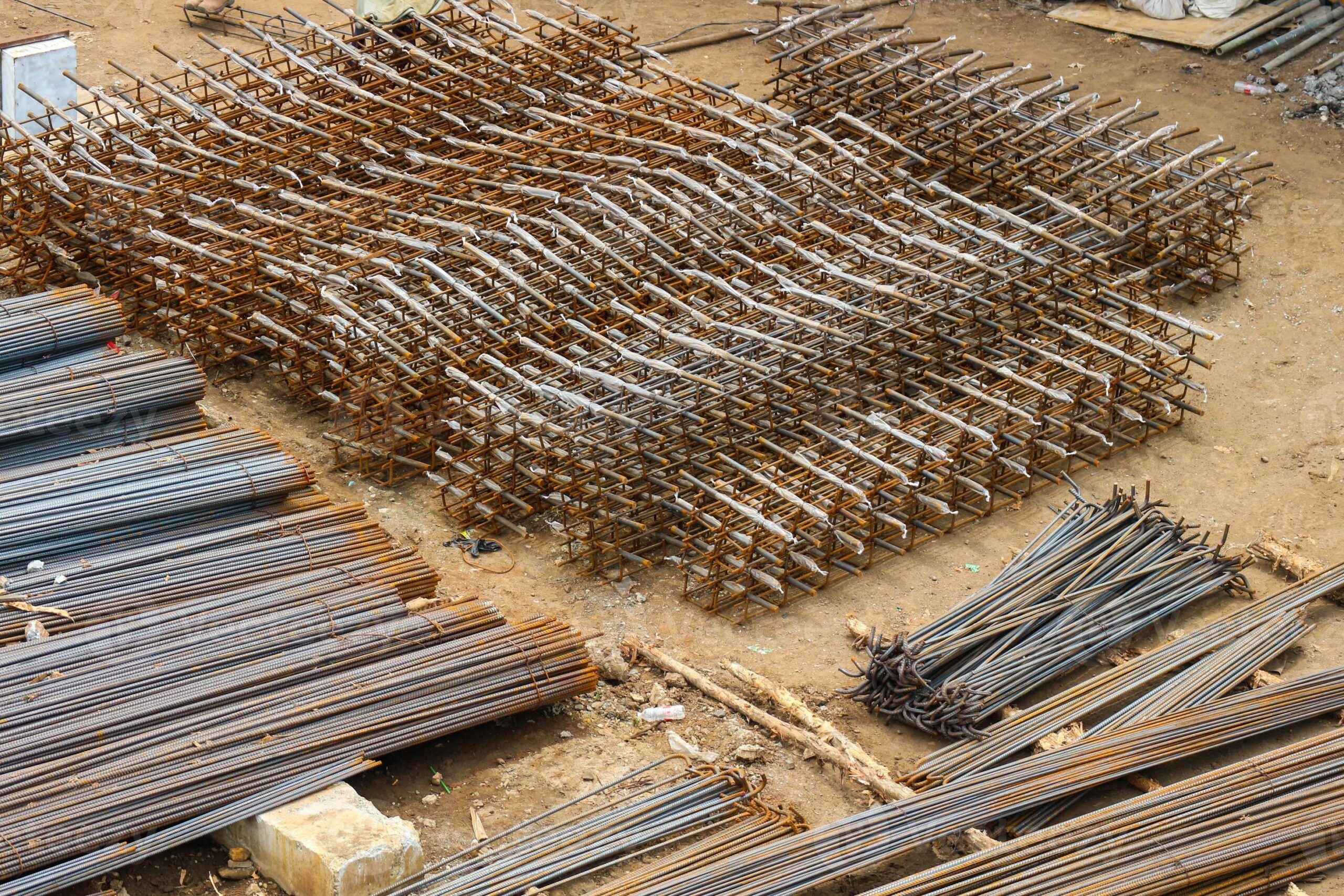
Rebar for Roads & Concrete Pavements
Dowel bars, tie bars and mesh for jointed and continuously reinforced concrete pavements — supplied as B500B bar, cut-and-bend cages, mesh and couplers to DIN 488 / EN 10080, designed to Eurocode 2.
Rebar for Roads & Concrete Pavements: An Engineering Overview
Concrete road pavements offer a long service life (typically 30–50 years), low maintenance cost, and resistance to heavy axle loads that make them the preferred choice for motorways, port aprons, airport taxiways, logistics park access roads and heavily-trafficked industrial yards. The reinforcement strategy depends on the pavement type:
- Jointed Plain Concrete Pavement (JPCP): Un-reinforced or lightly reinforced slabs (150–300 mm thick) with closely spaced transverse joints at 4–6 m. Dowel bars at transverse joints transfer shear without restraining movement. Tie bars at longitudinal joints prevent slab separation.
- Jointed Reinforced Concrete Pavement (JRCP): Reinforced slabs with longer joint spacings (8–15 m). Mesh or bar reinforcement controls crack widths within the slab while dowels continue to handle shear transfer at joints.
- Continuously Reinforced Concrete Pavement (CRCP): No transverse contraction joints; longitudinal reinforcement (typically 0.6–0.7% of cross-section) distributes cracking into many fine transverse cracks (≤0.5 mm) that interlock and remain structurally functional. Used on the highest-volume roads.
Dowel Bars: Specification and Supply
Dowel bars transfer wheel loads across transverse joints without restraining horizontal thermal and shrinkage movement. They must be:
- Plain (smooth) round bars — deformed bars would bond to the concrete on both sides and prevent movement. Typical diameter 25–32 mm, length 500–600 mm, spaced at 300 mm centres.
- One end is de-bonded (plastic sleeve or greased) over 250 mm to allow the joint to open and close freely.
- Strength: 500 MPa yield; smooth bar to DIN 488 / EN 10080 without the standard deformation pattern.
We supply plain round bars in the specified diameters and lengths, with sleeves and end caps available. Weight reference: Ø25 × 500 mm = 1.20 kg/bar; Ø32 × 600 mm = 3.79 kg/bar.
Tie Bars and Longitudinal Reinforcement
Tie bars connect adjacent slab panels at longitudinal joints (lane lines) to prevent differential settlement and slab spreading. Unlike dowel bars, they are deformed B500B bars and are fully bonded to the concrete on both sides — they do not allow free movement but do transfer tension. Typical: Ø12–16 mm, 800–1000 mm long, spaced at 600–900 mm centres. For CRCP, longitudinal B500B bar reinforcement at 0.6–0.7% of gross cross-section is required continuously along the full pavement length.
Pavement Reinforcement Quick Reference
Bar sizes, weights, and roles for concrete road pavement construction.
| Bar / Application | Diameter (mm) | Weight (kg/m) | Standard Length (mm) | Function |
|---|---|---|---|---|
| Dowel bar (transverse joint) | 25 | 3.85 | 500 | Shear transfer, free movement |
| Dowel bar (heavy traffic) | 32 | 6.31 | 600 | Shear transfer, motorway axle loads |
| Tie bar (longitudinal joint) | 12 | 0.888 | 800 | Tension tie, slab-to-slab connection |
| Tie bar (wide lane) | 16 | 1.58 | 1000 | Tension tie, prevent spreading |
| CRCP longitudinal bar | 16–20 | 1.58–2.47 | Continuous | Crack distribution, 0.6–0.7% ratio |
| Mesh (JRCP) | 8–10 | 0.395–0.617 | Panels | Crack width control within slab |
Export Supply for Road and Pavement Projects
International road infrastructure projects sourcing rebar from Germany benefit from reliable quality documentation, consistent mechanical properties, and competitive logistics. Our supply for road and pavement applications includes:
- EN 10204 3.1 Mill Test Certificates with full chemical and mechanical traceability by heat number.
- Certifcate of Origin (German / EU) for import duty and preferential trade agreement purposes.
- CE marking / Declaration of Performance in accordance with EN 10080.
- Seaworthy bundled packaging (~2 t per bundle) for container or break-bulk shipment to any port.
- Coordination with freight forwarders for FCL (full container load) and LCL (groupage) options.
For large road programmes requiring phased delivery schedules, we can structure supply in multiple shipments aligned to the project’s construction programme. Learn more about export and delivery.
Frequently Asked Questions
What is the difference between dowel bars and tie bars in concrete pavements?
What reinforcement ratio is required for a continuously reinforced concrete pavement?
Can you supply dowel bars with pre-fitted plastic sleeves?
What concrete pavement design standard is used in Germany?
Do you supply mesh for jointed reinforced concrete pavements?
Source German-standard rebar with full export documentation
Tell us your specification and destination port — we’ll respond with a detailed quotation.
