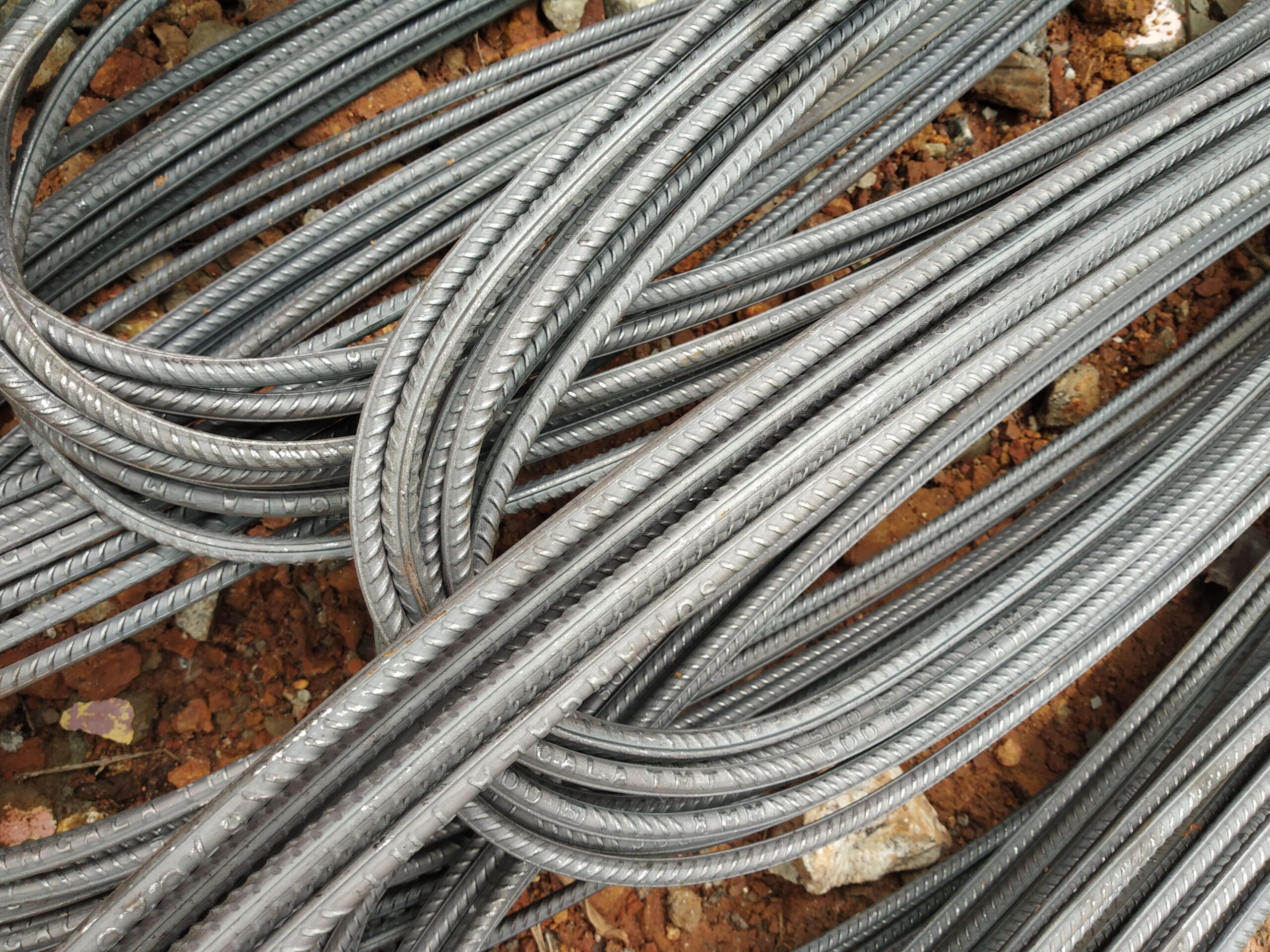
Steel Rebar Export to Spain
Supply German-standard B500B reinforcing steel — EN 10080-compliant, UNE-comparable — to major construction and infrastructure projects across Spain. Three Atlantic and Mediterranean port options: Valencia, Barcelona and Bilbao.
Rebar Spain: Market Context
Spain is one of Europe’s largest construction markets, driven by a combination of residential development (concentrated around Madrid, Barcelona, Valencia, and coastal tourism zones), major public infrastructure programmes under EU co-funding (PNIEC energy transition, TEN-T transport corridors, AVE high-speed rail extensions), and significant activity in renewable energy civil works — wind and solar farm foundations, offshore substation bases, and interconnection cable routes. The construction of large residential towers, logistics parks, and port expansion quays creates sustained demand for structural reinforcing steel.
Spanish structural engineering practice follows EN 1992-1-1 (Eurocode 2) with the national annex UNE EN 1992-1-1. Reinforcing steel is specified under UNE EN 10080 (Spain’s adoption of EN 10080), with common grades designated B500SD (seismic ductility, Class C in some interpretations) and B500B. Our German B500B material meets EN 10080 requirements; its properties are technically comparable to B500SD/B500B in UNE EN 10080. We do not claim formal Spanish national type-approval or AENOR certification — structural engineers and project owners should confirm suitability with the competent authority. See our Standards & Certification page for the full framework.
Common diameter ranges for Spanish construction: 8–16 mm for slabs, walls, and secondary elements; 20–32 mm for beams, columns, and bridge substructures; 40 mm for heavily loaded pile caps and deep foundations.
Products Available for Spanish Export
- B500B straight bars — 8–40 mm diameter, 6–18 m lengths (12 m standard), ribbed surface per EN 10080. B500B product page →
- B500A/B500B coils — 6–16 mm, for automated stirrup bending lines and mesh prefabrication. Rebar coils →
- Welded reinforcing mesh — standard Q/R panels and bespoke sizes up to 6.0 × 2.3 m. Mesh panels →
- Mechanical couplers — parallel-thread and taper-thread, 12–40 mm, reducing lap splice congestion in seismic and high-load frames. View couplers →
- Stirrups and cut-and-bent rebar — to project bending schedules per DIN 488 shape codes or equivalent. Cut & Bend →
Weight & Cross-Section Reference Table
| Diameter (mm) | Weight (kg/m) | Section area (mm²) |
|---|---|---|
| 8 | 0.395 | 50.3 |
| 10 | 0.617 | 78.5 |
| 12 | 0.888 | 113 |
| 16 | 1.58 | 201 |
| 20 | 2.47 | 314 |
| 25 | 3.85 | 491 |
| 32 | 6.31 | 804 |
| 40 | 9.86 | 1257 |
Shipping to Spain: Valencia, Barcelona & Bilbao
Spain’s three principal commercial ports cover the Mediterranean coast, the Catalan industrial hub, and the Atlantic north. Each offers container and break-bulk facilities for heavy steel cargo.
Port of Valencia
Spain’s largest container port and a major Mediterranean gateway. Serves the Valencian Community, La Mancha, and Madrid inland distribution. Strong container handling infrastructure with fast transit north and south along the Mediterranean corridor.
Port of Barcelona
Catalonia’s primary port. Serves Greater Barcelona, the Ebro corridor, and Aragon. Well-connected by road and rail to Madrid and northern Spain. Efficient break-bulk and container terminals for steel products.
Port of Bilbao
Northern Spain’s leading commercial port. Serves the Basque Country, Navarra, La Rioja, and Castile-León. Atlantic routing from Northern Europe is particularly direct. Bilbao is also an established hub for the Spanish steel sector generally.
UNE EN 10080: Comparability with German B500B
Spanish structural design uses UNE EN 1992-1-1 (Eurocode 2, national annex). Reinforcing steel is specified per UNE EN 10080. The two most common Spanish designations are:
- B500B — standard ductility Class B (k ≥ 1.08, Agt ≥ 5.0 %), for slabs, secondary elements, non-seismic applications.
- B500SD — seismic ductility, Class C (k ≥ 1.15, Agt ≥ 7.5 %), widely specified in the Spanish seismic zones (Norma de Construcción Sismorresistente NCSE-02) for primary ductile frames in Andalusia, Murcia, and other moderate-to-high seismic risk areas.
Our B500B material produced to EN 10080 is technically comparable to UNE EN 10080 B500B in terms of yield strength (≥ 500 MPa), k ratio (≥ 1.08), and elongation (Agt ≥ 5.0 %). No formal Spanish national approval or AENOR-DIT certification is claimed. The EN 10204 3.1 Mill Test Certificate we supply allows the specifying engineer to verify conformity. For seismic-grade B500SD requirements, please inquire about B500C supply. Visit Export & Delivery for logistics detail.
Export & Delivery details →Frequently Asked Questions — Rebar Spain
What is the difference between B500B and B500SD used in Spain?
Which Spanish ports are used for rebar imports from Germany?
Is there import duty on rebar from Germany to Spain?
What export documents do you provide for Spanish shipments?
Can you supply rebar cut-and-bent to Spanish project schedules?
Source German-standard rebar with full export documentation
Tell us your specification and destination port — we’ll respond with a detailed quotation.
